

UltraGreen sells a green dye that surgeons inject to light up blood flow while they operate. On 12 August it filed a strong-looking half, with higher sales and a wider gross margin, under the headline it chose: “UltraGreen Delivers Strong 1H2026; Underlying Net Profit Rises 45% to US$39.4 Million” [10].
The share price went the other way. It had climbed into the result, from US$1.18 on 7 August to US$1.33. After the numbers came out it reversed, sliding to US$1.26 by 14 August and on to US$1.15 by 19 August, near a 52-week low and below where the run had begun [3].
The reason for the gap between a confident headline and a falling price is not in the announcement. Part of it is in the accounts, where most of the profit growth is a currency swing that will not repeat and the operating margin actually shrank. The larger part is not in the filing at all: it is the thing the company left out, and the bigger story here.
One point the company has genuinely proved is worth stating plainly, even though it is not what moved the stock. Since 2024 it has raised the US price of the dye by about a quarter and now sells about a fifth more of it, a large increase met with more volume rather than less. Half of that you can see only by rebuilding a chart the company has stopped publishing.
The rest of the numbers, quickly. Sales rose 24% to US$87.2 million, or 31% excluding the software business sold last year. Gross margin improved to 86.6%. Vials shipped rose 11% to 589,511: America 377,616 (up 4%); EMEA 196,165 (up 24%); APAC 15,730 (up 45%). Cash and short-term liquid investments finished at US$197.6 million with no borrowings excluding lease liabilities. Full-year sales guidance narrowed to US$175 million to US$185 million. And the board declared the first post-listing dividend, one US cent a share, payable 4 September.
What we said in June
We started covering UltraGreen on 15 June.

Our argument was that 2025 profit looked worse than the business really was, for two dull reasons: an US$8.5 million tax charge that might get refunded, and a full year of almost no interest earned on IPO cash that only arrived in December. Fix both and we got to roughly US$87 million of profit for 2026.
We also put a stake in the ground. If second-quarter vials came in below 248,000, our explanation for a weak first quarter fell apart.
And we flagged the one thing the whole case depended on. UltraGreen had raised American prices three times: 60% in August 2023, 30% in April 2024, and again in the third quarter of 2025. American hospitals do not buy drugs one at a time. They buy through large purchasing groups that negotiate on behalf of hundreds of hospitals at once. Whether UltraGreen’s increases survived those negotiations was, in our words, “the single most important undisclosed structural variable in the filings.”
We named a second risk too, and set it right behind the first. In June the field was empty: UltraGreen held both US approvals and the FDA’s own register showed no rival, so a hospital paying the higher price had nowhere else to go. We put a generic entrant on the short list of things that would break the thesis, calling it the event that would “change the pricing architecture permanently.” We thought it distant. It was not.
So we came into this filing with two questions left open from June: the buying groups, and the generic.
It answers both. One held. The other happened. Neither answer is in the part the company wrote for journalists.
The numbers behind the headline
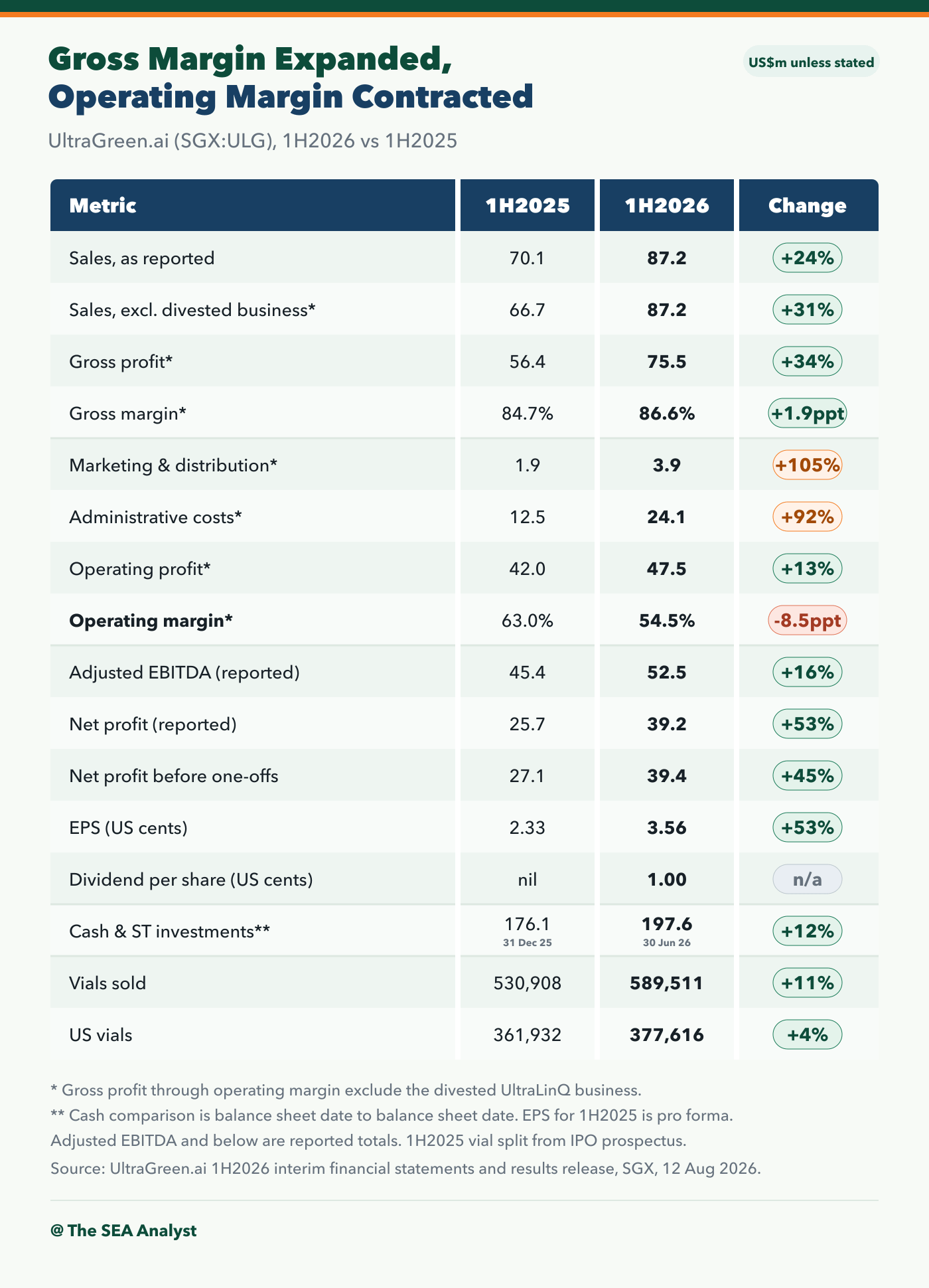
Two things to clear up before we get to the interesting part.
First, that 45%. Almost all of it is a currency swing that will not repeat. The company lost US$7.02 million on currency moves in the first half of 2025, and almost nothing in the first half of 2026. The 45% sets this year’s clean profit against last year’s currency-hit profit, so the growth rate looks bigger than it is. Strip the currency noise out of both halves and profit grew about 16%, which is exactly what the company’s own adjusted EBITDA grew. The company all but concedes the point: its slide credits the 45% to “significantly lower foreign-exchange losses recorded in 1H2025.” The figure is real arithmetic, but it is about three times the growth the business actually delivered, and the cause is already fixed, with every subsidiary moved to dollar reporting in January.
Second, interest income. It was US$2.47 million for the half, up from just US$67,008 a year earlier. Double it for a full year and it reaches about US$5 million, the bottom of the US$5 million to US$7 million we forecast in June. We were right that the IPO cash would throw off real interest income. Our range was just a little too high.
Did the thesis hold?
Volumes: yes, comfortably
The half-year filing gives six-month totals only, but the company published a full quarterly chart back in May [1], so subtraction does the rest. Second-quarter vials: 308,611. Our line was 248,000. It cleared it by 24%. Against the same quarter last year it is up 38%. It is the biggest quarter the company has ever had.
So our explanation for the weak first quarter holds. But the number that actually matters is the American one, and that is the number the company has stopped giving.
That is one thing the company left out of this filing. There is a bigger one, the very risk we flagged in June, and it has nothing to do with volumes.
In the roughly five weeks before these results, the US Food and Drug Administration approved two competing indocyanine green products.
On 10 July it cleared a ready-to-use version from Provepharm called ZYOGREEN, now approved and listed for the US market [6][9].
On 3 August, nine days before UltraGreen reported, it approved a straight generic from Zydus, one of India's largest generic drugmakers, under a programme the agency runs for markets it judges short of competition; Zydus announced it the next day [7][8].
For a company whose whole worth rests on being the only place to buy this dye at these prices, that is the most important development of the year, and it is the one thing the announcement does not mention.
That is the week the story changed. What it does to everything else in this filing is what the rest of this update is for.
The rest of this update is for paid subscribers: what those two FDA approvals do to the thesis, the reconstructed US quarterly series the company stopped printing, the seam answer (where the price increases actually went), the operating-leverage teardown, the tax, dividend and governance record, and the valuation at US$1.15.