

UltraGreen opened yesterday morning's release with growth: revenue from continuing operations up 35% to US$131.8 million for the nine months to September. The news was in the second bullet. The company now expects full-year revenue below the US$175 million to US$185 million range it set in August, and management expects the US business "to remain under pressure" through 2027 [1].
Indocyanine green products from Zydus and Provepharm have reached the US market, and the company reports "increasing pricing pressure and changes in customer purchasing patterns" [1]. It expects this to weigh on fourth-quarter revenue, and on both US revenue and US profitability next year.
The third quarter was still strong against last year. Revenue was US$44.6 million, up 44% on US$31.0 million a year earlier; the US grew 47% and the rest of the world 32% [3]. Against the second quarter it was not. Group revenue slipped from US$45.2 million to US$44.6 million. US revenue rose from US$33.9 million to US$35.2 million, while rest-of-world revenue fell from US$11.4 million to US$9.4 million, which the chief financial officer put down to distributor order timing and a seasonally slow July in Europe [2, Q5][3].
The warning sets a ceiling but no floor. With US$131.8 million booked by September, a full year below US$175.0 million needs only fourth-quarter revenue under US$43.2 million, just over 3% below the third quarter. The company has not said how far below the range it expects to land, and is not giving a new number [2, p4]. A small miss and a large one both fit the words.
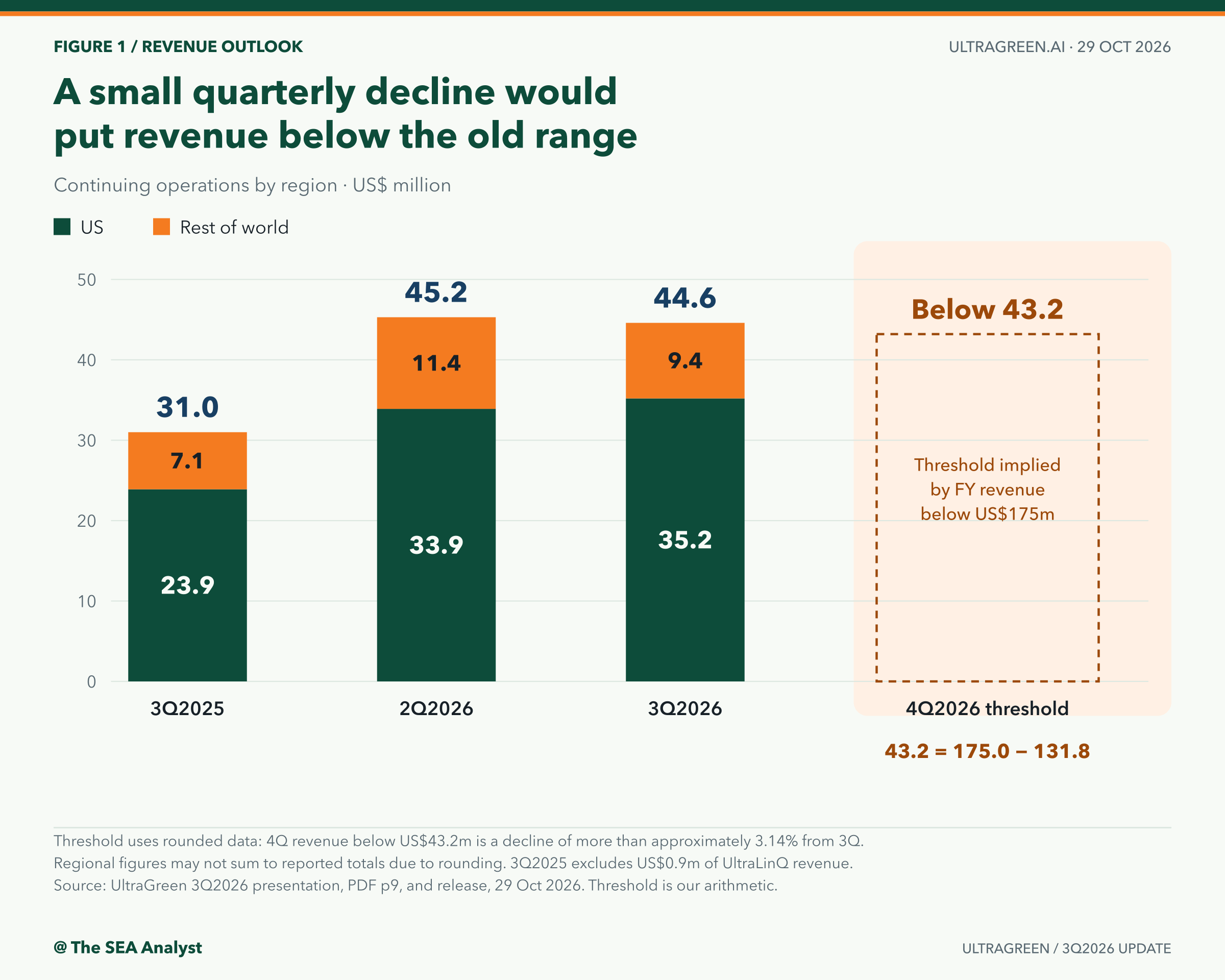
The cut comes ten weeks after a reaffirmation. On 20 August, responding to a Business Times article on the rival approvals, the board said there had been "no material change to the Company's business or outlook arising from these developments" that required a revision, and kept the US$175 million to US$185 million range, "with revenue in 2H2026 expected to exceed that of 1H2026" [13]. A second half above the first needs fourth-quarter revenue above about US$42.6 million; a full year below the range needs it below US$43.2 million. Both can hold at once, so the miss could be narrow. Yesterday's release does not repeat the second-half commitment.
The company is also publishing less from here. The chief financial officer said: "we no longer consider it appropriate to disclose certain operating metrics, including sales volumes, average selling prices and detailed market segment information, at the same level as previously" [2, p4].
Where we were too comfortable
In August we wrote that the rivals’ real impact “builds through the second half and lands with weight in 2027”, that “the first hard evidence in the numbers is a 2027 event”, and that “the near-term numbers still favour the company” [4].

The timing was too generous. Management now expects the effect in the fourth quarter of 2026. That is a forecast, not a reported result, but it brings commercial pressure into guidance earlier than our August framing allowed.
The slow-switching argument was right about the forces involved and wrong about their strength. Management still cites supply reliability and familiarity as reasons hospitals stay, and says hospitals "may initially trial new suppliers while continuing to rely on established products" [2, Q3, Q12, Q13]. What changed is speed. By the briefing, less than three months after the Zydus approval, management said "some channel customers have informed us of competing products available at lower prices and have provided us with opportunities to respond" [2, Q20]. That is a buyer asking for a matching price. The company did not say how many asked, how many moved, or at what price.
The rivals, on the FDA’s record
The FDA's public records fill part of the gap the company left.
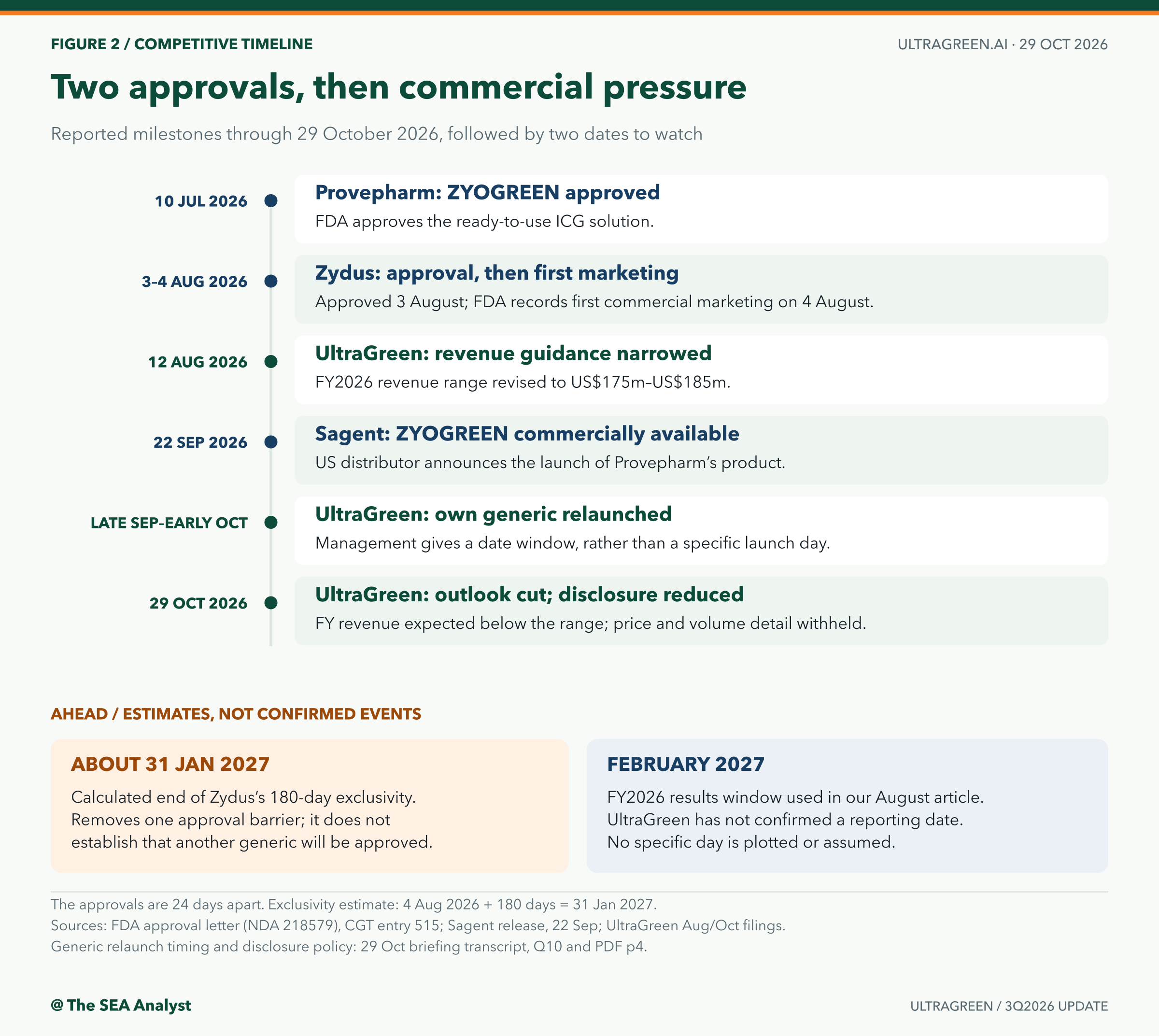
Zydus has been selling since August. The FDA's list of Competitive Generic Therapy approvals records the first commercial marketing of Zydus's generic on 4 August 2026, the day after approval [7]. In August we wrote that Zydus had not yet begun commercial marketing [4]. On the FDA's record it had, eight days before UltraGreen reported its half. Provepharm's ZYOGREEN was listed with the FDA from 16 July, but Sagent, its US distributor, announced commercial availability only on 22 September [8][9].
The field is also wider than we described in June.
The FDA lists five approved US ICG applications held by four companies: UltraGreen's IC-GREEN and its own generic, Stryker's SPY AGENT GREEN kit, approved in 2018, and the two newcomers [6]. In June we wrote that UltraGreen held both approved applications [11]. That missed Stryker's approval, although the same article put Stryker's share of US vials at about 17%. The generic UltraGreen has relaunched is its own 2007 approval, already sold under Olympus's label and inside Karl Storz kits [6][8].
The field is also wider than we described in June. The FDA lists five approved US ICG applications held by four companies: UltraGreen’s IC-GREEN and its own generic, Stryker’s SPY AGENT GREEN kit, approved in 2018, and the two newcomers [6]. In June we wrote that UltraGreen held both approved applications [11]. That missed Stryker’s approval, although the same article put Stryker’s share of US vials at about 17%. The generic UltraGreen has relaunched is its own 2007 approval, already sold under Olympus’s label and inside Karl Storz kits [6][8].
The next date matters more for 2027. Zydus’s approval carries 180 days of exclusivity under the FDA’s Competitive Generic Therapy programme. Until it ends, the FDA cannot approve another generic of the same drug. The clock runs from the first sale, so it ends about 31 January 2027 [7].
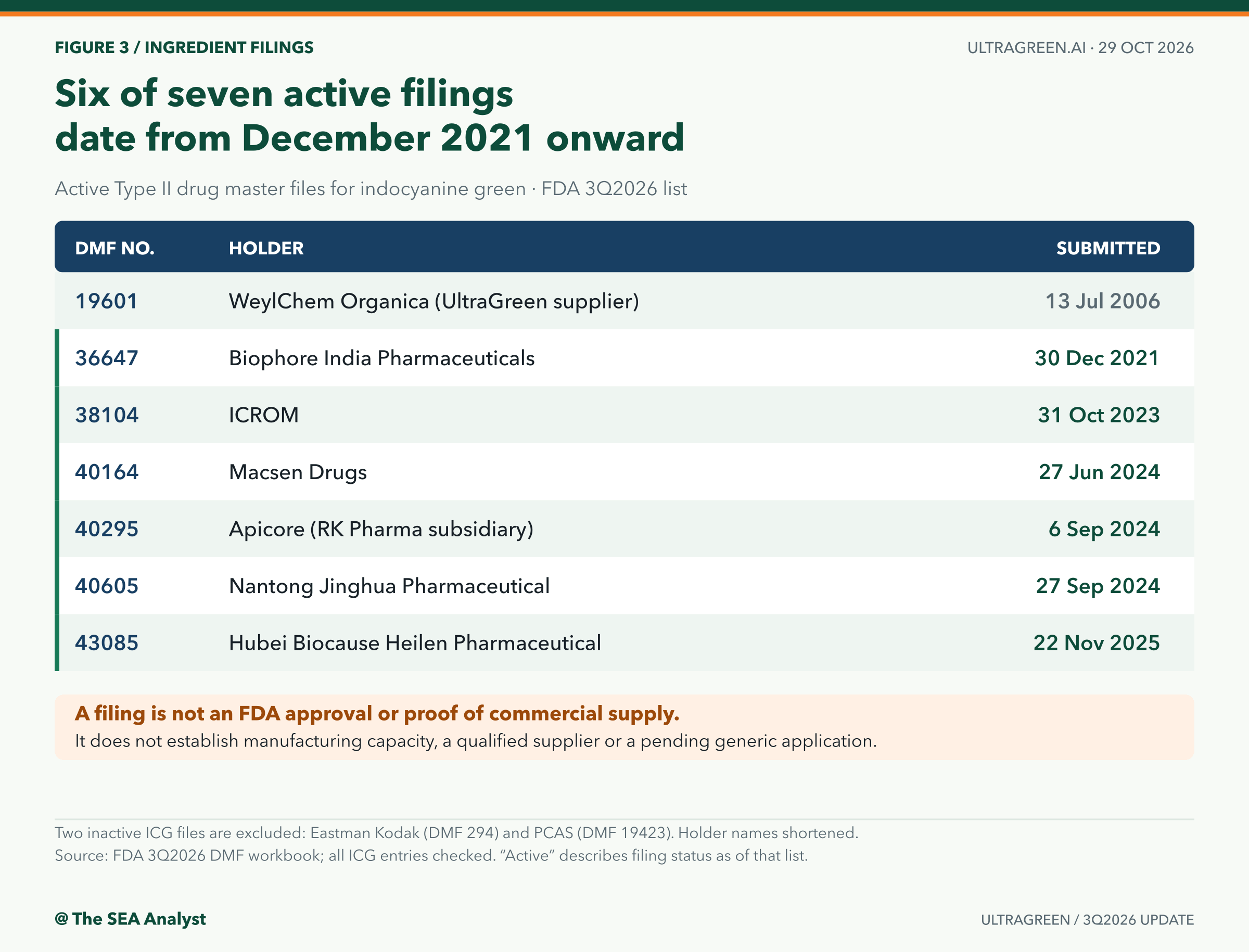
After that, the FDA is free to approve other generics, but none is assured, and pending applications are confidential. What is public is who supplies the ingredient. Seven companies hold active US drug master files for ICG, the dossiers a generic applicant can reference, and six of them filed since December 2021 [10]. The FDA does not approve these files, and a filing does not prove commercial supply or a coming generic.
What the records do not show is price. We have not established comparable realised US net prices for either rival, and UltraGreen says it has no direct visibility of competitors' contracted prices [2, Q8]. Zydus's coming quarterly results are where a rival could first put a number on its ICG sales.
The defence is the same vial at a lower price
UltraGreen's answer is to sell its own generic. It relaunched one through its main channel partners in late September or early October, alongside the branded IC-GREEN [1][2, Q10]. Its executive vice president for the Americas said: "There is no chemical difference or difference in labelling between our branded and generic products." The generic is priced lower [2, Q2]. Manufacturing costs are "broadly similar, with only minimal differences" [2, Q4].
So every hospital that moves from the branded vial to UltraGreen's own generic keeps the sale inside the company and gives up gross profit on it. In August we put the cost of making a vial at about 13% of what UltraGreen charges, on an 87% gross margin [4]. A cheaper vial with the same cost carries less margin, and IC-GREEN holds its premium only where a buyer chooses to keep paying it.
The company has two reasons to accept that.
The first is access: US purchasing channels "often favour generic alternatives when these become available", and a generic lets UltraGreen take part in their purchasing and discount arrangements [2, Q2, Q16].
The second is share: relaunching the generic, management said, "allows us to compete more effectively and defend market share" [2, Q2]. A sale lost to its own generic still earns a margin; a sale lost to Zydus earns nothing. It also intends to keep "premium pricing" on IC-GREEN [2, Q7], resting that on its supply record, physician familiarity and an orphan drug designation for liver cancer imaging, which could bring exclusivity for that indication after further clinical studies and approval [2, Q3, Q22].
One answer in the briefing works against the brand. ICG, management said, is "in most cases" not separately reimbursed in the United States; its cost sits inside the payment for the surgical procedure [2, Q17]. On our reading, a hospital that buys the cheaper vial keeps the saving, and the company itself names hospital procurement teams as the buyers for whom price matters most [2, Q12]. With the products chemically identical, that is a standing reason to switch.
We can describe the trade. We cannot size it. UltraGreen will not disclose the branded and generic sales split, the price gap, or the margin on either product, and it has about three weeks of sales data on the relaunched generic [2, Q7, Q10]. Still, a larger generic share would lower the blended US selling price even if branded prices hold. Because the generic costs about the same to make, the shift would reach gross profit, but gross margin will not isolate it. Geography and product mix move the percentage too, and a margin can stay high while gross-profit dollars fall. The first half's 86.6% [4] is one useful, imperfect indicator, to be read with revenue, gross-profit dollars and operating costs.
On cost, the accounts give a rough scale. In the first half UltraGreen's group cost of sales was US$11.6 million on 589,511 vials sold worldwide, about US$20 a vial, of which US$9.1 million was the product itself [12]. That is an accounting average, not a disclosed US unit cost, and distribution and administrative costs sit outside it.
Set beside a realised US price of about US$173 [4], it still shows that the cost of making a vial is not yet where the contest lies. It becomes one if prices fall toward cost, and there UltraGreen has no visible edge.
Its vials are made under contract by Patheon Italia or by LyoContract in Germany. Stryker's SPY AGENT GREEN comes from the same Patheon Italia. Zydus makes its generic in its own plant in Vadodara, India [8]. Owning the plant may give Zydus a cost advantage over a company paying contract manufacturers, but scale, yields and contract terms also matter, and neither company discloses unit costs.
Below the paywall: what UltraGreen has stopped telling investors, what the tax approval does to our profit estimate, and how much of the share price is cash.