Tiong Woon Corporation Holding (SGX: BQM) set new revenue and profit records in FY2026 (revenue up 15%, profit up 24%, gross margin recovered, net gearing improved, final dividend raised 43%), yet the shares have barely moved since.[9]
Our 17 April 2026 initiation flagged three risks to watch:

A gross margin decline that might be a trend rather than a blip;
Revenue concentration in one business segment and one country; and
A capex-and-borrowings ramp that needed to translate into fleet use rather than idle equipment.
Two of the three moved the reassuring way this period: margin recovered almost to its prior peak, and capital expenditure moderated while gearing improved. The third, concentration, is where the result gets interesting, because it runs straight into a target management had set for itself seven weeks before these numbers landed.
In early July, The Business Times reported management’s goal of more than S$200 million in annual revenue by FY2030, alongside plans to grow beyond crane rental and deepen the company’s regional footprint.[8] FY2026 revenue came in at S$187.7 million, already 94% of the way to that five-year target, in year one. On the revenue-scale half of the ambition, the company is essentially there, and the target looks conservative rather than stretching.
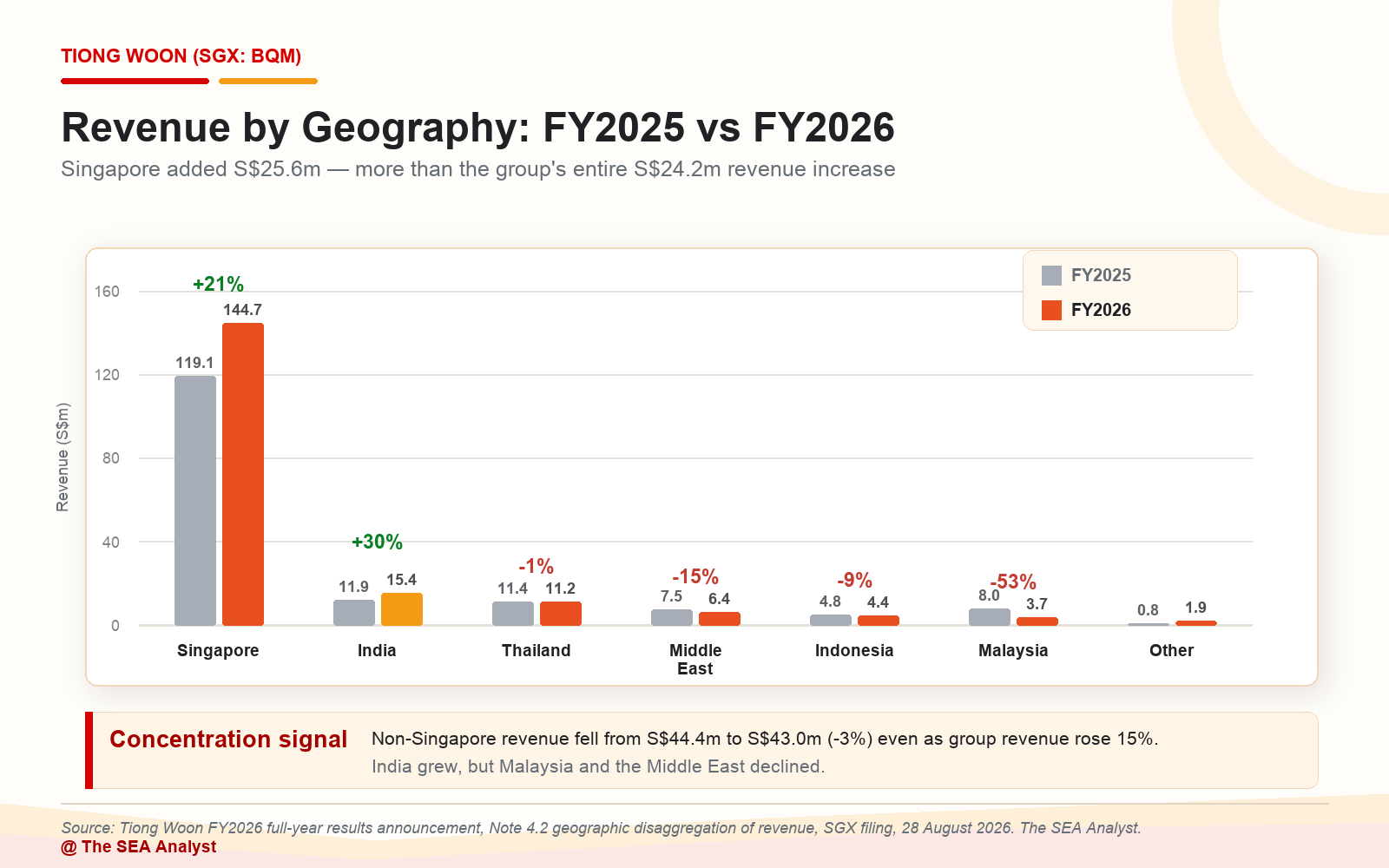
The diversification half went the other way. Of the group’s S$24.2 million revenue increase, Singapore alone contributed S$25.6 million (more than the entire gain), which means that, taken together, everywhere else net-subtracted from revenue. The non-Singapore book shrank from S$44.4 million to S$43.0 million even as the group grew 15%. India was the one genuine bright spot, up 30%; Malaysia roughly halved and the Middle East fell 15%.
One weak year is not proof that the strategy has failed. India, the Middle East and Malaysia are small, project-driven markets, where a single heavy-lift contract won or lost can swing revenue by millions, so a soft year in them proves little on its own.
What it does show is a real gap between what management says it is building and what it just reported. That gap is also the most likely reason a result this strong barely moved the share price: investors may be weighting the Singapore concentration more heavily than the margin recovery. The rest of this update works through what changed, what didn't, and where the thesis now stands.
What Happened
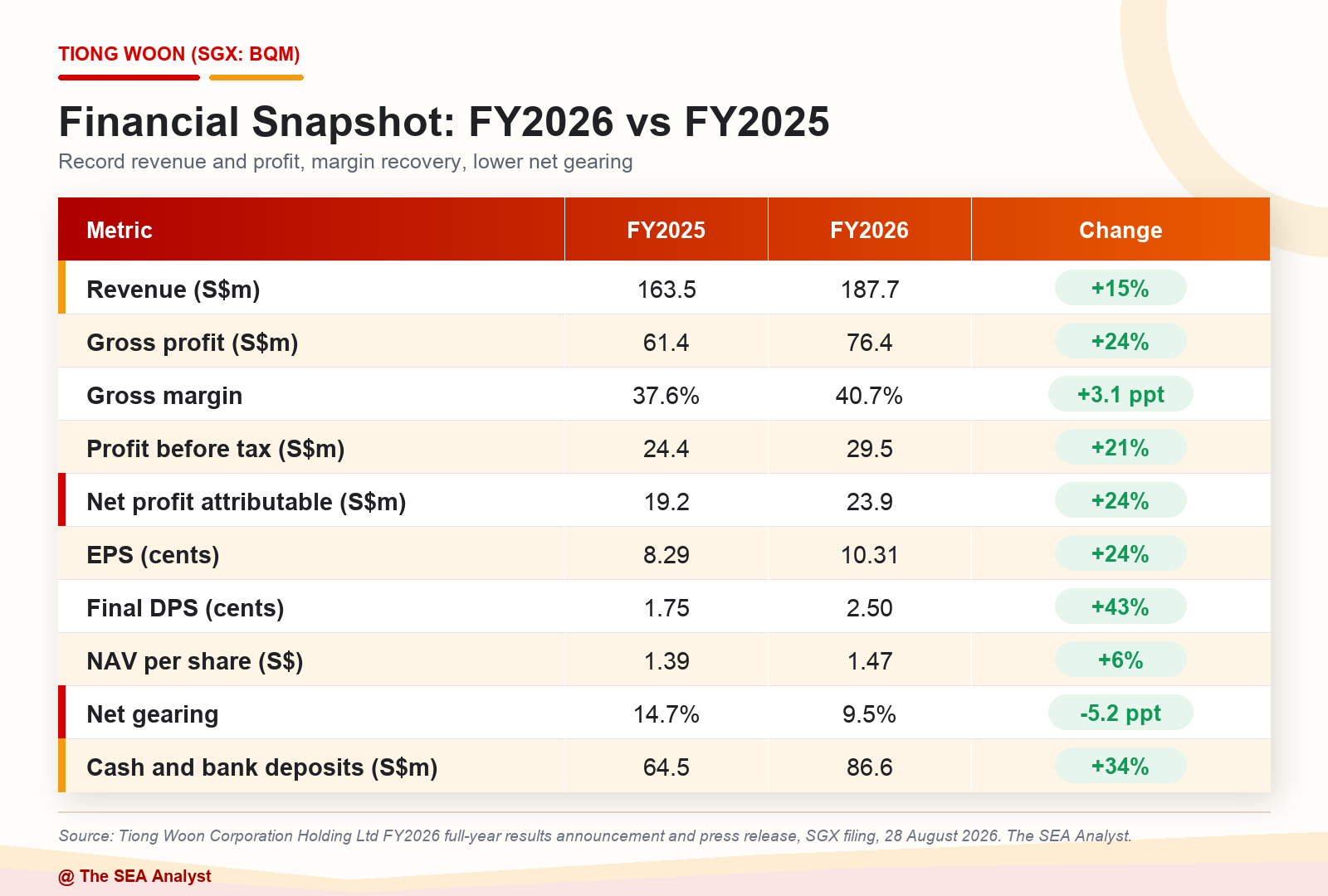
Group revenue for FY2026 came in at S$187.7 million, up S$24.2 million or 15% from S$163.5 million in FY2025, driven mainly by the core Heavy Lift and Haulage segment, which grew 12% to S$179.6 million on higher activity in Singapore, India and Brunei. Gross profit rose faster than revenue, up 24% to S$76.4 million, because gross margin recovered to 40.7% from 37.6%, a 3.1-percentage-point improvement that management attributed to stronger margins within the Heavy Lift and Haulage book. Profit before tax rose 21% to S$29.5 million, and net profit attributable to equity holders rose 24% to S$23.9 million, taking earnings per share from 8.29 cents to 10.31 cents.
The balance sheet strengthened alongside the income statement. Cash and bank deposits rose to S$86.6 million from S$64.5 million a year earlier, while net gearing fell to 9.5% from 14.7%, as the pace of fleet capital expenditure moderated: gross additions to property, plant and equipment were S$53.6 million in FY2026, down from S$65.5 million in FY2025, and net cash capex fell more sharply, to S$23.8 million from S$45.2 million, with the cash outlay running well below gross additions, reflecting financing and timing effects. Net asset value per share rose to S$1.47 from S$1.39.
The proposed final dividend of 2.50 cents lifts the payout ratio to 24.2% of net profit, from 21.1% in FY2025, still a conservative payout given the company’s now-lower gearing and larger cash balance.
The FY2026 results were released after the market close on Friday 28 August[1], when the shares had closed at S$0.955.[9] In the first full session after the release, on Monday 31 August, they closed at S$0.965[9], up about 1%, a muted move for a result that lifted both revenue and profit growth above the prior year’s pace.
Prior Thesis Recap
Our initiation argued that Tiong Woon was a well-run, family-controlled industrial company trading at a significant discount to tangible asset value (roughly 0.5 times book, 9.2 times earnings and 3.6 times EV/EBITDA at the time), with cumulative ten-year free cash flow (~S$204 million) exceeding the market capitalisation (~S$183 million).[2]
The central risks flagged were the FY2025 gross margin decline from a 41.2% peak, heavy revenue concentration in the Heavy Lift and Haulage segment (98% of FY2025 revenue) and in Singapore (73%), and a capex-and-borrowings ramp that, if it did not translate into utilisation, would represent a capital-allocation misstep.
New Financial Data
The segment and geographic breakdowns behind the headline numbers matter more than the headline itself.
By segment, Heavy Lift and Haulage's profit before tax rose 23% to S$28.4 million on the higher revenue and improved margin; Marine Transportation's profit before tax fell 35% to S$0.8 million on lower inter-segment revenue and a smaller share of associate profit; and Trading swung to a S$0.3 million profit from a marginal loss, on a low base (external revenue up 282% to S$5.5 million, still under 3% of group revenue).
As a share of total revenue, Heavy Lift and Haulage eased slightly to 95.7% from 97.8%, but that improvement came almost entirely from the small Trading segment's low-base growth, not from a structural shift in the core business.
Geographically, the detail behind the headline is the single most important finding in this result, and it is a dollar story before it is a percentage one. Singapore revenue rose S$25.6 million, from S$119.1 million to S$144.7 million, larger than the group's entire S$24.2 million increase.
The rest of the portfolio, taken together, therefore shrank: non-Singapore revenue fell from S$44.4 million to S$43.0 million, a 3% decline in a year the group grew 15%. India was the exception, and a real one, up 30% to S$15.4 million. But Malaysia roughly halved, to S$3.7 million from S$8.0 million; the Middle East fell 15% to S$6.4 million; Indonesia and Thailand were flat-to-lower; and Brunei contributed a new S$1.3 million. On a share basis the same movement reads as Singapore rising to 77.1% of revenue from 72.9%, and non-Singapore falling to 22.9% from 27.1%, the opposite direction from the regional-diversification story the company's own outlook commentary continues to tell.[3][4]