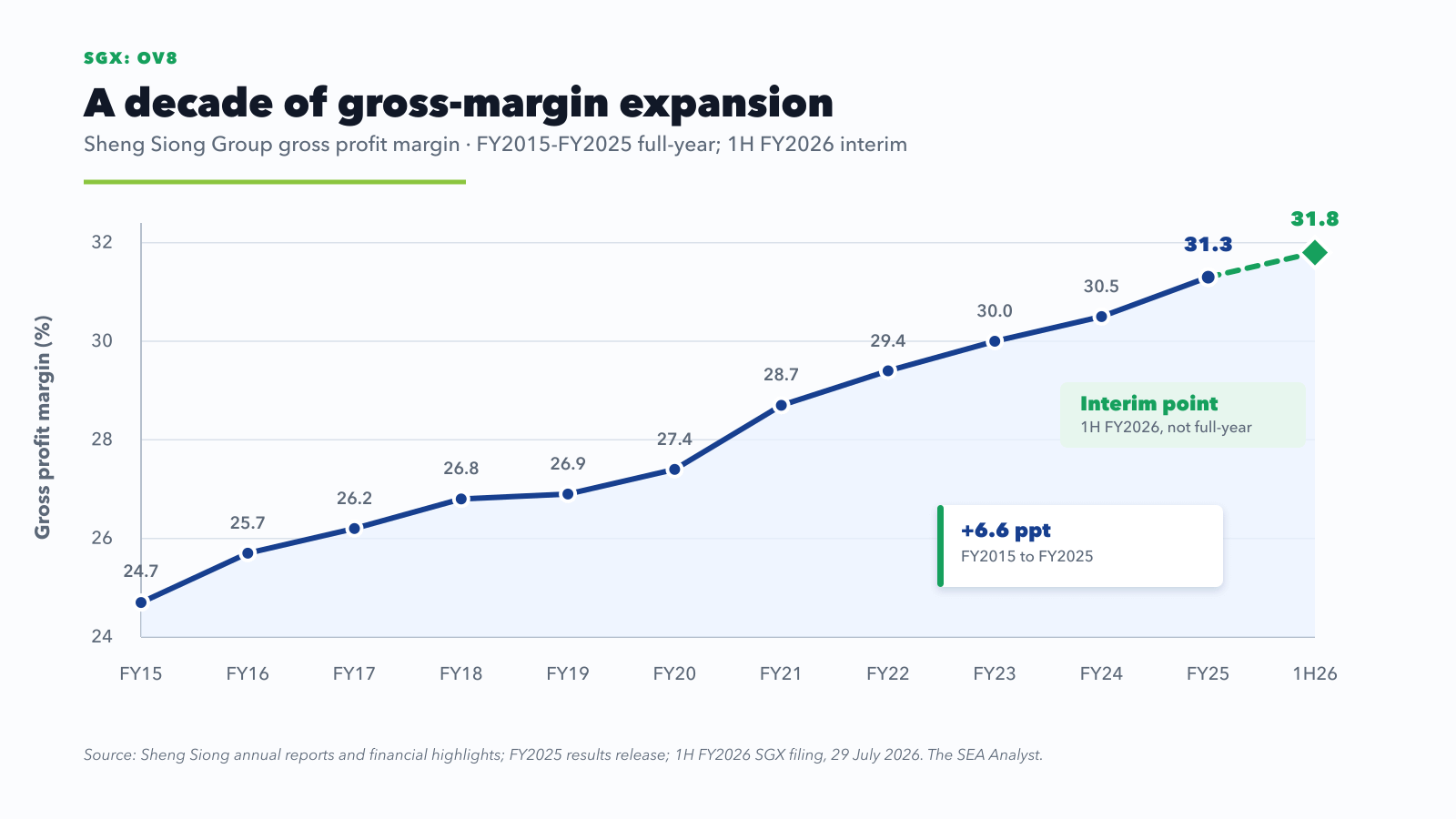
Sheng Siong (SGX: OV8) did what was expected. First-half net profit rose 11.9% to S$81.0 million, gross margin widened again to 31.8% from 30.8%, and the board lifted the interim dividend 17% to 3.75 cents [2]. Every line confirms the quality we underwrote when we initiated in April. What the print does not settle is the question that has always governed this stock. At roughly 31x earnings, the price already assumes execution of exactly this kind, and the S$520 million distribution centre that broke ground in July is about to test how much of that quality survives the trip to free cash flow.
The top line is clean. Revenue grew 11.9% to S$855.4 million, gross profit 15.6% to S$272.4 million, and earnings per share reached 5.38 cents against 4.81 a year earlier. Sixteen new and comparable-new stores supplied 9.7 of the 11.9 points of revenue growth, comparable same-store sales added 3.3% on the back of June’s CDC vouchers, and the network now stands at 90 supermarkets in Singapore plus six in Kunming [1].
That is the quality leg of the thesis, delivered in full.
The price leg is untouched, and the cash question is only now beginning.
What we said in April
We initiated on Sheng Siong on 30 April 2026.

The business was never the question. Eleven straight years of dividends, gross margin that had climbed six points over a decade to 31.3%, mid-single-digit revenue growth turning into roughly 10% earnings growth, a share count unchanged since the 2011 IPO, and S$435.5 million of net cash. The question was the price.
At roughly 31x trailing earnings and just under 8x book, the stock left, in our words, limited room for it to be wrong. We reduced the whole case to one variable: whether the gross-margin engine of sales mix, house brands and direct sourcing could keep grinding higher. At that price, the market was underwriting that it would, with little room for a slip. The flip triggers we have tracked on the name turn on two things:
a dividend cut or a capex step-up that thins dividend cover, and
a deterioration in the Group’s HDB-tender competitiveness.
The numbers
The first-half scoreboard validates the quality leg of the thesis and does nothing to relieve the valuation leg.
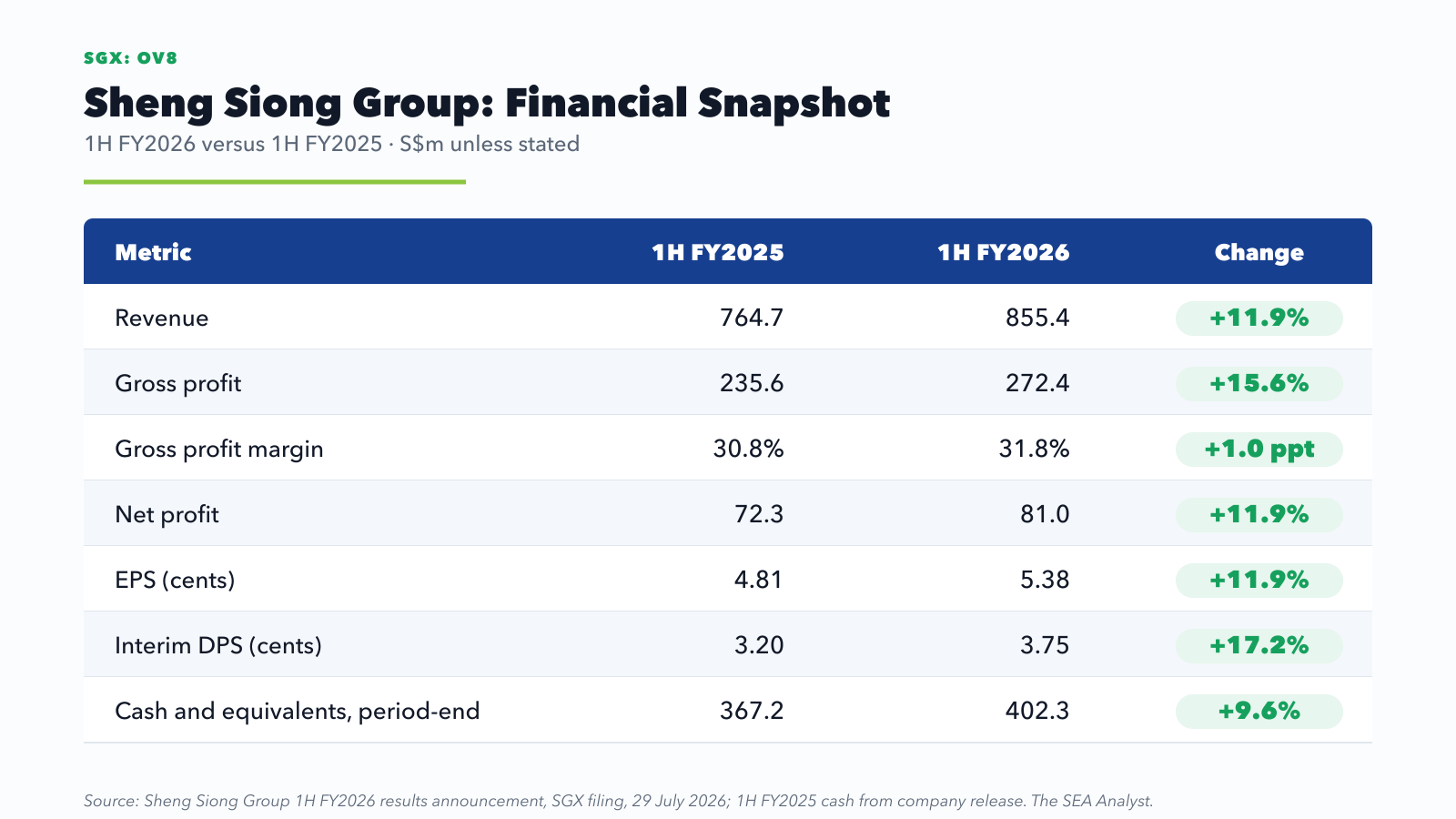
Three things sit underneath the headline.
First, the gross-margin gain is real and it is the number that matters most to this thesis. Management attributes the move to 31.8% to sales-mix improvement, and the mix effect held even as the cost base rose.
Second, the operating leverage below the gross line was partly absorbed. Selling and distribution expenses rose 15.7% to S$149.7 million and administrative expenses rose 14.0% to S$33.4 million, both driven by staff costs, which climbed to S$142.3 million from S$121.5 million on higher headcount for new stores, higher variable bonuses, and the September 2025 Progressive Wage Model increase. Operating profit still grew 15.7% to S$98.0 million, ahead of revenue, so the margin story survived the wage ratchet this half.
Third, cash and the cash flow statement need a second look. Operating cash flow for the half was S$54.8 million, down from S$86.4 million a year earlier. That decline is a working-capital swing, not an earnings-quality problem: trade and other payables fell S$68.7 million as the Group paid out accrued bonuses and settled vendor balances earlier than in the prior year, a timing item that sits inside the operating line.
Separately, the overall cash balance fell S$33.2 million over the half, to S$402.3 million at 30 June 2026 from S$435.5 million at 31 December 2025, as the operating inflow and modest S$8.4 million of capital expenditure were outweighed by S$57.1 million of dividends and S$25.7 million of lease payments in the financing line.
The Group still carries zero interest-bearing debt today, though a build of Sungei Kadut's scale may ultimately introduce some borrowing; the S$159.2 million of lease liabilities is store-lease accounting, matched by right-of-use assets on the other side. Finance income fell 44.5% to S$3.1 million as fixed-deposit rates came down, a small but growing headwind on a S$400 million cash pile as rates ease.
Step back from the half and the pattern is the real story. Gross margin has risen in every year of the past decade, from 24.7% in FY2015 to 31.3% in FY2025 [4] and 31.8% this half, six-plus points of expansion with no share issuance and no acquisition doing the work. That grind, sales mix, house brands and direct sourcing compounding quietly, is the engine the whole thesis rests on.