

Q&M Dental's first-half FY2026 results, out on 14 August, were fine: group net profit up 27% to S$4.9m on revenue up 13% to S$99.5m, and a core dental business that comfortably funds itself. That is the setup, not the story.
The story is what management is doing with a cash-generative Singapore core: committing roughly US$113.2m to buy dental chains in Australia and Thailand [8], funding the deals with a mix of debt and freshly issued stock, and deferring its own secondary listing to press ahead [9]. Alongside that, its China-listed subsidiary Aoxin has doubled its share base to keep expanding, and the group has quietly agreed to sell most of its dental-AI arm for scrip.
The 27% headline is the least interesting number in the half.
The interesting one is that Q&M is committing close to a third of its market value to turn a Singapore compounder into a pan-Asian roll-up, and betting a lean team can integrate it.
Where the thesis stood
At initiation we called Q&M a coin flip at around S$0.60: a defensive, recurring Singapore dental platform wrapped in a multi-country acquisition story whose execution was unproven. The local press had already flagged that acquisition-led shift [7].

Three things carried weight:
the Singapore business as the durable core;
Aoxin as a China call option that could equally be a capital sink; and
the acquisition war chest as optionality the market was not paying for.
The core has held up. What this half does is turn the acquisition optionality into committed capital, which is a different risk.
The core that makes the bet possible
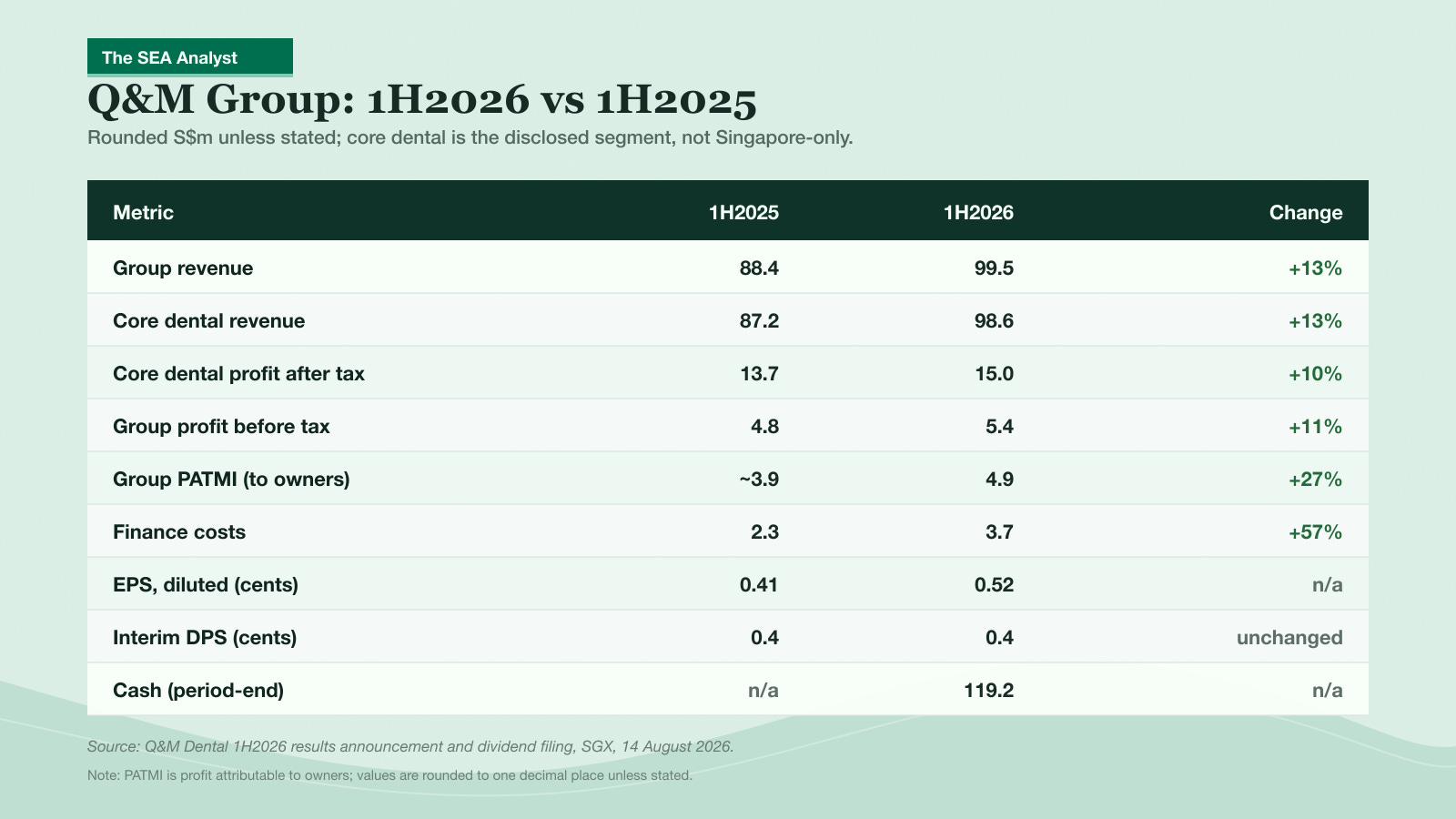
What makes the acquisition programme possible is the core, though not by paying for the deals directly. The core dental business earned S$15.0m of profit after tax this half, up 10%, on revenue of S$98.6m, and it throws off cash: the group closed the period with S$119.2m of it.
That cash generation and the balance-sheet capacity behind it are what let Q&M raise the S$130m of notes and issue stock to fund the offshore purchases; the acquisitions are paid in debt and shares, not out of half-year profit. The self-funding quality of the core is the whole basis of the thesis, and it is intact.
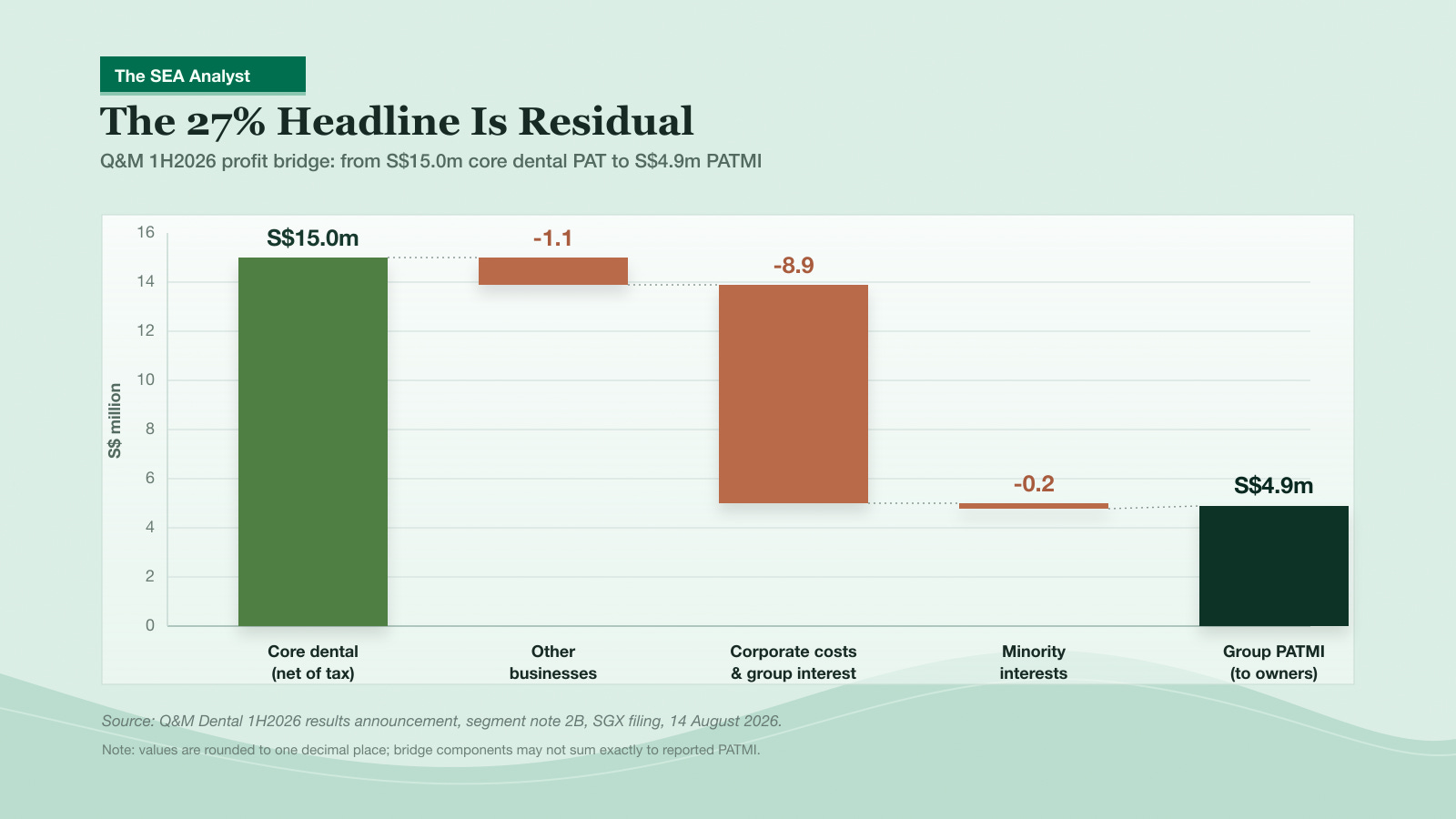
The group’s S$4.9m bottom line is what is left once the core carries everything else.
Start with the S$15.0m the core dental business earned: corporate head-office costs and unallocated group interest take S$8.9m of it, the other businesses (family medicine and aesthetics) lose S$1.1m, and minority interests, mainly the outside share of Aoxin, take another S$0.2m. Finance costs alone rose 57% to S$3.7m, the cost of the S$130m of notes issued last July.
Two one-off items also lift the 27%. This half’s S$5.4m of pre-tax profit includes a S$1.4m gain on the sale of the Jurong East property, about a quarter of the total; the year-ago S$4.8m base was the mirror image, held down by a S$4.3m non-cash loss booked when Aoxin and EM2AI were consolidated. The 10% rise in core-dental profit is partly bought rather than earned, too: this half carries six months of Aoxin against only one a year ago. Taken together, it is not the clean underlying growth it appears to be.
What does the real work is the S$15.0m core dental line, led by Singapore and Malaysia with the consolidated China clinics alongside. That is the annuity Q&M is now leveraging.
The full analysis below (the sizing of the bet, the deal structure, the Aoxin and EM2AI reads, the triggers, and the bottom line) is for paid subscribers.