

Update on 2 September 2026
Since this update published, the catalyst we described as quiet has moved. On 1 September Jollibee disclosed that it is contemplating a proposed Hong Kong Main Board listing of its international business, to be held by the listing vehicle, Jollibee Foods Corporation International (JFCI).
Existing JFC holders would receive JFCI shares corresponding to their prevailing JFC interest, effectively an in-specie distribution. Richard Shin, JFC's Chief Financial and Risk Officer and CEO of JFC International, was named to lead JFCI. JFC itself stays PSE-listed with the Philippine business.
The company calls the plan preliminary, subject to restructuring, market conditions, and required corporate, regulatory, and HKEX Listing Committee approvals, with no assurance on final terms, timing, or completion; no size or valuation was given. JFC closed at ₱152.80 on 1 September, below the ₱156 close after the August results and above our ₱147.10 initiation anchor. [6]
This advances the thesis rather than upsetting it.
The venue-mirage argument was that a US listing cannot hold a US growth multiple; picking Hong Kong over a US listing makes a US-style re-rating far less likely, since Hong Kong-listed Asian restaurant and coffee names trade nearer Asian marks.
We read the choice as pointing toward crystallisation at roughly the arm's Asian value, not proving it, since venue alone does not settle valuation.
The pro-rata structure looks friendlier than feared for a Manila holder, who gets the shares directly rather than through an access wrapper, though tax, currency, and custody frictions remain. And the announcement is silent on the JWPL 2025 notes' change-of-control put, under which holders can require JWPL to repurchase their notes at 101 percent upon a Change of Control Event, including if JFC ceases to own, directly or indirectly, at least 50 percent of JWPL's outstanding voting stock, a real constraint if JWPL sits inside the separated group [4][7].
The muted response fits our frame: a listing may crystallise value, not multiply it. We will cover the mechanics when the circular or notice to bondholders appears.
This is an update to our 22 July 2026 initiation. It is for informational and educational purposes only, is not investment advice, and its author is not a licensed investment adviser. The author holds no position in Jollibee Foods Corporation and has not traded in it in the 30 days before publication.

On 11 August 2026 Jollibee led with a record. Net income to the parent (NIAT) of ₱3.40bn, up 5.7 percent on the year and up 130.5 percent on the first quarter, the best quarter the group has ever printed [1]. Revenue rose 10.7 percent to ₱85.9bn. System-wide sales grew 14.2 percent. The gross margin clawed back to 18.5 percent from 16.5 percent in Q1 and left June at 19.0 percent [1]. Same day, the board approved redeeming the ₱9bn Series B preferred (JFCPB) and trimmed parts of the full-year guidance [1][2].
The market liked it. Shares jumped about 5 percent to ₱156.00, above the ₱147.10 we anchored three weeks earlier [5]. Fair enough on the quarter. The half is another story: first-half NIAT was ₱4.87bn, down 13.3 percent year on year, operating income down 7.1 percent, net income down 16.7 percent [1]. So the record Q2 is a bounce off a weak, cost-pressured Q1, not a higher earnings base. And look under the operating line. Q2 income before tax actually fell 1.7 percent, to ₱4.84bn. NIAT rose anyway, because the tax rate dropped from 30.6 to 27.3 percent and the minority share fell 39 percent [3]. That gap, between the headline and what sits beneath it, is what this update is about.
Prior thesis recap
Our 22 July initiation made three claims.
The profit is almost entirely Philippine. Two-thirds of the stores are overseas, yet the international arm loses money at the net line while the home business pays for the build-out.
This is not the net-cash compounder some assume. At FY2025 the group carried about ₱86.5bn of debt against ₱34.9bn of cash, net debt near ₱52bn, plus ₱52.8bn of leases.
The “venue mirage.” A US listing of the arm can crystallise value but cannot sustain a US growth multiple, so its value is already explainable on Asian marks and needs no re-rating.
No price target. The sum-of-the-parts ran ₱145 to ₱225 on limited debt, ₱114 to ₱194 once the arm carries its fuller net debt. This quarter tests all three.
New financial data
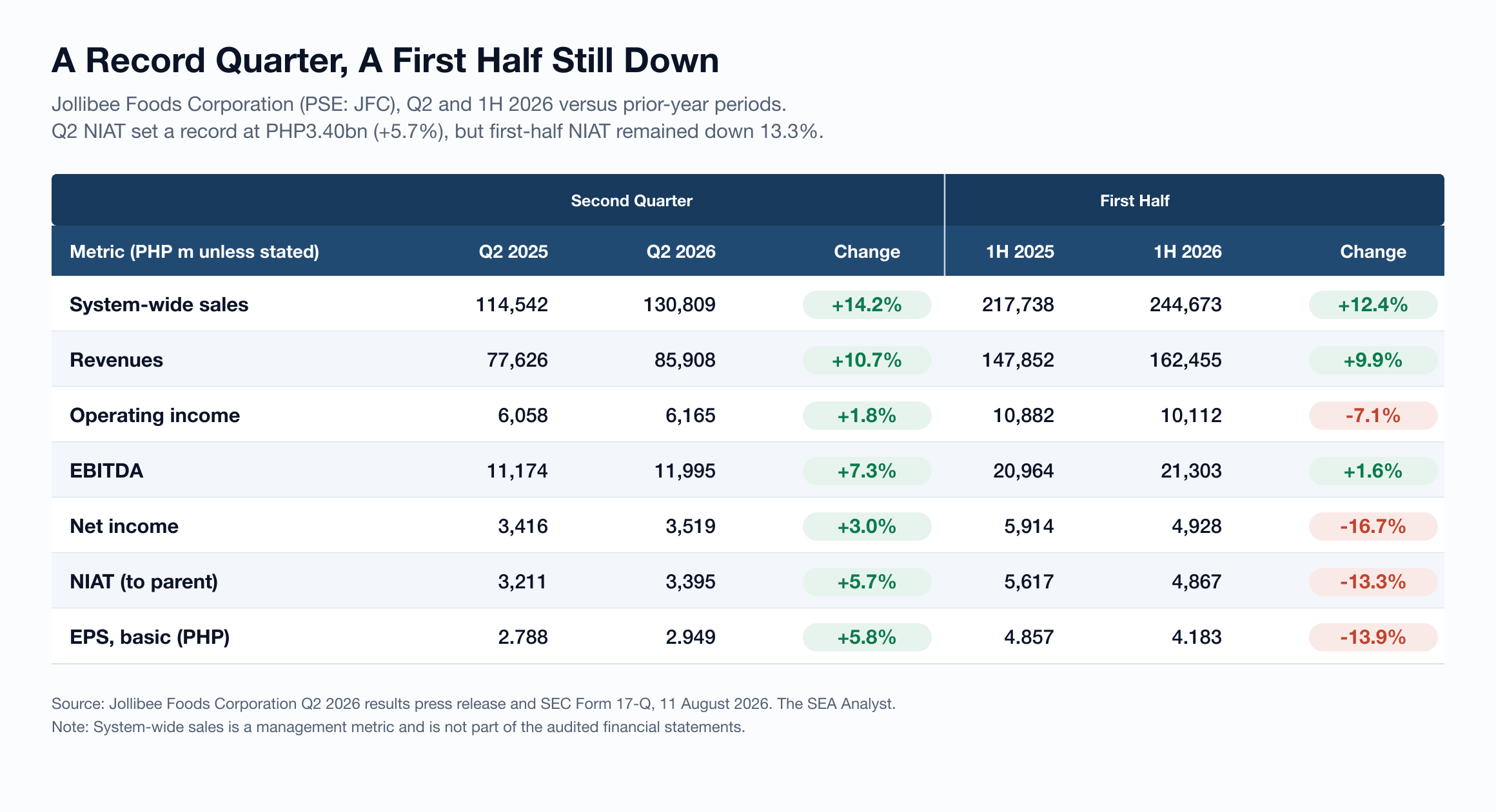
The margin recovery is real, and we said as much. Pricing from April, plus sourcing and cost discipline, took the gross margin from 16.5 percent in Q1 to 18.5 percent in Q2, and June exited at 19.0 percent gross, 9.1 percent operating and 6.2 percent NIAT, the best run-rate of the year [1]. Group EBITDA rose 7.3 percent. No argument there.
It just was not broad. The EBITDA growth came from the Philippines, where EBITDA rose 12.8 percent. International EBITDA fell 0.4 percent, weighed down by ₱239m of transition costs as Smashburger and Yonghe King close stores and move to franchising [1]. Take out the home engine and the overseas arm grew its earnings by nothing this quarter.
Thesis check
Bear: “the profit is almost entirely Philippine.” Validated. The quarter says it in the segment lines. Philippine EBITDA up 12.8 percent, international EBITDA down. And yet international system-wide sales grew 25.4 percent, led by Highlands Coffee (+46.7 percent), Compose (+39.7 percent), Tim Ho Wan (+23.0 percent), Jollibee North America (+21.6 percent) and Milksha (+12.4 percent) [1]. Fast sales, no earnings. That is the shape we drew: a coffee-led arm that is real and growing and does not yet pay the group’s bottom line. The bull points at the 25 percent. The income statement still says Manila.
Bear: “not net cash; leverage is real and rising.” Validated, and worse. The balance sheet went the wrong way.
Gross interest-bearing debt rose to ₱93.2bn at 30 June from ₱86.5bn; cash fell to ₱29.8bn from ₱34.9bn.
Net debt ex-leases climbed to about ₱63.4bn from ₱51.6bn, up roughly ₱12bn in six months, near 1.5 times annualised EBITDA against about 1.2 at year-end [1][3].
The composition is the tell we flagged: senior notes fell ₱16bn to ₱36.6bn as JWPL redeemed the shorter 2020 tranche, but bank debt rose ₱21.9bn. “Partly refinanced with bank borrowings,” on the page. Financing interest rose 9.8 percent [3]. The record NIAT swallowed that bigger interest bill; it was not handed a smaller one.
Bear: the ₱9bn preferred redemption is another call on that same cash. Redeeming all nine million Series B preferred at their ₱1,000 price, about ₱9bn, on 14 October helps common holders a little in isolation: out goes a claim and a dividend that sit ahead of them [2]. But the balance sheet is already tighter than six months ago, and this is the same cash the change-of-control bond put we analysed at initiation could one day demand [4]. Pay it from cash and group cash drops toward ₱21bn. Pay it from debt and net debt heads toward ₱72bn. Either way, the liquidity we called committed gets more committed.
Bull: the coffee-led engine is real. On sales, not yet on profit. Highlands and Compose are compounding system-wide sales north of 40 percent. Jollibee Vietnam is the standout, same-store sales up 17.9 percent, store payback under four years. The group folded in Shabu All Day, a Korean brand under Jolli-K (172 stores acquired, 156 in the network at 30 June), about 5 percent of international sales [1]. The asset-light turn shows up where it matters: China’s franchise ratio is 62 percent, from 14 percent in 2016; Yonghe King is at 65 percent and aiming for 70; Canada added franchise development deals. This is the honest, non-venue route to a higher multiple we named as a trigger. It has not landed. International EBITDA is still flat-to-down, because the very restructuring that makes the arm asset-light costs money now. The winners win. The arm, as a whole, does not yet pay.
Flip trigger: “Compose and the coffee platform inflect to clear, sustained group-level profitability.” Not crossed. The one thing that would hurt us most is the overseas arm turning profitable at the net line. It went the other way. International EBITDA fell. We are watching for the quarter when “the profit is almost entirely Philippine” stops being true, and this half moved away from that, not toward it.
Bear: the venue mirage. No real update; the catalyst stayed quiet. Fifteen pages on record earnings, margins, capital-light growth and awards, and not one on the separation or the US listing, the centre of the whole bull case [1]. The 17-Q is barely louder: a routine subsidiary note tied to the planned spin-off, with no venue, no timing, no strategic-review update [3]. In January this was the headline. This quarter it is a footnote. One release is not cancellation, and we will not pretend it is. But it fits the drift we mapped, firm January plan to hedged June review, and it is not how a company markets a re-rating. A mirage stays a mirage while nobody points at it.
Risks revisited
Two risks moved.
Leverage moved up. Net debt rose about ₱12bn in six months, the preferred adds another ₱9bn, and the flexibility is thinner, so the change-of-control put, if a separation ever fired it, would hit a tighter balance sheet.
Execution moved down, a little: the margin recovery and the franchise discipline in China and North America show management can react to cost and will eat near-term charges to get asset-light.
Against that, the guidance cut. Full-year same-store growth trimmed to 3-4 percent, gross openings to 1,000-1,100 stores, operating-income growth to 10-15 percent, a quieter outlook than a year ago [1].
What to watch
Three things.
International EBITDA first: the quarter to wait for is the one where the Smashburger and Yonghe King costs roll off and the coffee winners are big enough to lift overseas earnings, not just sales. Until then the trigger holds.
The separation second: the next annual meeting, or any circular or notice to bondholders, answers the venue question, and its absence from results talk is itself worth logging.
The balance sheet third: the 14 October redemption, capex of ₱13-15bn, and whether net debt keeps climbing into the second half will tell us whether “committed liquidity” is easing or worsening. The 17 August briefing is the first chance for management to speak to any of it.
Bottom line
Call it a beat. We read it as a confirmation. Jollibee posted a real, home-led margin recovery and a record headline NIAT, and did it while the half was down double digits, overseas earnings went backwards, net debt rose about ₱12bn, and the US listing behind the bull case drew nothing but a footnote. None of that moves the initiation. The profit is still Philippine. The balance sheet is still levered, and more so. The venue mirage is quieter, not louder.
We stay non-directional, no price target. At ₱156 after the pop, the market sits in the lower half of our limited-debt band and above the fuller-debt one; the framework holds. JWPL’s own note balance fell as it redeemed a tranche, which helps the arm’s standalone equity a touch, but group net debt rose and a ₱9bn preferred call is booked, so the capital-structure-dependent range, with its wide gap between the two debt cases, matters more now, not less.
What would change our mind has not: an arm that turns durably profitable at the net line, or a separation document that gets more value, more cleanly, to a Manila holder than we expect.
Neither showed up this quarter. A record was set. It was set at home.
Data Integrity Notes
Q2 and 1H 2026 figures are taken from Jollibee’s 11 August 2026 press release and the accompanying SEC Form 17-Q; balance-sheet figures are from the unaudited consolidated statement of financial position as at 30 June 2026 in the 17-Q [1][3]. System-wide sales and same-store sales growth are management metrics and are not part of the audited financial statements. Net debt is our calculation (short-term debt plus current and non-current long-term debt plus senior debt securities, less cash and cash equivalents) and excludes IFRS-16 lease liabilities of ₱52.8bn. The ₱9bn preferred-redemption figure is nine million JFCPB shares at a ₱1,000 redemption price plus accrued dividends, per the 17-C redemption disclosure [2]. The share price of ₱156.00, up 5.05 percent on the day, is the PSE quote at the time of writing [5]; our initiation anchored ₱147.10 on 20 July 2026, so the stock has risen into the results and should be refreshed at publication. The results press release did not mention the US listing; the 17-Q carries a routine subsidiary disclosure tied to the planned international spin-off but no venue, timing, or strategic-review update [3]. This is our reading of the filings, not a company statement that the plan has changed.
References
[1] “The Jollibee Group Reports Record Q2 2026 Results, with Margin Recovery from Controlled Pricing and Record-High Quarterly Net Income Attributable to Equity Holders of the Parent Company,” Jollibee Foods Corporation press release (PSE 17-C, Form 4-31, C06118-2026), 11 August 2026.
[2] “Redemption of Series B Preferred Shares,” Jollibee Foods Corporation (PSE 17-C, Form 4-21, C06121-2026), 11 August 2026: 9,000,000 JFCPB shares at a ₱1,000 redemption price plus accrued dividends, less customary transfer costs, redemption date 14 October 2026, record date 30 September 2026, kept as treasury.
[3] Jollibee Foods Corporation SEC Form 17-Q for the quarter ended 30 June 2026 (PSE CR06002-2026), 11 August 2026: unaudited consolidated statement of financial position and statement of comprehensive income. Gross interest-bearing debt ₱93.2bn, cash ₱29.8bn, senior debt securities ₱36.6bn, long-term debt ₱40.6bn (current plus non-current), lease liabilities ₱52.8bn.
[4] The SEA Analyst, “Jollibee’s Global Arm Is Real. Its Wall Street Re-Rating Is a Mirage.” (initiation), 22 July 2026. https://www.theseaanalyst.com/p/jollibee-jfc-philippines-pse-stock-us-spin-off
[5] Jollibee Foods Corporation (PSE: JFC) share price of ₱156.00, up 5.05 percent on the day, the Philippine Stock Exchange quote as at 11 August 2026. https://www.pse.com.ph/company-information-JFC/
[6] Jollibee Foods Corporation, SEC Form 17-C / PSE disclosure, “JFC Advances Planned Spinoff of International Business; Selects Hong Kong for Proposed Listing and Names JFCI CEO,” 1 September 2026 (signed by CFO and Chief Risk Officer Richard Chong Woo Shin). https://edge.pse.com.ph/downloadHtml.do?file_id=1962201
[7] Jollibee Worldwide Pte. Ltd., Final Offering Circular dated 25 March 2025 (SGX): change-of-control put at 101 percent triggered if JFC as guarantor ceases to own at least 50 percent of JWPL’s voting stock. https://links.sgx.com/FileOpen/JOLLIBEE%20WORLDWIDE%20PTE.%20LTD.%20-%20Final%20Offering%20Circular%20-%20dtd%2025%20March%202025.ashx?App=Prospectus&FileID=65389