

Disclosure: the author holds no position in Jollibee Foods Corporation and has not traded in it in the 30 days before publication, and has received no compensation from any company mentioned. This is for informational and educational purposes only, is not investment advice, and its author is not a licensed investment adviser. Do your own research and consult a licensed adviser before investing.
The mirage
In January 2026, Jollibee Foods Corporation said it would separate its international business from its Philippine operations and list the overseas arm on a United States exchange, handing existing shareholders stock in the new company. It was something no Philippine consumer company had attempted at this scale, and local brokers greeted it as a way to unlock the value of a global restaurant group the Manila market had never fully credited. Investors liked it at once, and the shares rose around 16 percent [2]. Two-thirds of Jollibee's more than 10,000 stores sit outside the Philippines, and the pitch was simple: put that fast-growing global business in front of American investors who pay up for restaurant growth, keep the steady Philippine cash machine at home, and the sum of the parts is worth more than the blended company trading in Manila. The logic was easy to follow, and for a few days the market bought all of it.
Six months later the enthusiasm had cooled. At its June annual meeting the company no longer described a spin-off and a 2027 US listing but an “ongoing strategic review” with “multiple pathways to unlock value over time,” one that would proceed “regardless of the outcome,” and the venue had drifted from New York toward Hong Kong [3]. The company’s annual-meeting messaging placed the separation inside a broader strategic review rather than repeating January’s firm transaction language. The shares gave back the excitement and now trade in the 140s, about a third below their level a year ago.
Most of the debate since has been about whether the spin happens. That is the wrong question. The more important one, which almost nobody asks, is whether it would deliver the thing it is premised on: a Wall Street re-rating of the international arm. And there is evidence to test it, because the market has already run several versions of the experiment.
The spin-off can crystallise value, but the listing alone cannot durably multiply it. The reason is simple: the closest available US-listed precedents, each Chinese or Chinese-origin, have not sustained US growth multiples. Chagee IPO’d on Nasdaq in 2025 at roughly 2.5 to 3 times sales on an enterprise basis and, as its growth cooled, fell to about 0.7; Yum China, spun off and NYSE-listed, sits near 1.3.
That matters because the bull case depends on a venue re-rating. Jollibee’s international arm may be valuable, but its value is already explainable on Asian marks. The mirage is not the business; it is the idea that New York changes the multiple. What follows builds that case from the filings up: what Jollibee is, where its profit sits, what it has bought, and then the test itself.
What Jollibee really is
Built from a single ice cream parlour the Tan family opened in 1975, Jollibee is now one of Asia’s largest restaurant operators, with more than 10,400 stores across 33 countries and around 20 brands. When customers at that ice cream parlour kept asking for hot meals, the founders switched the menu to burgers and fried chicken and incorporated the business as Jollibee in 1978. The defining moment came in 1981, when McDonald’s entered the Philippines and, against every expectation, failed to dislodge the local upstart: Jollibee had tuned its food to a Filipino palate, sweeter burgers and saltier fried chicken, that global chains never quite matched. To this day the Philippines is one of the very few markets on earth where the home-grown chain outsells McDonald’s on its own ground, and Brand Finance ranks Jollibee the most valuable restaurant brand in Southeast Asia [4]. That victory taught the company two lessons that still shape it: that local taste and habit beat global scale, which is why the domestic business is so hard to dislodge; and that the formula does not automatically travel, because the home-turf advantage is exactly what it lacks everywhere else.
Underneath the brands sit three businesses. The first is operating restaurants, some company-owned, most franchised, and the distinction drives the economics. A franchised store sends Jollibee a royalty with almost no incremental cost or capital; a company-owned store carries the full weight of rent, staff and fit-out. Jollibee’s mature domestic brands lean heavily franchised, which is why the home business throws off cash, while several overseas businesses are more company-operated, which is one reason they consume it. The flagship makes the split visible: of the 1,279 Jollibee-branded stores in the Philippines at the end of 2024, about two-thirds were franchised; of the 480 abroad, three-quarters were company-owned. Same brand, inverted model.
The second business is the commissary and supply chain, a network of central kitchens and distribution centres that manufactures the standardised sauces, marinades and frozen components which make a Chickenjoy in Davao taste like one in Manila. It is unglamorous, and it is a real moat: it enforces consistency, captures manufacturing margin a pure franchisor would hand to suppliers, and cannot be cheaply copied. A competitor can clone a recipe; it cannot clone a nationwide commissary built over four decades.
The third business, increasingly central, is capital allocation, which is to say buying restaurant companies. The domestic portfolio was assembled partly by acquisition; the international arm almost wholly so. This makes Jollibee as much an acquirer and operator of brands as a single chain, and it is the fact that most shapes how the overseas business should be valued. Management has spoken for years of becoming one of the largest restaurant companies in the world, so the spin-off is the logical endpoint of a decades-long ambition rather than a sudden idea, which is part of why the company is reluctant to abandon it even as the mechanics turn out to be hard. Two familiar Singapore touchpoints, for orientation: Jollibee owns The Coffee Bean & Tea Leaf, controls Tim Ho Wan through an investment fund, and through a joint venture took Tiong Bahru Bakery and Common Man Coffee Roasters to the Philippines [5].
Around the flagship sits a portfolio built to cover the whole Filipino table: Chowking for Chinese-style fast food, Mang Inasal for grilled-chicken value, Greenwich for pizza, Red Ribbon for cakes and bread, together roughly 3,500 outlets. That breadth captures the eating-out peso across occasions and price points and gives the commissary the volume that makes it efficient. Stack the layers and the domestic moat comes into focus: a brand that is a cultural default, a portfolio that spans the table, a franchised structure that turns dominance into high-return royalties, and a supply chain that enforces quality while capturing manufacturing margin. It is the combination, not any single layer, that a competitor finds hard to match, and it still has room to run as the group pushes into higher-growth provincial markets behind new commissary capacity in the Visayas.
The pattern to carry forward is that all of this is local. Brand affection, portfolio breadth, franchised density and commissary scale are built on Filipino habit and Philippine geography, and those things do not travel. Everywhere except Vietnam, Jollibee competes abroad without the home-turf advantage, as one more challenger buying its way into crowded markets. That is the deeper reason the profit sits where it does.
The profit is still Philippine
Almost all of Jollibee’s profit is Philippine, a fact the “clean unlock” framing skates over.
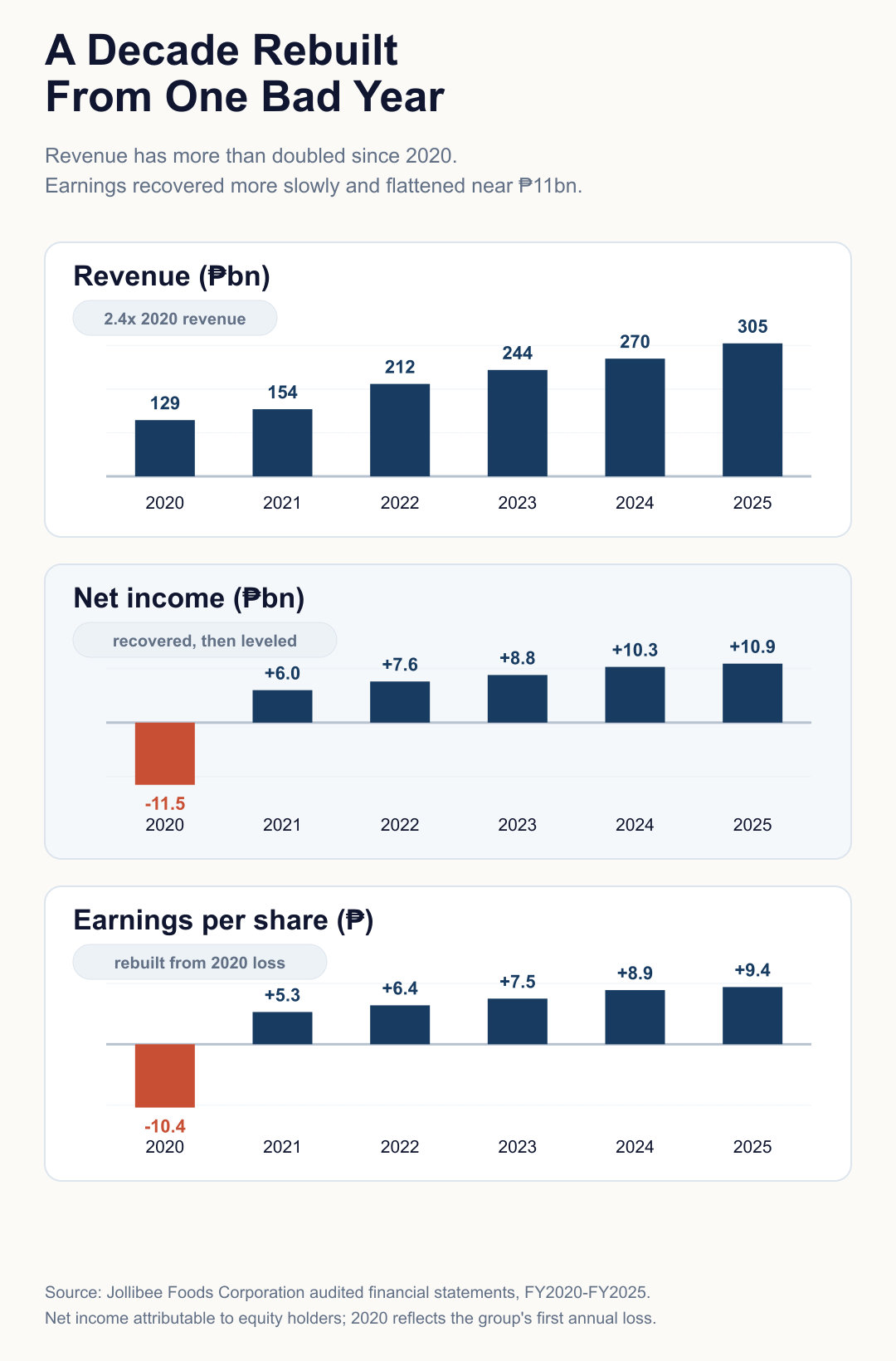
The six-year record contains a violent shock and an incomplete recovery. Revenue fell to about ₱129bn in the 2020 pandemic year, when dining rooms shut and the group posted its first-ever annual loss, roughly ₱11.5bn. It then recovered hard, to ₱154bn, ₱212bn, ₱244bn, ₱270bn and ₱305bn in the five years to 2025, more than doubling the top line. The bottom line came back more slowly and has since flattened: net income to shareholders climbed from that loss to about ₱10.9bn, but the step from ₱10.3bn in 2024 to ₱10.9bn in 2025 was small, and momentum turned negative in early 2026. Reported profit is also flattered slightly by deferred tax assets recognised on the overseas units’ accumulated losses, an entry that lifts net income without adding a peso of cash, and one more reason to read the segment detail rather than the headline.
On the company’s own FY2025 geographic figures, the Philippine business earned about 112 percent of group net income to shareholders; the international arm, taken together, was a small net loss, about minus 12 percent. The overseas arm made an operating profit, roughly 19 percent of group operating income, but a net loss once financing and acquisition costs were counted, so the Philippine business had to out-earn the whole group to offset it. The pattern held the year before, at plus 111 and minus 11 percent, and it worsened at the net line in early 2026: in the first quarter the international operations lost roughly ₱0.7bn, about minus 52 percent of a depressed group net income, and attributable net income fell about 39 percent, to roughly ₱1.5bn [8].
The home engine is strong but maturing. Philippine same-store sales growth has stepped down from about 7.5 percent in 2024 to 5.2 percent in 2025 to 3.2 percent in the first quarter of 2026, the last against a base lifted by election-related spending, and domestic margins felt cost pressure early in 2026. This is a dominant, franchised, cash-generative business that is also slowing, not an annuity that compounds untouched, which is part of why management keeps reaching abroad.
The point this sharpens is what the separation actually is. It is not two profitable halves going their separate ways. It is a profitable Philippine business that has quietly subsidised a global build-out, and a proposed separation that would hand at least part of that build-out to public investors abroad. The question the rest of this piece works through is what the shareholder left holding the Philippine business receives in exchange, and what it costs to deliver.
The international arm is real, but mixed
This does not make the international arm bad. It makes it early, and real. International EBITDA grew about 20 percent in FY2025 to ₱14.1bn, its operating margin rose from 2.0 to 3.0 percent, and its share of group operating income climbed from 13 to 19 percent. The engine is coffee: of that ₱14.1bn, ₱8.6bn, more than 60 percent, is Coffee and Tea, led by Compose in Korea (EBITDA up 156 percent in its first full year inside the group), The Coffee Bean & Tea Leaf, and Highlands in Vietnam. Around it sit the newer Asian brands and a scatter of turnarounds still dragging, China (international EBITDA down 69 percent) and Smashburger (EBITDA of about minus ₱1.0bn) among them. Jollibee’s international business is, first and foremost, a coffee platform with a Vietnamese quick-service winner attached, not a scaled-down replica of the chicken chain at home.
One caveat on the brand itself, precisely because it is easy to overstate. Where the Jollibee brand has travelled abroad, it has historically done so on the back of Filipinos rather than by winning locals: its overseas stores cluster where the diaspora is thick, and the company’s own push to reach mainstream American customers concedes as much [9]. Vietnam is the telling exception, with only a small Filipino population but more than two hundred stores selling to local diners. Kept in proportion, this applies to the Jollibee brand abroad, a few hundred of the arm’s thousands of stores; the arm’s growth case rests on the acquired local brands, Compose, Highlands and The Coffee Bean & Tea Leaf, where Filipino demand is beside the point. The value is not the brand’s diaspora pull but the businesses it has bought.
Because the arm is bought rather than built, judging it means judging Jollibee as an acquirer, and the record is genuinely mixed. The domestic template worked: Mang Inasal, bought in 2010, became one of the group’s best growth engines, a heavily franchised grilled-chicken chain that still posts some of the fastest same-store growth in the portfolio. That is the template the bulls hope repeats abroad, buy a strong local concept and scale it through franchising, though the domestic deals had the home-turf advantages working for them, which is exactly why they are weak evidence for what happens overseas. Abroad the results are harder to read. Smashburger, the American “better burger” chain taken to full ownership by 2018, has underperformed for years and was still being reformatted in 2026; The Coffee Bean & Tea Leaf, bought in 2019, has been a turnaround more than a growth story; China has been a repeated cycle of openings and closures. Against those sit the clear winners, and they cluster in Asia and in the newest deals. Vietnam is the standout, with systemwide sales up more than 40 percent last year; Tim Ho Wan more than doubled its Hong Kong store count within a year of full integration; and above all Compose, bought in 2024 for about US$340m [6] at roughly eight times its annual operating earnings, grew its underlying product sales more than 10 percent in 2025 [15], even as its reported contribution to the group jumped far more on its first full year of consolidation. Tellingly, Highlands is pursuing a parallel Vietnam listing at a reported US$400m [7], a separate monetisation path that could complicate, or potentially thin, the eventual international perimeter, depending on how the two transactions are structured. The honest reading is that the arm is some winners and some turnarounds wearing a single growth label, and the separation is partly an attempt to let the market price the winners without the drag.
The exits tell their own story. Over the past decade the group has quietly walked away from a US subsidiary, China’s Dunkin’ and a hotpot venture, and Vietnam’s Pho24, none large alone but together the mark of a company that buys often and is willing to cut its losers. That is healthier than clinging to them, but it is not the effortless compounding the “global growth company” label implies. Compose is the counter-example the bulls lean on hardest: almost entirely franchised, close to debt-free and high-margin, it is the asset-light model the group wants to define its international future. And the buying has not stopped, which is a tell in itself. In February 2026, well into the “strategic review,” the group agreed to acquire the South Korean hot pot chain Shabu All Day for about US$87m [6], a second Korean deal in under two years that sits awkwardly against the idea that the arm is being frozen and readied for a clean carve-out.
Management knows this ceiling, and its answer is instructive. It has been expanding its US franchising programme, aiming for a majority-franchised American footprint and courting mainstream customers rather than only Filipinos [9]. That is a genuine point in the separation’s favour. The open question is whether the strong US unit economics the company advertises hold beyond a handful of high-traffic destination outlets in areas of dense Filipino settlement; that is the diaspora question restated, and we flag it as our reading rather than a proven claim, since we lack the store-level customer data to settle it either way.
All of this sits on the balance sheet as about ₱78.8bn of goodwill and brand intangibles, more than a quarter of the group’s total assets, the accumulated price of a decade of buying. It is not a cost that recurs, but it is capital that has to earn a return, and at the group’s net line the international business has not yet earned one on it. Judging Jollibee therefore means judging its record as a buyer, which is why the mixed record above weighs as much as the growth rate.
What the closest US-listed Asian precedents show
Here is the mechanism the bull case needs, stated plainly. Today the international arm is buried inside a Manila-listed chicken chain and the market gives it little; the whole company trades at roughly what the Philippine business alone is worth. Separate it, list it in New York where investors pay rich multiples for restaurant growth, and the same business re-rates to a US growth multiple. The gap between “nothing” and “US growth multiple” is the unlock, and the venue-driven bull narrative maps that supposed re-rating onto the gap between the current price and bullish valuation scenarios, from the consensus mean near ₱211 [1] to the ₱287 top of the current range and the ₱330-plus targets seen before the recent de-rating.
Everything hinges on one link: a US listing produces a US multiple. It is the single testable claim on which the whole bull case rests, and it has been tested, because several Asian restaurant and coffee companies have already reached a US exchange by different routes, and we can see what the market paid. The closest to Jollibee’s proposed transaction is Yum China, which Yum Brands spun off and listed on the New York Stock Exchange in 2016: a carved-out, Asia-focused restaurant operator, made independent and primarily US-listed. It is large, profitable, dividend-paying and cleanly run, and it trades at about 1.3 times sales and nine times EBITDA. A fresher test arrived in April 2025, when Chagee, a Chinese premium-tea chain, listed directly on Nasdaq in a primary IPO; it trades near 0.7 times sales. And Haidilao carved out its own international arm as Super Hi and added a Nasdaq line in 2024; it sits near one times sales. Three routes onto a US exchange, a spin-off, a primary IPO and a carve-out, and the same answer each time:
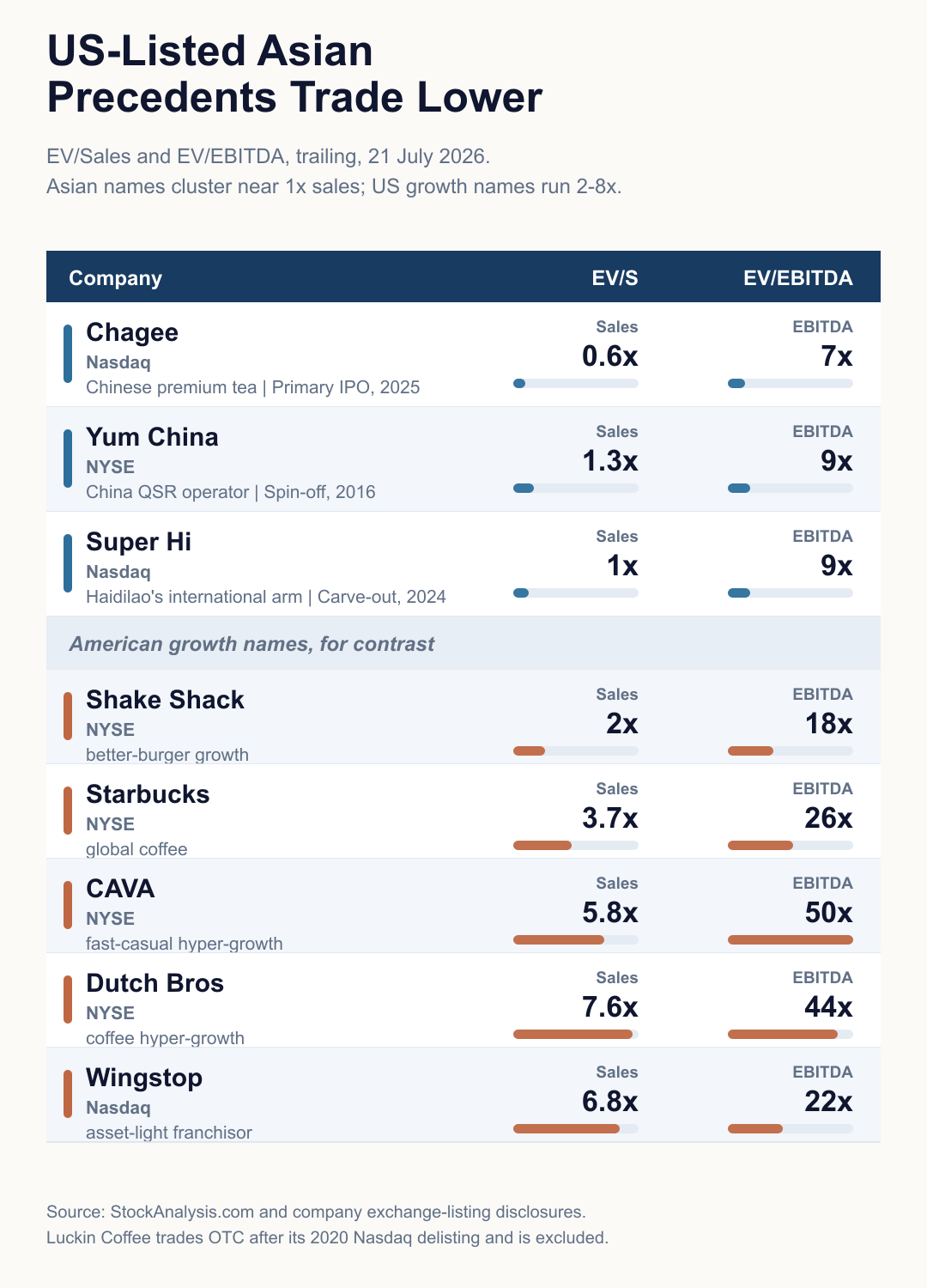
Read down the Asian names and the pattern is hard to miss: across these three precedents, the current valuations sit at roughly 0.7 to 1.3 times sales, while the American growth names command three to eight. Chagee is the sharpest test, and it cuts both ways. When it IPO’d on Nasdaq in April 2025 the market did hand it a substantial US-style listing premium, valuing it at roughly 2.4 times sales on an enterprise basis at its IPO price and nearer 3 times at the opening pop, depending on the treatment of its IPO cash; as its growth cooled, that premium drained away and it now trades near 0.7 times EV/sales, like the rest. So the honest lesson is not that a US listing can never confer a substantial listing premium, it plainly can at the moment of listing, but that the venue cannot sustain one the underlying economics do not support.
Each Asian name has its own story, Chagee’s cooling growth, Yum China’s China-market risk, Super Hi’s dual listing, and that is exactly why the pattern persuades: the explanations differ, but the durable multiple is missing in every case. We are not claiming the venue is worth nothing; a genuine US listing can add liquidity, disclosure and investor access, and the research on cross-listing premiums says those are worth something. We are claiming something narrower and sturdier: no plausible venue benefit durably turns a one-times-sales Asian platform into a five-times-sales American one. Absent materially better growth, margins and capital efficiency than it shows today, Jollibee’s coffee-led Asian arm belongs nearer one to two times sales than to the multiples of US growth chains. The re-rating the bull case needs is the part that does not last.
There is a real limitation to this comparison, and it is worth stating plainly. Each of the three closest US-listed precedents used here is Chinese or Chinese-origin: Yum China operates almost entirely in China, Chagee is a Shanghai-based chain, and Super Hi is the carved-out international arm of a Chinese hotpot operator. Part of their discount may therefore be China-specific, reflecting US-China delisting risk, governance perceptions around Chinese issuers, capital controls and single-market concentration, rather than a generic Asian penalty. Jollibee’s arm is Philippine-controlled and spread across Korea, Vietnam, China and North America, and could on that basis command a somewhat higher multiple than a pure-China name. So our claim is not that these precedents prove an immutable Asian ceiling. It is narrower and harder to dispute: they offer no support for assuming an automatic leap to US growth-chain valuations, and any durable premium Jollibee’s arm earns will have to come from its own growth, margins and capital efficiency, not from the ticker. On that score its own record, loss-making at the net line, minority-laden and built by acquisition, argues for caution rather than a premium.
So a US listing crystallises value without multiplying it. That leaves the two questions that decide whether the stock is actually cheap: what are Jollibee’s parts really worth, and how much of that ever reaches the person holding the shares in Manila?
Below, for paid subscribers: the sum-of-the-parts, and how far the per-share value drops once the arm carries its real share of JWPL's debt; the leaks between enterprise value and a Manila shareholder's pocket; the bull case at full strength; and the evidence that would prove us wrong.