

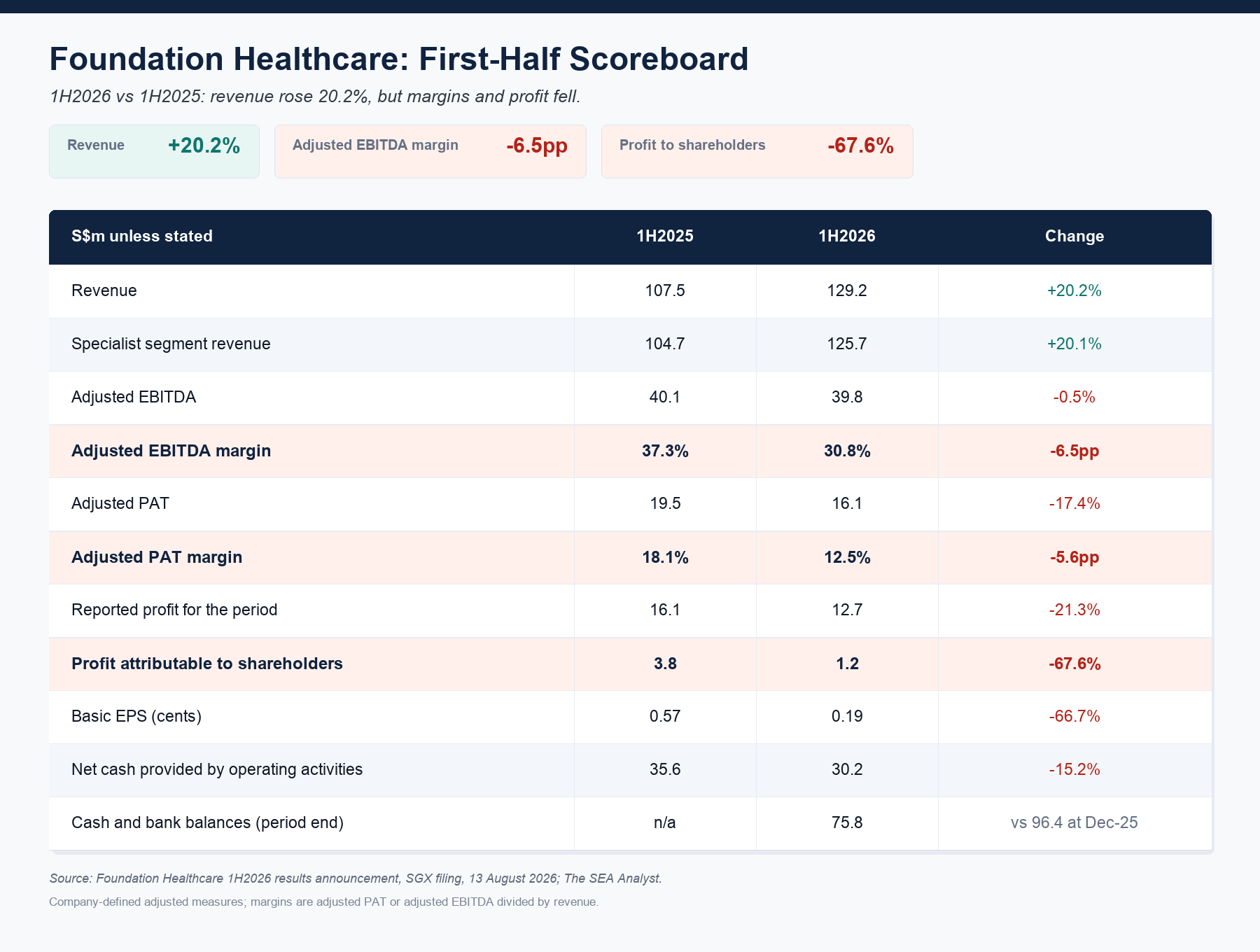
Foundation Healthcare's profit fell 68% in its first results as a public company. Revenue rose 20%, to S$129.2 million. The stock dropped 8% on the news, then clawed it back. And the number everyone quoted, that 68% drop, is the one that matters least. Here is why.
That number is the S$1.2 million of profit the company reported for shareholders, and the results-day headlines led with it [1]. It looks alarming, but it is misleading. It comes from an old ownership structure that ended on 1 July, the day after this period closed. It will not be there next time.
The number that matters is the margin, and it slipped. The business kept less profit from each dollar of sales than a year ago. Adjusted profit fell 17% to S$16.1 million, even though revenue rose 20%. The adjusted EBITDA margin dropped from 37.3% to 30.8%. That is what the market reacted to, and it is the number the whole valuation is built on.
The result came out on 13 August, after the market closed. The shares fell from S$0.805 to S$0.740 the next day, about 8%, then recovered over the following two sessions to S$0.775 by 17 August, back above the S$0.76 they listed at on 8 July. The half also carried S$5.4 million of one-off IPO and acquisition costs, against S$0.6 million a year earlier.
Prior Thesis Recap
We first wrote about Foundation Healthcare on 29 June, while the IPO was still open [2].

Our point then was simple. This is a good business, but it was coming to market through a structure that flatters its earnings just before listing. In FY2025 the group earned S$41.2 million, but only S$14.0 million reached shareholders. The doctors still owned 40% of most of their own practices, and took their share first. A pre-IPO deal called the Share Swap, done on 1 July, bought those doctors out and moved that profit to shareholders. We said the swap was struck cheaply and was good for new investors. We also said the real thing to watch was not the fast revenue growth, but what happened to margins once the practices sat inside the group. At the time we noted the stock listed at 21 to 25 times its pro forma earnings and 13 to 15 times pro forma EBITDA [2]; on the group's pro forma adjusted profit of S$51.4 million, the swap-neutral base we use below, that is about 20 to 24 times. This is the first result we can test that against.
New Financial Data
Here is the thing to understand about that S$1.2 million, because it explains this result and the next one.
Profit is counted before it is split between the group and the doctors who own minority stakes. The margins, the revenue growth, the adjusted profit, all of it is measured before that split. The Share Swap only changes the split. It takes the doctors’ share and gives it to shareholders. It does nothing to the profit the business makes in the first place.
So the S$16.1 million of adjusted profit the group earned this half is the same whether the doctors own 40% or nothing. This half ended on 30 June, one day before the swap. The old split still applied, so the doctors’ share, the non-controlling interests, took S$11.5 million of the S$12.7 million reported. And the S$5.4 million of acquisition and capital-raising costs, mostly the IPO, landed on shareholders too. That is how a business earning S$16 million of adjusted profit reports S$1.2 million to its owners.
Next half, the swap runs the same trick in reverse. The doctors’ share is gone, so shareholders keep almost all the profit, and the headline earnings will jump. That jump will look like a big recovery. It will not be one. It is just the swap.
The simplest way to hold this in your head: the swap changes the size of your slice, not the size of the pie. This half it made a decent pie look like a sliver. Next half it will make the pie look bigger than it grew. If you want to know how the business is really doing, ignore the slice and look at the pie. And the pie got thinner this half.
That is the real news. The business made less profit on each dollar of sales. Adjusted profit margin fell from 18.1% to 12.5%, so even with 20% more revenue, adjusted profit went down.
This matters because of what the market paid for.