

Walk into Raffles Hospital on North Bridge Road and the mix in the waiting areas tells you what the business is: corporate staff on company health plans, expatriate families, medical travellers from the region, and long-standing private patients. That breadth (primary care, specialists, a hospital and an insurer under one brand) is what the market pays for. It is a genuine Singapore healthcare franchise, and the FY2025 result read, at first glance, like that franchise reaccelerating.
The market treats Raffles Medical as a quality defensive compounder and prices it at roughly 21.5 to 22.5 times trailing earnings. FY2025 seemed to support the framing: revenue up 1.8% to S$765.3 million, profit after tax and minority interests up 13.4% to S$70.6 million, and a raised dividend.
Two things need saying about that figure before turning to the business quality. It is a rebound from a low base: PATMI peaked at S$143.2 million in FY2022, inflated by pandemic testing, vaccination and transitional-care work, then fell to S$90.2 million in FY2023 and S$62.2 million in FY2024, so FY2025 recovers only part of that decline and remains below FY2023. And the FY2025 increase was concentrated in a handful of items, not broad-based operating growth.
The pre-tax bridge shows where the profit came from, and the deep dive lays it out in full: of the S$6.6 million increase in group pre-tax profit over FY2024, a S$4.7 million investment-property revaluation and a S$3.2 million narrowing of the insurance segment's loss account for more than the whole of it. One of those, the property mark, is non-cash and non-recurring; the other, the insurance improvement, is a reported narrowing of the loss off a still-loss-making base, real in the accounts but not yet proof of clean underwriting.
Beneath them, the Singapore hospital operating company did grow. But combine it with its property landlord, set aside finance income and intra-group impairment swings, and the result was roughly flat on our illustrative measure. Meanwhile the pandemic-era clinic and transitional-care activities kept shrinking. That is why group revenue fell 6.7% in the first half of 2026.
Raffles Medical is a good business. The question is whether roughly 21.5 to 22.5 times earnings is the right price for it. Return on equity, at 6.7%, has settled back to around its pre-pandemic level. China, the growth leg, still draws cash from the parent. And the Singapore base faces more public hospital beds, insurers holding down bills, and cheaper regional hospitals competing for medical travellers.
The group itself does generate cash. In FY2025, after capital spending, leases and interest, it produced S$83.3 million, more than the S$66.2 million it paid out in dividends and buybacks. What is unproven is whether China will return cash rather than absorb it. The group surplus also came in a year of unusually low capital spending.
History
Raffles Medical traces to 1976, when Dr Loo Choon Yong and Dr Alfred Loh took over Teng's Clinic in Singapore; in 1980 the practice moved to larger premises and was renamed Raffles Medical Group [16]. In 1997 it became the first full-fledged healthcare provider to list in Singapore, and Dr Loo has been Executive Chairman since that listing [16][17]. The group marks its fiftieth anniversary in 2026 [17]. The integrated model came later: Raffles Hospital opened in 2001, and the insurance arm took its current name, Raffles Health Insurance, in 2012 [16].
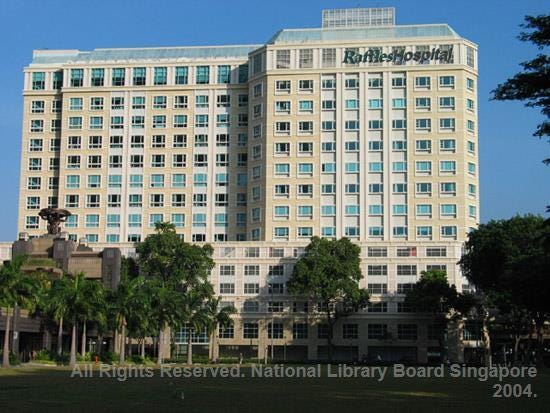
The physical inflection came on 31 March 2001, when Raffles Hospital at North Bridge Road began taking patients, with 380 beds at the time; it was officially opened in March 2002 [16][18]. Over the following two decades the group densified its Singapore position with more Raffles Medical clinics and, from January 2018, the Raffles Specialist Centre, a 22-storey tower connected to the hospital [19]. Both the hospital and the specialist centre sit on 99-year leasehold sites granted from 1 March 1979 [17]: long-dated, but leasehold, not freehold.
Then came China.
Raffles Hospital Chongqing, a 700-bed hospital by design, opened on 2 January 2019; commissioned beds are not disclosed [19].
In 2020 the group converted its Beijing medical centre into Raffles Hospital Beijing [16], which is held through the 80%-owned International SOS (MC Holdings) chain [17].
Raffles Hospital Shanghai, a 400-bed hospital in the Qiantan area of Pudong, opened on 26 July 2021 [4].
These turned a Singapore operator (itself capital-intensive, with an owned hospital and specialist centre) into a materially more capital-heavy and execution-heavy cross-border group. The consequences, S$304 million of non-current assets in Greater China at end-2025 [17], are the central financial question today.
The pandemic delivered a windfall and a distortion at once. From FY2020 to FY2022 the group took on large public-health work: COVID-19 testing, quarantine facilities and vaccination centres, then, from July 2022, a transitional care facility for chronically ill patients from public hospitals [4][20]. FY2022 PATMI reached S$143.2 million on restated revenue of S$822.9 million [16], the most profitable year in the group's history. The recurring healthcare business did not disappear afterwards, but the incremental pandemic windfall was never repeatable, and it has been draining out of the numbers since, which is what makes FY2022 a misleading benchmark and the last two years the real test.
What the Company Does
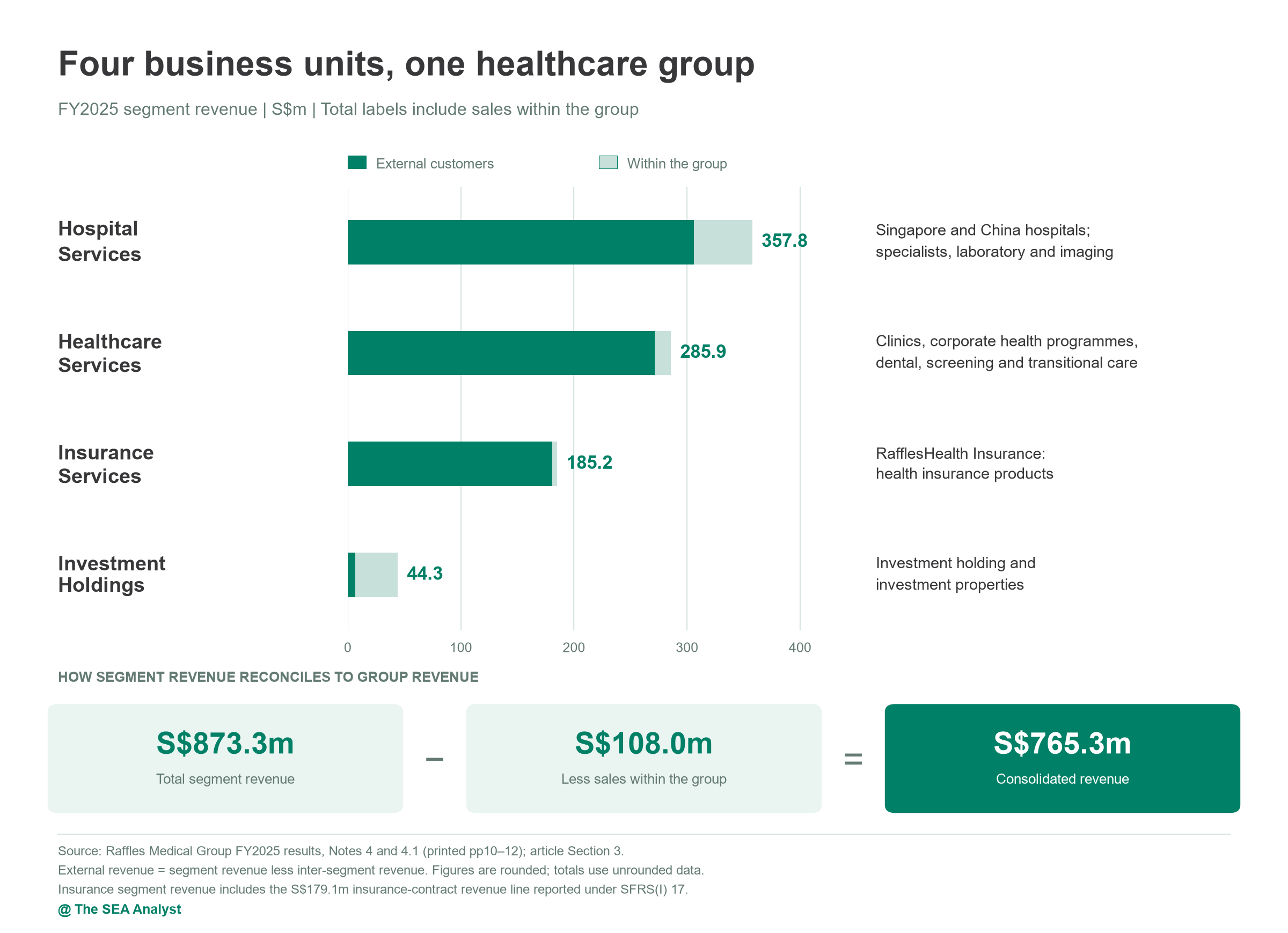
Raffles Medical reports four segments [21]. Before internal sales are removed they total S$873.3 million of revenue, against consolidated revenue of S$765.3 million, so the segment figures below include S$108.0 million of business the segments do with each other.
Hospital Services, at S$357.8 million, is the largest: the flagship Singapore hospital, the specialist centre, laboratory and imaging, and the hospitals in China.
Healthcare Services, at S$285.9 million, is the network: clinics, corporate health programmes, dental, health screening and the transitional-care facilities set up during the pandemic.
Insurance Services is RafflesHealth Insurance, at S$185.2 million.
Investment Holdings, at S$44.3 million, holds the group's investment properties.
The insurer is improving but still loses money. Its revenue grew 4.1% in FY2025 and its pre-tax loss narrowed from S$6.3 million to S$3.1 million, which management puts down to repricing and claims discipline [17][21]. A smaller loss is not yet proof of a profitable insurance book. The insurer also inflates the group's top line: since 2023 the insurance accounting standard, SFRS(I) 17, has grossed up insurance revenue, which is why FY2022 revenue restated on that basis is S$822.9 million against S$766.5 million originally reported [16][20].
In China, the hospitals and the buildings they occupy sit in separate companies.
In Chongqing both are wholly owned [17].
In Shanghai the hospital operator was already wholly owned; the minority was in the property company, Shanghai Qihua Hospital. In October 2025 the group bought that remaining 30% for S$16.6 million [17], so the deal bought out a landlord's minority, not a hospital's. Both cities' operators and property companies are now wholly owned.
Beijing is different. Raffles Hospital Beijing is 80%-owned through International SOS (MC Holdings), which also holds clinics in other Chinese cities and a Vietnam operation, and which had negative net assets of S$33.6 million at end-2025 [17].
Raffles Japanese Clinic, 87.5%-owned, is the group's other material minority interest [17].
The group does not report each hospital's earnings, but its own accounts do say the two flagship hospitals are still losing money. In both 2024 and 2025 it tested Raffles Hospital Shanghai and Raffles Hospital Chongqing for impairment "due to their continued operating losses" [17]. Independent valuations put the hospitals' assets above their book value, so no further write-down was booked. That sits uneasily with management's statement that the China business "contributed positively" to group performance [22]: the assets hold their value, but the hospitals still lose money at the operating level.
Industry
Raffles Medical operates in two very different markets.
In Singapore it is a private integrated provider competing for privately-funded and insured demand alongside the listed majors and a fragmented specialist field.
In China it is a foreign-owned premium hospital operator competing against a vast public system and a growing private tier.
The Singapore market is structurally supported but not frictionless. The population is ageing [1], private healthcare spending tends to rise with age and affluence, and medical-cost inflation generally runs ahead of headline CPI. But demand at Singapore private prices is not automatically unconstrained: management itself has pointed to competition from Kuala Lumpur and Bangkok for regional medical travellers [2], and the state actively manages healthcare cost. From 1 April 2026, newly sold Integrated Shield Plan riders must carry a minimum co-payment cap of S$6,000 (excluding the deductible), with the minimum 5% co-payment retained; the change applies to newly sold riders rather than uniformly to every existing policy [3]. RafflesHealth Insurance has said it will launch a compliant rider.
Three developments qualify the ageing tailwind: more public hospital capacity, insurers holding down private bills, and cheaper regional hospitals competing for medical travellers.
First, public capacity. The Ministry of Health plans about 2,800 more public acute and community hospital beds by 2030, almost all of it subsidised rather than private [10]. That is not a private-market glut, but it matters at the margin. Health Minister Ong Ye Kung has noted that public hospitals typically run above 90% occupancy while private hospitals are “barely half occupied”, and the government plans to tender a site in the east for a lower-cost, not-for-profit private hospital of 300 to 400 beds with caps on bill sizes [9]. Policy favours restraining private bills, not letting demand run to price.
Second, insurers. Under IHH Healthcare’s iXchange arrangements, which Income and Singlife joined in 2023, insurers steer patients toward managed pathways, more day surgery and shorter stays, and IHH reports that bill growth in these programmes has slowed [11][12]. Raffles sits on both sides: it owns an insurer, RafflesHealth Insurance, but its hospitals also treat patients whose insurers impose that bill discipline.
Third, medical tourism, where the direction is clearer than the magnitude. Lower-cost hubs in Malaysia (Penang and the Klang Valley, backed by a dedicated promotion agency) and Thailand (Bangkok) increasingly compete for the price-sensitive cases that once defaulted to Singapore, even as demand for complex treatment continues. The Raffles-specific evidence is management’s own: at the February 2024 results briefing Dr Loo flagged the loss of foreign patients as a challenge for the group; the same report notes that at IHH, Singapore’s largest private operator, foreign patients had fallen to about 15% of its base by end-2023 from 20% in 2019, with the lost volume in health screenings and scopes rather than complex care [13]. Three cautions keep this in proportion: it is a historical observation from early 2024, not evidence of continued deterioration through 2026; a fall in foreign-patient share is not the same as a fall in absolute numbers; and neither figure quantifies an earnings impact, since Raffles does not disclose its medical-travel revenue. IHH’s group chief executive frames the demand as deferred rather than lost and expects Singapore to keep its lead in complex work [14]. Eventual treatment need, however, does not guarantee revenue for the original provider: a patient who chooses a Malaysian hospital in the same group is retained there, not at Raffles.
China is the opposite proposition: enormous latent demand, a public system dominated by crowded tertiary hospitals, and a premium private niche that is hard for foreign operators to make pay: long ramp periods, heavy upfront capital and years of losses, a pattern Raffles’ own China record has followed. Encouragingly, Greater China revenue grew 13.0% in RMB terms in 1H2026 (to CNY184.8 million from CNY163.6 million), a clear acceleration from FY2025’s 2.3%, which management attributes to growing brand recognition. The tension is that revenue growth on a S$304 million asset base is necessary but not sufficient: the two flagship hospitals carried disclosed operating losses in 2025, and the overseas holding chain again drew fresh parent funding, so the question is whether growth converts to cash, not just to higher revenue.
If you’re interested in another perspective on Raffles Medical, I’d recommend this piece by Angsana Anderson. It looks at what bed occupancy at Woodlands Hospital might tell us about demand for Raffles’ transitional care services.

Moat: A Lower-Priced Network That Does Not Travel
Raffles' advantage in Singapore comes from owning each step of a patient's path. A patient can start at a Raffles clinic or through an employer's health plan, be referred to a Raffles specialist or the hospital, and be insured by RafflesHealth Insurance, which has a reason to steer care to Raffles facilities. Its doctors work within the group, under what it calls a group practice model, and the network is large: the group serves over 2.8 million patients a year and more than 7,000 corporate clients through over 100 clinics across its markets [17]. Add a brand built over fifty years and a hospital on long-dated leasehold land in central Singapore that would be hard to replicate [17].
Some of that internal flow shows up in the subsidiaries' accounts.
Raffles Diagnostica, the group's laboratory, earned S$50.3 million of its S$55.0 million FY2025 revenue, about 91%, from other group companies [15].
The hospital operator, Raffles Hospital Pte Ltd, shows the flow in both directions. On the cost side, it paid a related company S$27.7 million for diagnostic services. On the revenue side, S$19.9 million of its S$299.5 million revenue, about 7%, came from medical services to other group companies [6].
At group level, S$108.0 million of segment revenue, about 12%, was between segments, including S$51.8 million in Hospital Services and S$37.5 million in Investment Holdings, which owns the group's properties [17].
What the accounts do not show is the referral flow itself. A patient referred from a Raffles clinic pays the hospital directly, so that traffic is not disclosed. Nor is the share of the insurer's claims paid to Raffles providers: RafflesHealth Insurance writes mainly medical cover for corporate clients and individuals in Singapore, and works through a panel of medical service providers [17].
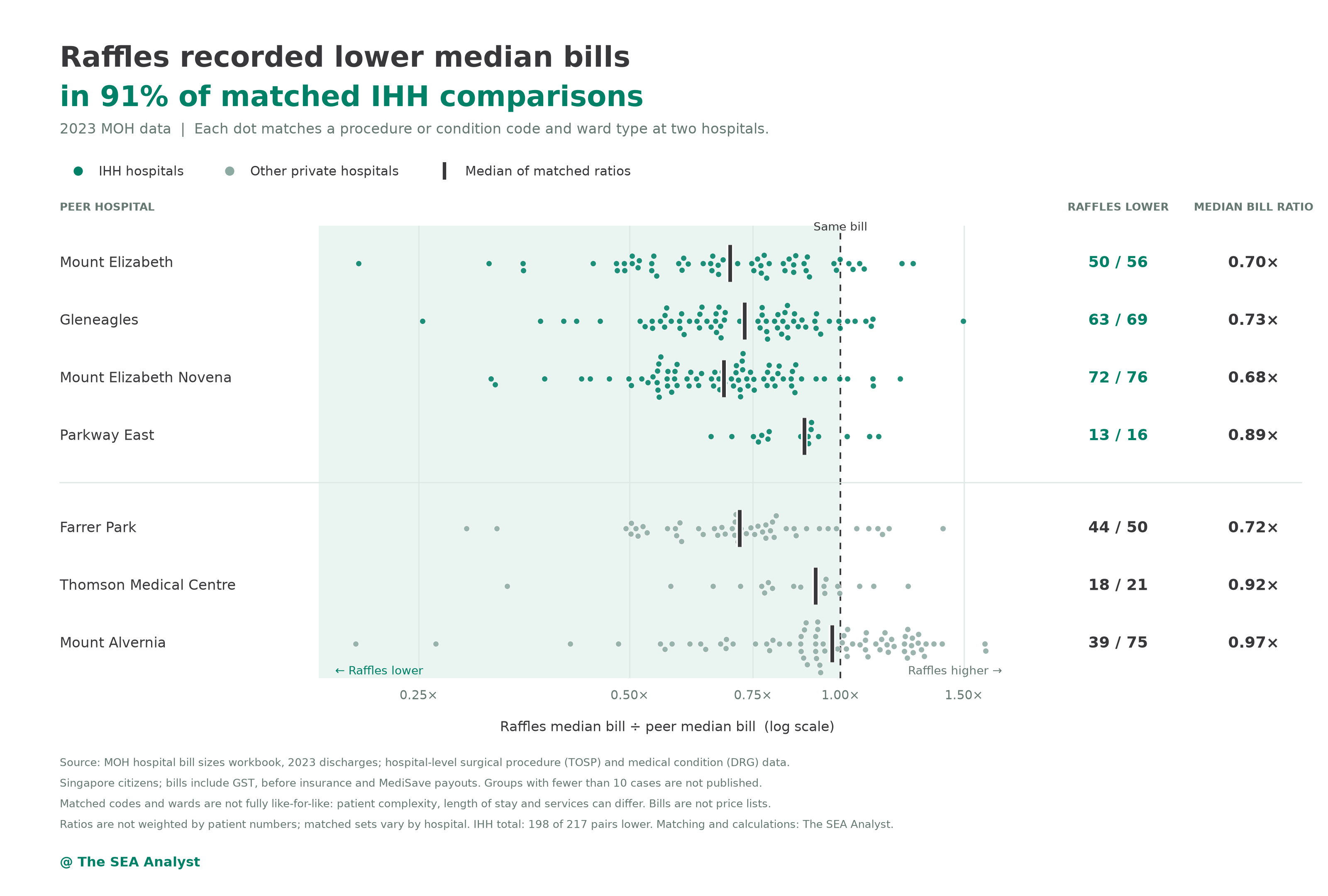
Price is the clearer evidence. The Ministry of Health publishes median bills by hospital for 2023, for Singapore citizens [32]. We matched every procedure and medical condition that Raffles Hospital and another private hospital both bill in the same ward type, and Chart 5 plots each pair. Against IHH's hospitals, almost every dot sits on the cheaper side: Raffles' median bill was lower in 50 of 56 pairs against Mount Elizabeth and 63 of 69 against Gleneagles. In half the pairs, Raffles' bill was at least about 30% below Mount Elizabeth's and 27% below Gleneagles'. Raffles inpatients also stayed 9% to 18% fewer days, which may account for some of the gap. But where stays were within 15% of each other, Raffles was still cheaper in 37 of 42 and 41 of 45 pairs. Outside IHH the picture is mixed: Raffles is well below Farrer Park but roughly level with Mount Alvernia. These are 2023 bills, and they reflect each hospital's mix of patients, so they are not a price list. Raffles does not compete as the premium name. Its bills sit below IHH's flagships, which suits a market where insurers and policy are pushing toward lower-cost care.
Volume is harder to compare. IHH's Singapore inpatient admissions fell 9% in FY2025 while revenue per admission rose, and in Singapore dollars its Singapore revenue rose about 1% [31]. Raffles does not disclose admissions; its hospital operator grew revenue 4.7% [6], and management described patient volumes as steady [17].
Margins cannot settle the comparison, because the two models differ. Raffles’ hospital revenue includes its doctors’ fees, and its costs include their pay: staff costs were 44% of Raffles Hospital Pte Ltd’s revenue [6]. IHH’s hospitals work with contracted doctors [11]. On their own reported bases, IHH Singapore earned an EBITDA margin of 28.0% in FY2025 [31], and Raffles Hospital Pte Ltd an operating margin of 17.4% after about S$22 million of rent paid to its own landlord [6]. A lower price and a different cost structure make a lower margin unsurprising; they do not by themselves show a weaker business.
The challenge is that ownership is not the only way to coordinate care. IHH's iXchange model does it partly by contract, coordinating treatment pathways, fees and intensity across IHH's own hospitals, its contracted doctors and outside insurers [11][12]. That does not erase Raffles' advantage, but it means Raffles has no monopoly on insurer-aligned care. The evidence above points to lower prices and steadier volumes; what it does not yet show is that owning the pieces earns higher returns than contracting.
The advantage does not travel. The Chinese hospitals cannot draw on the Singapore insurer, corporate clients or brand density; they compete in China on their own. Their record so far, heavy assets and growing but loss-making operations, is what an entrant looks like before it has a moat. Brand recognition and local corporate and insurer ties may yet build one, but it has not yet shown up in returns.
Below the paywall: why FY2025's S$6.6 million rise in pre-tax profit was more than explained by a property revaluation and a narrower insurance loss; why the Singapore hospital's underlying result was roughly flat once its landlord is included; how the parent's funding of the China chain rose to S$48.2 million in 2025 from S$29.0 million; and our modelled range for the shares of S$0.53 to S$1.12 at end-2027, with what the S$0.84 price already requires.