

On 13 August 2026, PropNex (SGX:OYY) reported its first-half results for the six months to 30 June 2026 [1]. Net attributable profit was S$40.9 million, down 3.1% from S$42.3 million a year earlier. Revenue was almost unchanged at S$603.0 million, up 0.7%. The board declared an interim dividend of 5.0 cents per share, flat on last year, at a payout ratio of 90.4% [1].
Underneath a nearly flat top line sat the exact rotation we described when we initiated on this name in May [3].

Commission income from agency services (resale, HDB, leasing) rose 6.9% to S$360.5 million, while commission income from project marketing, the new-launch business, fell 7.8% to S$238.4 million against a thinner launch calendar [1]. One engine slowed; the others sped up enough to keep the group level. Market share by transaction volume rose to 64.3% for the half, from 60.6% for the 2025 financial year, and it rose in every single segment PropNex reports [1].
Where the thesis stood
We published our initiation on 20 May 2026, using the 19 May close of S$1.83, then roughly 30% below the October 2025 high.
Our central call was that the market was pattern-matching “new launches down, so PropNex down” without doing the segment arithmetic. Project marketing was only about 39% of revenue; the other 61% was driven by volumes management guided as flat to growing. We flagged a 60/30/10 split between our base, bear and upside cases, called it a positive-expected-value position rather than a high-conviction one, and named the single most dangerous risk explicitly: a fresh government cooling measure aimed at the HDB upgrader chain [3].
The half in numbers
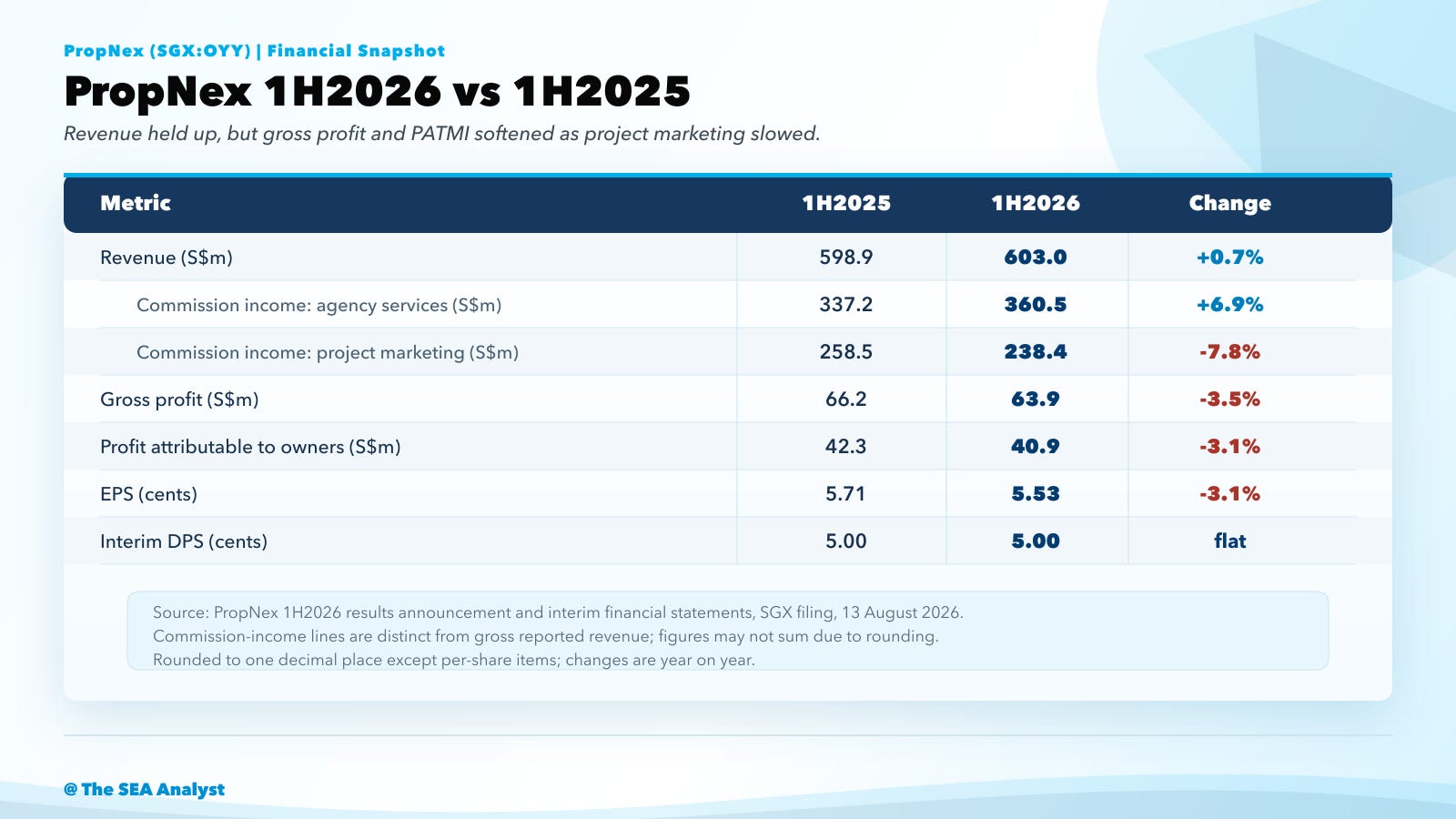
Two lines carry the story.
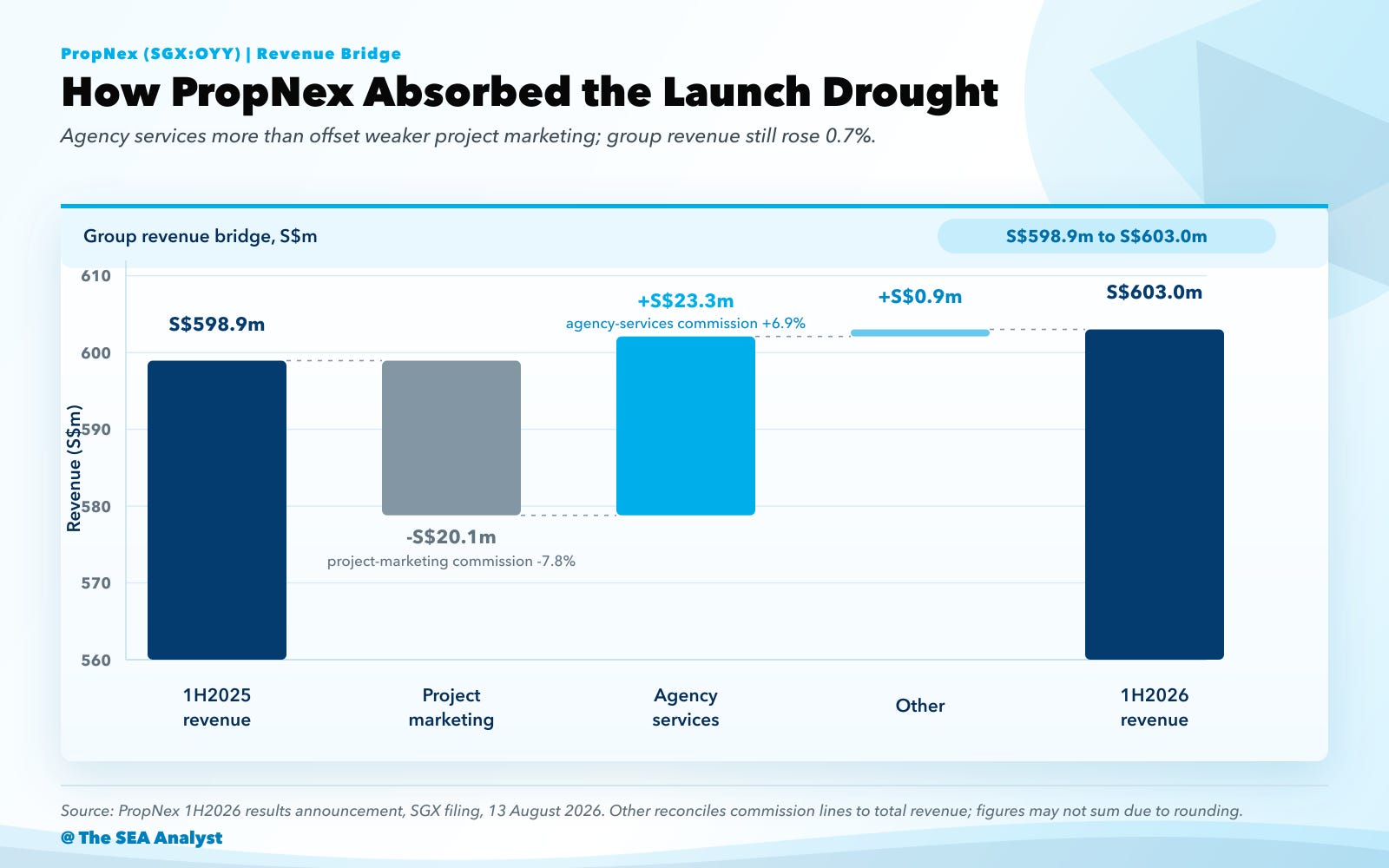
The first is the split within revenue. Project marketing commission fell S$20.1 million year on year; agency commission rose S$23.3 million [1]. The offset was not merely present, it was slightly larger than the drag, which is why revenue edged up rather than down. This is the segment-mix resilience our initiation rested on, showing up in the accounts on schedule.
The second line is gross profit, down 3.5% to S$63.9 million, which fell faster than revenue [1]. Gross margin slipped to 10.6% from 11.0% as the cost of services rose faster than revenue, and segment profit margins compressed [2]. We would not read this as a mix effect: project marketing in fact carries a lower segment profit margin than agency services, so this half’s shift toward agency should, if anything, have helped. It is a modest compression, not a rupture, but it is real and it is the one number in this release that does not flatter the bull case.
On the balance sheet, cash and cash equivalents stood at S$130.2 million at 30 June 2026, down from S$149.1 million at the start of the year, with a further S$31.0 million held in other investments and no bank borrowings [2]. The S$18.9 million cash decline over the half came after a S$33.2 million operating cash inflow, S$33.3 million of dividends to owners and S$1.4 million to minorities, and about S$18.0 million redeployed into long-term deposits and other investments [2]. This is a company returning nearly all of its profit and still sitting on net cash, carrying only about S$3.7 million of lease liabilities and no bank debt.
The salesforce, the asset the whole franchise rests on, grew to 14,574 licensed salespersons as at 3 August 2026, up from 13,945 at the start of the year [1]. PropNex added roughly 630 net agents through a period in which a competitor was publicly recruiting against it.
Below for paid subscribers: our judgment and the valuation - the point-by-point thesis check, the PropNex-vs-ERA scorecard, the policy read, the risk section, and the price.