

All-Link Air & Sea Limited does not have a telephone number. Its own prospectus says so, in the contact-details box, next to an address for a small unit in the Trivex building on Burn Road. For a company asking the Singapore public to buy its shares, that is a striking detail, and it is the right place to start, because it tells you what this business actually is. All-Link is not a fleet, a warehouse network or a terminal operator. It owns almost nothing. It is a freight-forwarding intermediary: it arranges air, sea and some road cargo space on other people’s aircraft, ships and trucks, and it takes a margin in the middle. Asset-light is the polite description. The harder question, the one the rest of this piece tries to answer, is whether there is a durable company here at all, or whether the market is being offered a two-year revenue spike dressed as a growth story.
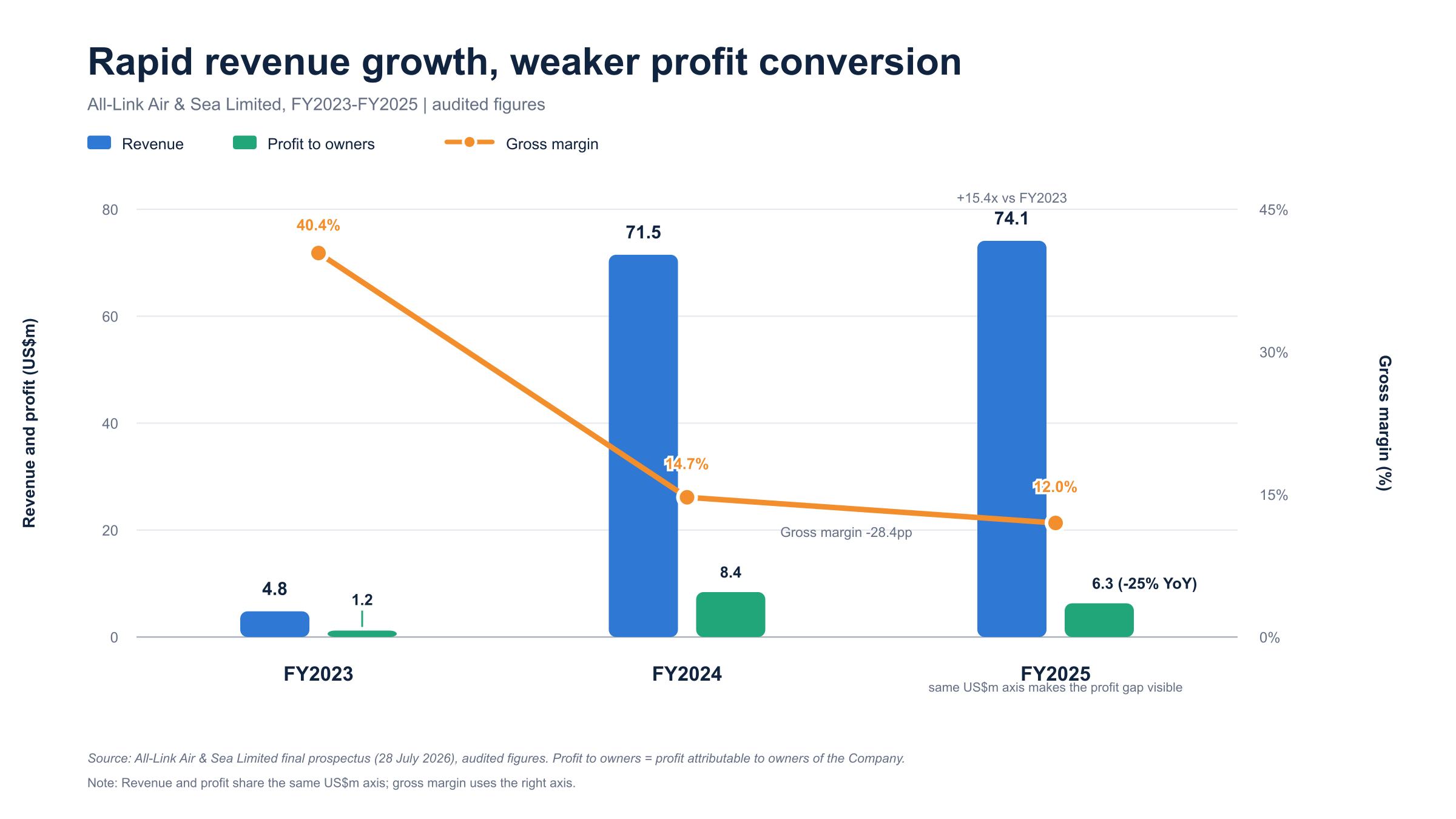
The spike is real, and it’s big too. Revenues increased from $4.8 million during the fiscal year to December 2023, to $71.5 million during FY2024, and $74.1 million during FY2025. This is over fifteen times in two years. Not many publicly listed firms have a chart looking like this. But this type of a chart should rather increase the readers’ caution because such an incredible rate of growth rarely happens due to a lot of clients. Instead, it happened due to only one.
From a Shanghai supply-chain desk to an SGX listing
The company that will trade on the SGX Mainboard was incorporated in Singapore only on 24 December 2021, and became a public company as recently as 19 June 2026. It was set up as a joint venture between AGX Singapore, a subsidiary of the Bursa-listed logistics group AGX Group Berhad, and Mr. Xu Hao, a Chinese logistics entrepreneur. Mr. Xu Hao does not sit on the board. His wife does. Mdm. Tang Ying, formerly a vice-president at a Shanghai supply-chain company, is an Executive Director and, before the offering, the 70% controlling shareholder. AGX Singapore holds the other 30%.
The name came with the relationship. As per the prospectus, the name chosen by the company on incorporation was meant to indicate its origin and commercial relationship with All-Link PRC, a different Chinese-owned freight forwarding firm which Mr. Xu Hao owns through his 64.8% ownership and which the document is very careful to point out does not belong to the group to be listed. There are also at least two other firms trading under related names. Since then, All-Link has established its own customer base using the trade name, its own logo, and even filed an application for trademark registration of the name in Malaysia – the application remains pending – in the name of its Malaysian subsidiary rather than the company that is to be listed. Bear the relationship in mind, because it is the entire thesis. The listed company was incorporated to provide logistical services to the customers of All-Link PRC, moving the cargo of these customers into Southeast Asia and earning its money from doing so.
The operating history is short. Singapore operations began in 2022. A Philippines subsidiary was incorporated in September 2022. In 2024 the group was appointed a logistics provider to the TikTok Group. In 2025 it incorporated a Malaysian arm and, in August, bought the freight-forwarding business of a local operator called MF Logistics, which is the source of the only goodwill on its balance sheet. Headcount went from ten to seventy in about a year, and had reached 112 by the time the final prospectus was registered. This is a company that grew up around a single opportunity, very fast, and is now asking for permanent public capital on the strength of it.
What the offer actually contains
All-Link is selling 37,924,500 new shares at S$0.53 each, split into a 35,824,500-share placement and a small 2,100,000-share public tranche. The public offer opened on 28 July and closes at noon on 3 August, with trading expected to start on the Mainboard at 9.00 a.m. on 5 August 2026. Every share on offer is newly issued, so the money raised goes to the company rather than to the sellers, and the raise is sponsored, underwritten and placed by CGS International Securities Singapore. The prospectus expressly grants no over-allotment option, and discloses no cornerstone investor or tranche, which for a deal this size is worth noting rather than assuming.
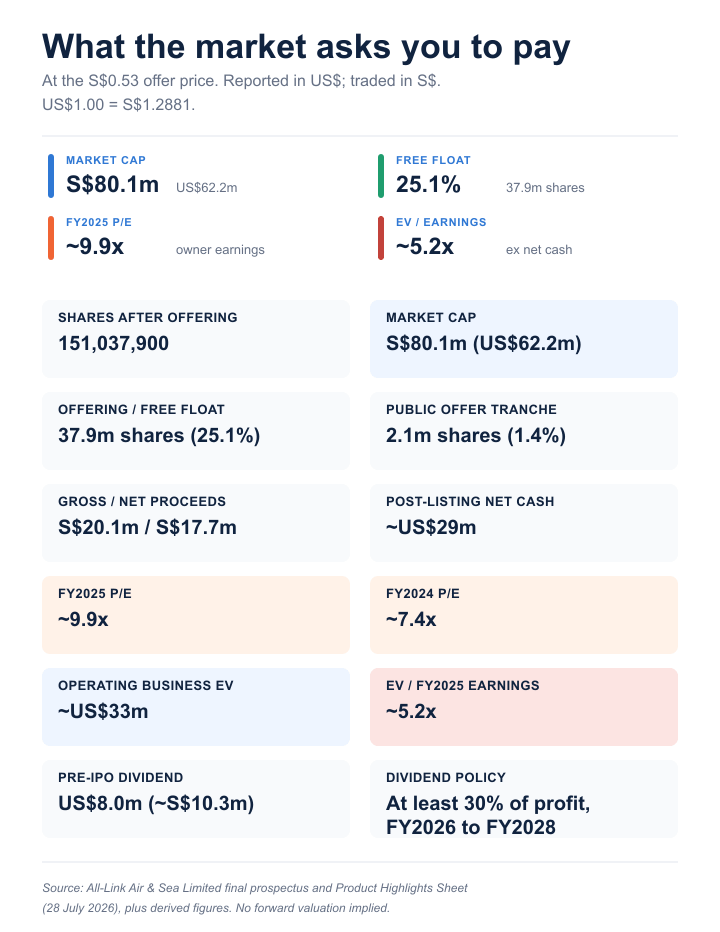
At S$0.53, the 151,037,900 shares in issue after the offering value the whole company at about S$80 million. The offering represents 25.1% of that, so roughly three-quarters of the company stays with the people who already own it: Mdm. Tang Ying with 51.7% and AGX Singapore, and behind it the Bursa-listed AGX Group Berhad, with 23.2%. The public float is 25.1%, but the portion actually offered to retail investors through the public tranche is only 2.1 million shares, about 1.4% of the company. This is a placement-led listing with a thin retail slice, and the controllers keep firm control.
The proceeds, roughly S$17.7 million after expenses, are earmarked for expansion, for “strategic acquisitions” (part of which is intended to buy out Mr. Xu Hao’s 30% stake in a related Vietnamese operation), for technology, and for working capital to pay airlines and carriers. None of it goes to repaying debt, because there is essentially none.
One item in the offer deserves to be read slowly. In March and June 2026, in the months before the listing, the company declared a US$8.0 million dividend in respect of FY2025, split as a US$2.0 million interim and a US$6.0 million final payment. Roughly US$5.6 million of that flows to Mdm. Tang Ying and US$2.4 million to AGX Singapore. That US$8.0 million is about S$10.3 million, or close to 13% of the entire post-listing market value, paid out to the controllers on the way in. On a pro forma basis it cuts the group's cash from US$23.6 million to US$15.6 million and its net assets from US$16.2 million to US$8.2 million. New shareholders do not share in it. They are buying the company the morning after the payout, then supplying fresh capital of their own on top.
The revenue that is not quite the company’s own
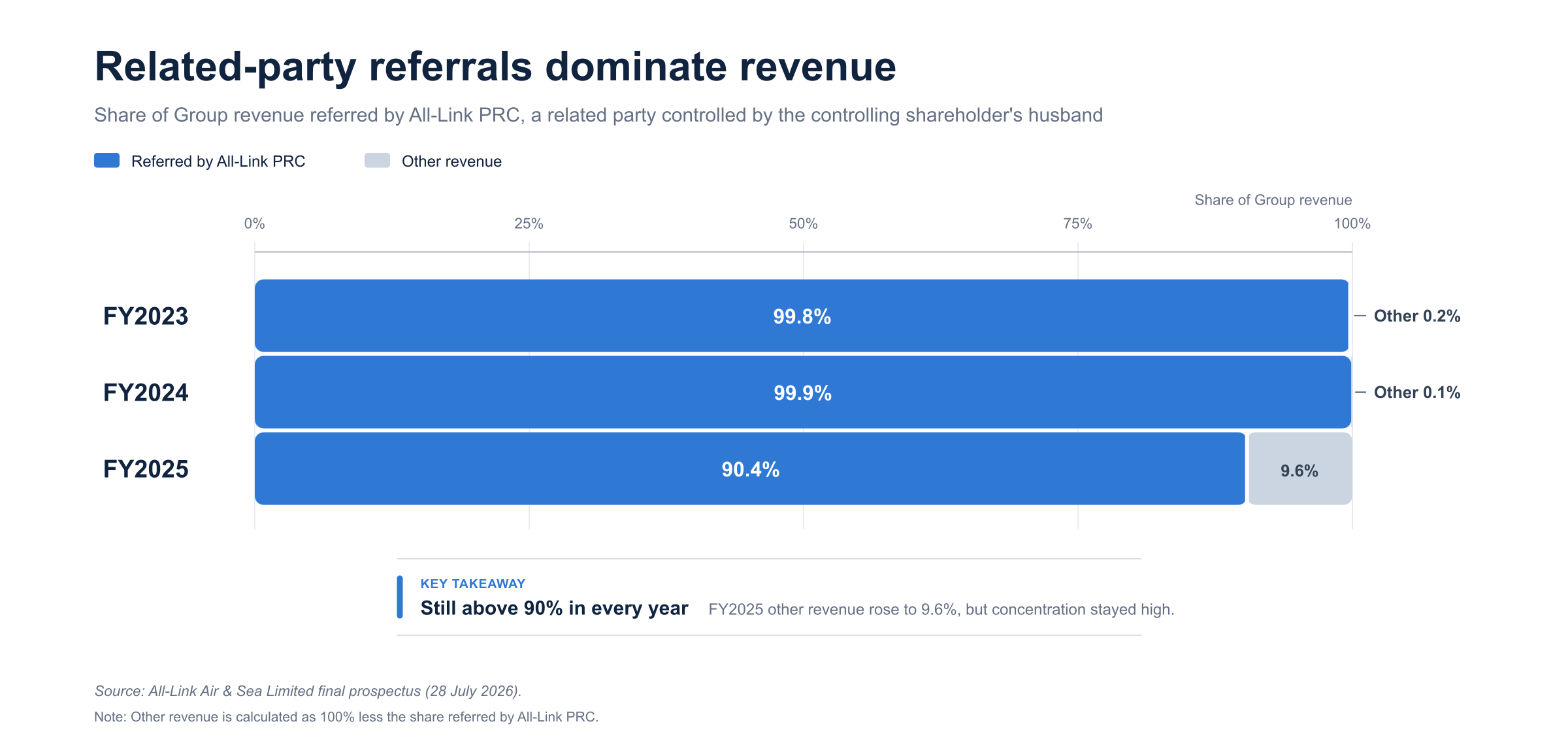
The single most important disclosure in the prospectus is not a number in the accounts. It is the sentence that says roughly 90% to 99.9% of the group’s revenue over the three years came from customers referred by All-Link PRC. In FY2023 and FY2024 the figure was above 99%. In FY2025 it was 90.4%.
This is important since All-Link PRC is not the customer that has an agreement and a purchase order. This is the family-run Chinese firm that provides the listed firm with the orders. The agreement between the two is now under the Non-Compete and Collaboration Deed of 30 June 2026 where All-Link PRC promises to give priority to the group when shipping to ASEAN countries. However, the risk factors of the group itself are rather blunt about the fragile nature of this protection. The deed is terminable and it automatically terminates if the firm is delisted or if Mrs. Tang Ying and Mr. Xu Hao lose control of the firm. Beyond this, as stated in the prospectus, All-Link PRC may reduce, redirect or stop the referrals “without liability to our Group”. In other words, the source of almost all the revenues lies with a firm that is run by the controlling shareholder’s husband, and continues to function due to the family retaining control and not due to any commercial obligation.
The dependency runs the other way too. To service that referred business, the group buys freight-forwarding and related services back from All-Link PRC, about US$20.5 million worth in FY2025, a sum equal to roughly 139% of the group’s latest net tangible assets, for origin-side handling in China where the listed company has no operating presence. So the referrer is also a major supplier, accounting for 31.5% of last year’s cost of sales. Money flows to the family entity on both sides of the trade.
The cost side concentrates too, and around the same name. The group’s largest supplier, at 40.5% of last year’s cost of sales and 79.7% the year before, is a company called All-Link Air and Sea Company Limited, which the prospectus says is not part of the group and is managed independently. The document does not define it, does not say what country it is registered in, and does not name its owners, though it does state that no director or substantial shareholder holds an interest in any major supplier apart from Mr. Xu Hao’s stake in All-Link PRC. Between them, two separately managed businesses carrying the All-Link name supplied 72% of last year’s costs.
Who this company answers to
Ownership answers part of the question the offer poses. After listing, Mdm. Tang Ying holds 51.7% and AGX Singapore 23.2%, so roughly three-quarters of the company stays with the insiders, and the 25.1% float, most of it placed rather than offered to the public, carries little voting weight. A minority buying in here is a genuine minority.
The more unusual feature is who sits behind AGX Singapore. It is wholly owned by AGX Group Berhad, which is itself a listed company, on the ACE Market of Bursa Malaysia. The prospectus is explicit about what that parent does:
“AGX Group Berhad is a company listed on the ACE Market of Bursa Malaysia and is principally in the business of providing sea and air freight forwarding, aerospace logistics, warehousing, road transport and distribution services globally. Save for aerospace logistics, the AGX Group operates in substantially similar business segments as our Group in overlapping geographical markets, including Singapore, Malaysia and the Philippines.”
In plain terms, one of All-Link’s controlling shareholders is also a listed competitor. That is the company’s own disclosure, not our characterisation. The alignment of the people running it points the same way. Mr. Peter Neo, the chief executive, owns no All-Link shares at all; his 18.90% economic stake is in AGX, the competitor he co-founded and whose board he left only on 1 January 2026. Mr. Chang Poh Sheng sits on All-Link’s board while serving as chief financial officer of AGX and holding 2.36% of it. The hands on the wheel still have meaningful ties next door.
That overlap is managed by agreement rather than by competition. On 30 June 2026 the two companies undertook not to solicit each other’s ten largest customers, and the All-Link names covered by that pact accounted for 100%, 100% and 94.7% of the group’s revenue across FY2023 to FY2025. Almost the entire customer book, in other words, is fenced off from the parent by a private undertaking, and like the referral deed it lasts only while AGX stays in control and the company stays listed. Half of the six-person board is independent, which is the regulatory minimum rather than a comfort, and the controlling shareholders’ lock-ups run just six months. What a buyer is being offered is a quarter of a company controlled by a listed rival, fed by a private family entity, with its customers allocated by contract rather than won in the open market.
The financial scoreboard
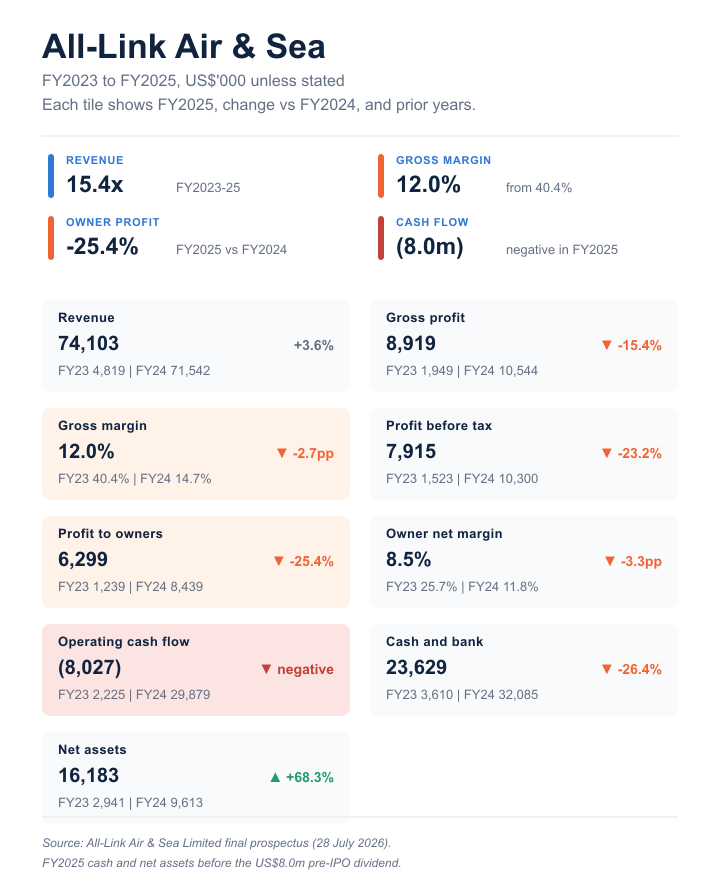
Look past the revenue line and the picture is not one of a business getting stronger. Gross margin fell from 40.4% in FY2023, when the company was tiny, to 14.7% in FY2024 and 12.0% in FY2025. Profit attributable to owners, the figure that matters to a shareholder, fell 25% in FY2025 even as revenue edged higher, from US$8.4 million to US$6.3 million. Administrative expenses nearly tripled to US$1.8 million as the company built out and prepared to list. And roughly US$0.8 million of the US$7.9 million pre-tax profit was simply interest earned on the cash pile, much of which is now being paid out as the pre-IPO dividend.
Cash flow tells the sharpest version of the story. Operating cash flow was positive US$29.9 million in FY2024, then turned to negative US$8.0 million in FY2025, as a large swing in trade payables unwound. For a business with almost no fixed assets, working capital is the whole game, and in its most recent year the working-capital tide went out.
The loophole that closed
To understand why the economics turned, you have to understand what the TikTok cargo was. It was low-value e-commerce parcels moving by air from China to the United States, the same flow that powered the rise of Shein, Temu and TikTok Shop. That flow existed on the scale it did because of the United States de minimis exemption, which let goods worth under US$800 enter the country free of duties and taxes. Cheap parcels, cheap entry, enormous volume.
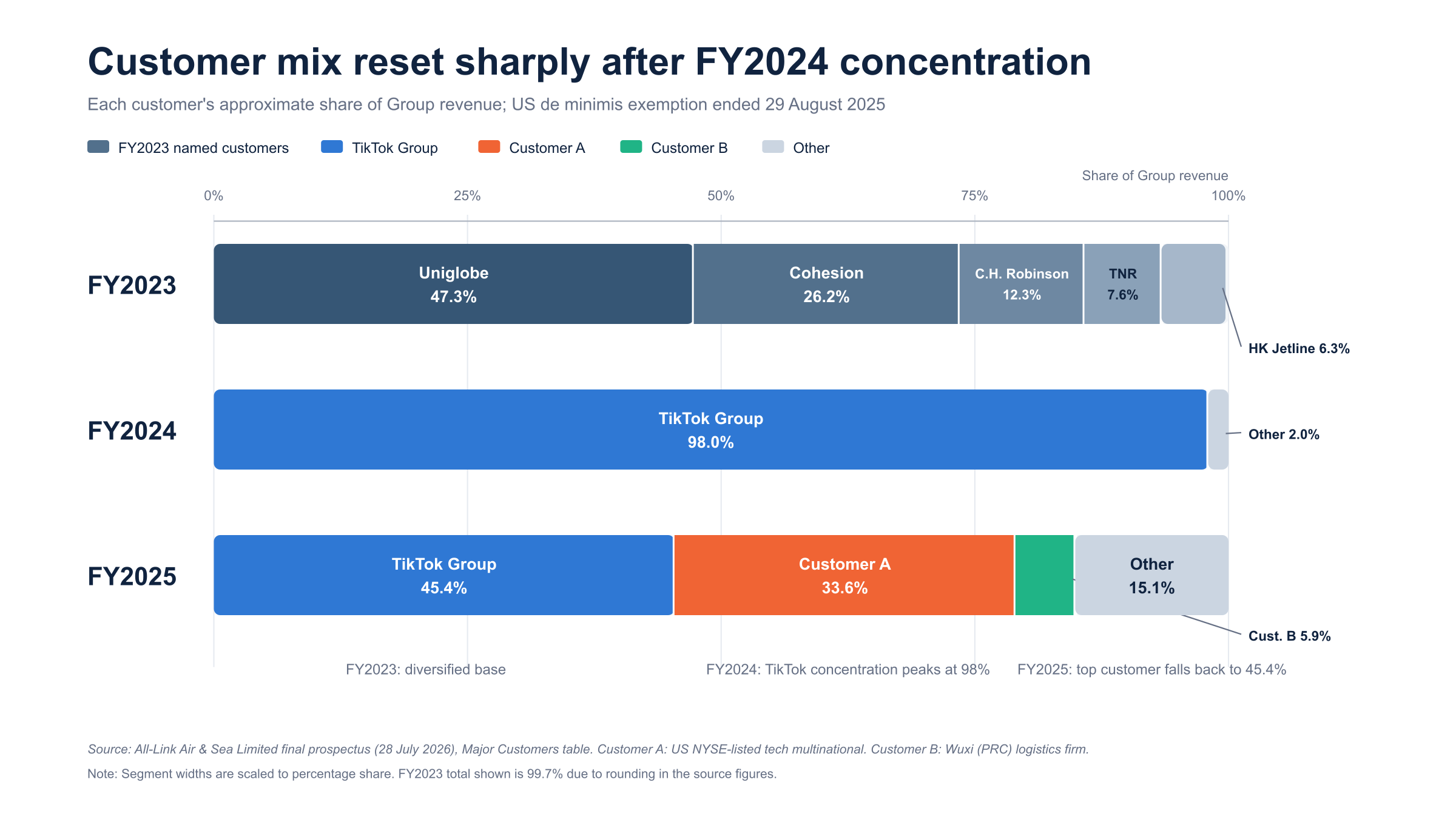
On 29 August 2025, the United States removed the exemption. Every shipment now attracts duty regardless of value, which raises the landed cost of exactly the parcels All-Link was flying. The prospectus does not hide the consequence. It states that the removal “materially and adversely impacted” the group’s performance through a decline in volumes for the TikTok Group. The number tells the story: TikTok went from about 98% of revenue in FY2024 to about 45% in FY2025. The company is listing into the aftermath of the event that made it.
The pivot the story now depends on
Management is not blind to any of this, and the FY2025 numbers already show the beginning of a pivot. A new customer, described only as a US-listed multinational technology company with over US$2 billion of annual profit, arrived and contributed 33.6% of FY2025 revenue. The Malaysian and Philippine arms, which were rounding errors a year earlier, together reached about 9.6% of revenue. The stated plan is to push into Vietnam and Thailand, buy the Vietnamese affiliate, and diversify away from both TikTok and, over time, the All-Link PRC referral channel.
It is the obvious strategy. Whether it is a moat is a different question, and honesty requires stating where the strategy is weaker. Swapping a 98% dependence on one customer for a 34% dependence on another is real progress, but it is still concentration. The Malaysian growth was bought, not built, which is a faster route but a more expensive and less certain one. And the deepest dependency, the referral relationship with a family-controlled entity, is not something the diversification plan removes so much as leans on, since the new customers are still being won inside a network the family assembled. A forwarder’s genuine edge is density and relationships in specific trade lanes, and All-Link does have a credible one, handling an estimated 12% of Vietnam-origin air cargo to the United States in 2025. The trouble is that its largest lane by far was the China-to-US e-commerce lane, and that lane is precisely the one policy has turned against.
The cross-border parcel question
Every sector has a cautionary tale, and All-Link’s is not a single failed company but a whole category. The China-to-US low-value parcel boom created a generation of logistics and e-commerce businesses whose unit economics quietly assumed the de minimis exemption would last. When the exemption went, the volume went with it, and the businesses built on top of it discovered that a regulatory subsidy is not the same as a competitive advantage. All-Link’s own industry report, prepared by Frost & Sullivan, acknowledges the shift, noting a sharp contraction in low-value direct-to-consumer parcels, partly offset by a move toward consolidated bulk freight.
What is genuinely different in All-Link’s favour is that it is small, nimble, profitable and debt-free, and that it saw the shift early enough to start diversifying before listing rather than after. What is not different is the structural lesson: a business whose scale came from a policy window should be valued as if that window can close, because in this case it already has. The honest verdict is that the pivot is plausible and underway, but unproven, and the burden of proof sits with the next two years of results, not with the FY2024 revenue peak.
What the market is asking you to pay
Now that the price is fixed, the question stops being abstract. At S$0.53, All-Link is valued at about S$80 million. Against FY2025 profit attributable to owners of US$6.3 million, roughly S$8.1 million at the prospectus reference rate, that is a trailing price-to-earnings multiple of about 9.9 times. The post-offering earnings-per-share the company itself discloses, US 4.17 cents, lands on the same 9.9 times, so the figure is internally consistent. Measured instead against the FY2024 peak, when owner profit was US$8.4 million, the multiple is about 7.4 times. In other words, the market is paying roughly ten times the earnings of a year in which those earnings had already fallen a quarter.
There is a second lens that matters for an asset-light, cash-rich company, and it cuts the other way. After the pre-IPO dividend and the fresh money raised, All-Link should sit on something like US$29 million of net cash and near-zero debt, against a market value of about US$62 million. Strip the cash out and the operating business is being valued at roughly US$33 million, or a little over five times its FY2025 owner earnings. That is a much less demanding number, and it is the honest way to see what you are paying for the franchise itself rather than for the bank balance that comes attached. The tension between those two figures, ten times on the headline and about five times net of cash, is the whole valuation debate in miniature: the cash is real and large, but it is the earnings power, not the cash, whose durability is in question.
On dividends, there is little for a new buyer to price yet. The US$8.0 million already declared went to the existing owners before listing, so new shareholders do not receive it. Going forward the board has stated an intention, though not a binding policy, to pay out at least 30% of profit attributable to shareholders for FY2026 through FY2028. Applied to last year’s profit, that would have come to roughly 1.6 Singapore cents a share, or about 3% at the offer price. Whether it comes to that again depends on a profit line that fell 25% in the year just reported, and on cash reaching the listed holding company itself, since dividends must be paid out of its own distributable profits rather than the group’s.
How that compares with the neighbours
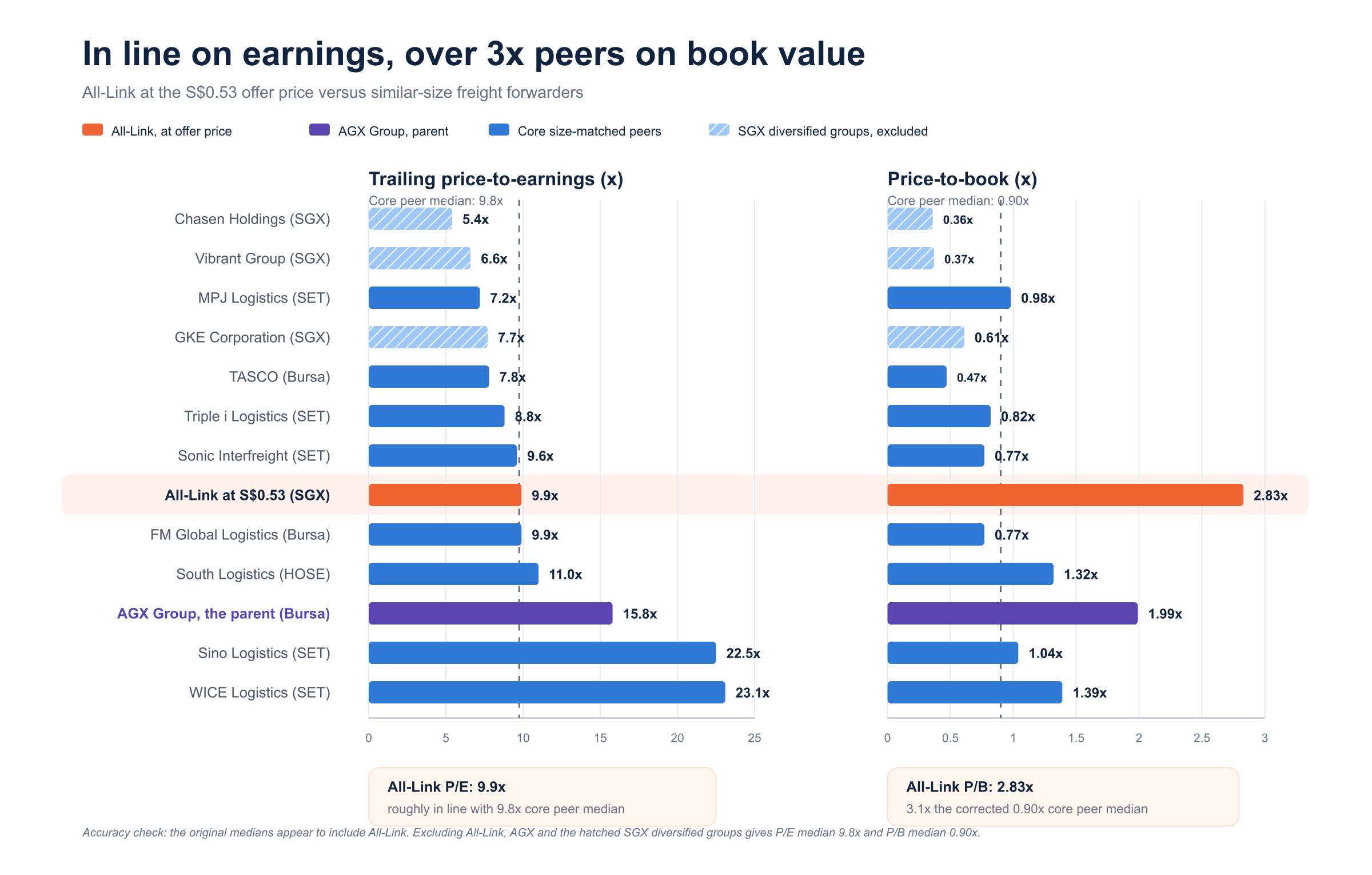
A multiple means little without a comparison of similar size, since small companies trade at structurally lower multiples than large ones. Nine freight forwarders listed in Malaysia, Thailand and Vietnam sit within a third to four times All-Link’s S$80 million. Their median trailing multiple is 9.9 times. All-Link is being offered at 9.9 times. Against the companies it most resembles, it is priced almost exactly in line.
One name in that set breaks the pattern, and it is the one that matters most. AGX Group Berhad, All-Link’s own controlling shareholder, running substantially the same business in the same markets, trades at about 15.8 times. The subsidiary is being sold to the public roughly 40% cheaper than the parent that controls it. That gap is not the sector’s verdict, because the sector median is 9.9 times. It is a verdict on this company in particular.
Singapore itself offers little to measure against. The exchange has no listed pure freight forwarder, and the three groups that do carry forwarding businesses, Vibrant Group, GKE Corporation and Chasen Holdings, trade on 5.4 to 7.7 times earnings. But each owns its warehouses and plant, so what they price is asset-heavy logistics rather than forwarding.
On assets there is no such ambiguity. Price-to-book measures what a buyer pays against the accounting value of what a company owns, and All-Link is the most expensive name in the comparison by a wide margin: about 2.8 times book, after the pre-IPO dividend and the new proceeds, against a forwarder median just under 1.0. No other company in the set, the parent included at 2.0, reaches two times.
The two readings meet in the middle. An asset-light forwarder owns almost nothing, so its book is thin and its return on that book looks extraordinary for as long as the work keeps arriving: about 29% on post-listing equity in FY2025, against a peer median near 8%. That ought to command a premium to book, and it does. What it is not getting is any premium on earnings, which is the market’s way of saying it doubts the 29% survives. If the return holds, three times book will look cheap. If it drifts back toward the sector’s 8%, the buyer holds the premium with no earnings discount to cushion it.
The bull, the bear, and the honest answer
The bull thesis is simple.
It is an asset-light, profitable, and cash flow generative company that started from scratch and generated US$74 million of revenue in two years, has no debt, has management with extensive local logistics experience, is already diversifying its customer base and geographically, and is going public with new money to fuel an ASEAN expansion into some of the fastest-growing airfreight markets in the world.
It is trading at five times net of cash last year’s profits, which is not an ambitious valuation for a logistics company with growth potential. If the strategy succeeds, the small surprise may just be a growing pain.
The bear case is equally clear, and sits mostly in the ownership and dependency structure rather than the trading.
The revenue engine is a related party the minority cannot control.
The single biggest customer’s volumes have already halved on a policy change with no obvious reversal.
Profitability is falling, not rising. Margins are thin and getting thinner.
The controllers extracted US$8 million in dividends immediately before listing, kept three-quarters of the company, and floated only a sliver to the public, and
the whole edifice of referrals rests on the family remaining in control, which is exactly what an eventual sell-down would erode.
On the one measure where the peer comparison is unambiguous, the shares are being floated at roughly three times what comparable forwarders fetch for their book value, with no discount on earnings to offset it.
The honest answer is that both cases are true at once, and that the deciding question is not really about logistics. It is about whether you believe a business assembled around one family’s China relationships and one customer’s tariff-advantaged parcels can become a diversified, self-standing ASEAN forwarder now that the advantage is gone. The prospectus gives you the evidence for the attempt and, at last, the price of the ticket. What it cannot give you is the result. At close to ten times a falling earnings line, the market is asking investors to pay for a transition that has only just begun.
Data integrity notes
Items materially relevant to readers, including estimates, definitions and known limitations.
All company figures come from the offer documents. Financial data is drawn from the prospectus dated 28 July 2026 and the accompanying Product Highlights Sheet, covering audited results for the financial years ended 31 December 2023, 2024 and 2025 [1][2].
Currency conversions use the prospectus rate. The group reports in United States dollars while the offer is priced in Singapore dollars. Conversions use the prospectus reference rate of US$1.00 to S$1.2881 as at the Latest Practicable Date [1].
The valuation measures are our own calculations. Market capitalisation, the trailing price-to-earnings and price-to-book multiples, the post-listing net cash estimate and the illustrative dividend are calculated from disclosed figures at the S$0.53 offer price and the 151,037,900 shares in issue after the offering. Book value is struck after the pre-IPO dividend and the net proceeds [1][2].
Two concentration measures should not be read as one. The Major Customers table gives the combined share of customers that each contributed 5% or more of revenue, at 99.7%, 98.0% and 84.9% for FY2023 to FY2025. The risk factors give top-five customer concentration, at 99.7%, 99.8% and 89.9%. The series diverge because the fourth and fifth largest customers each fell below the 5% threshold in the later years [1].
Peer multiples are indicative. They rest on traded prices as at 10 July 2026 and will have moved, while All-Link’s rest on an offer price and audited figures. The comparison is limited to freight forwarders worth between a third and four times All-Link, since multiples are size-sensitive, and excludes loss-making and distorted-earnings names. Widening the size band would raise the earnings median from 9.9 to 11.0 times; the narrower and less flattering figure is the one used [4].
The three Singapore names are context, not comparables. Vibrant Group, GKE Corporation and Chasen Holdings each run freight forwarding alongside property, materials or relocation businesses and own their asset base, so they sit outside the medians [4].
The industry figures are from the commissioned report. Air-cargo corridor shares and market commentary come from the Frost & Sullivan report reproduced in the prospectus, not from independent verification [3].
No third-party research was used. No sell-side or analyst research was an input. The article draws no forward earnings estimate, valuation target or recommendation.
References
[1] All-Link Air & Sea Limited, “Prospectus dated 28 July 2026,” lodged with and registered by the Monetary Authority of Singapore (audited FY2023-FY2025 financial statements, offer terms, capitalisation, use of proceeds, major customers and major suppliers, interested person transactions, moratorium undertakings, dividends, risk factors). Primary source for all company figures.
[2] All-Link Air & Sea Limited, “Appendix 4 Product Highlights Sheet dated 28 July 2026.” Both documents are available via the SGX-ST website and the MAS OPERA portal.
[3] Frost & Sullivan (Singapore) Pte Ltd, “Independent Industry Report,” reproduced as Appendix G in the All-Link Air & Sea Limited prospectus (ASEAN air-cargo growth rates, corridor tonnage and market share, cross-border e-commerce commentary).
[4] Peer valuation data for listed ASEAN freight forwarders, from exchange filings and market data as at 10 July 2026. Median set: MPJ Logistics (SET MPJ), TASCO (Bursa 5140), Triple i Logistics (SET III), Sonic Interfreight (SET SONIC), FM Global Logistics (Bursa 7210), South Logistics (HOSE STG), AGX Group (Bursa 0299), Sino Logistics (SET SINO), WICE Logistics (SET WICE). Core forwarders outside the size band: Tri-Mode System (Bursa 0199), Transimex (HOSE TMS). Singapore-listed logistics groups shown for local context: Vibrant Group (SGX BIP), GKE Corporation (SGX 595), Chasen Holdings (SGX 5NV).
[5] United States executive action removing the de minimis exemption for imports valued under US$800, effective 29 August 2025, as described in the All-Link prospectus risk factors and industry report.
Important Disclaimers
This article is published for informational and educational purposes only. It does not constitute financial advice, a recommendation, or a solicitation to buy, sell or hold any securities. The author is not a licensed financial adviser under the Financial Advisers Act 2001 of Singapore and this content is exempt under Regulation 34 of the Financial Advisers Regulations as a generally available publication. Consult a licensed adviser before investing. Past performance is not indicative of future results. The author holds no position in the securities discussed.
Good article! Probably more hidden red flags…. time will tell!