

Haw Par Corporation (SGX: H02) reported its condensed interim results for the half year ended 30 June 2026 on 14 August 2026. Group net profit fell 25.2% to S$107.9 million, on revenue of S$115.9 million (down 8.2% year-on-year). The board declared a first interim dividend of 20 cents per share, tax-exempt, payable on 11 September 2026, matching the prior year’s interim. [1] [3]
The profit decline came mostly from lower dividend income from strategic investments, down 27.7% to S$75.2 million from S$104.1 million in H1 2025, with a smaller drag from lower interest income. The dividend cause sits one level up the ownership chain, and it is more a special-dividend story than an ordinary-payout cut.
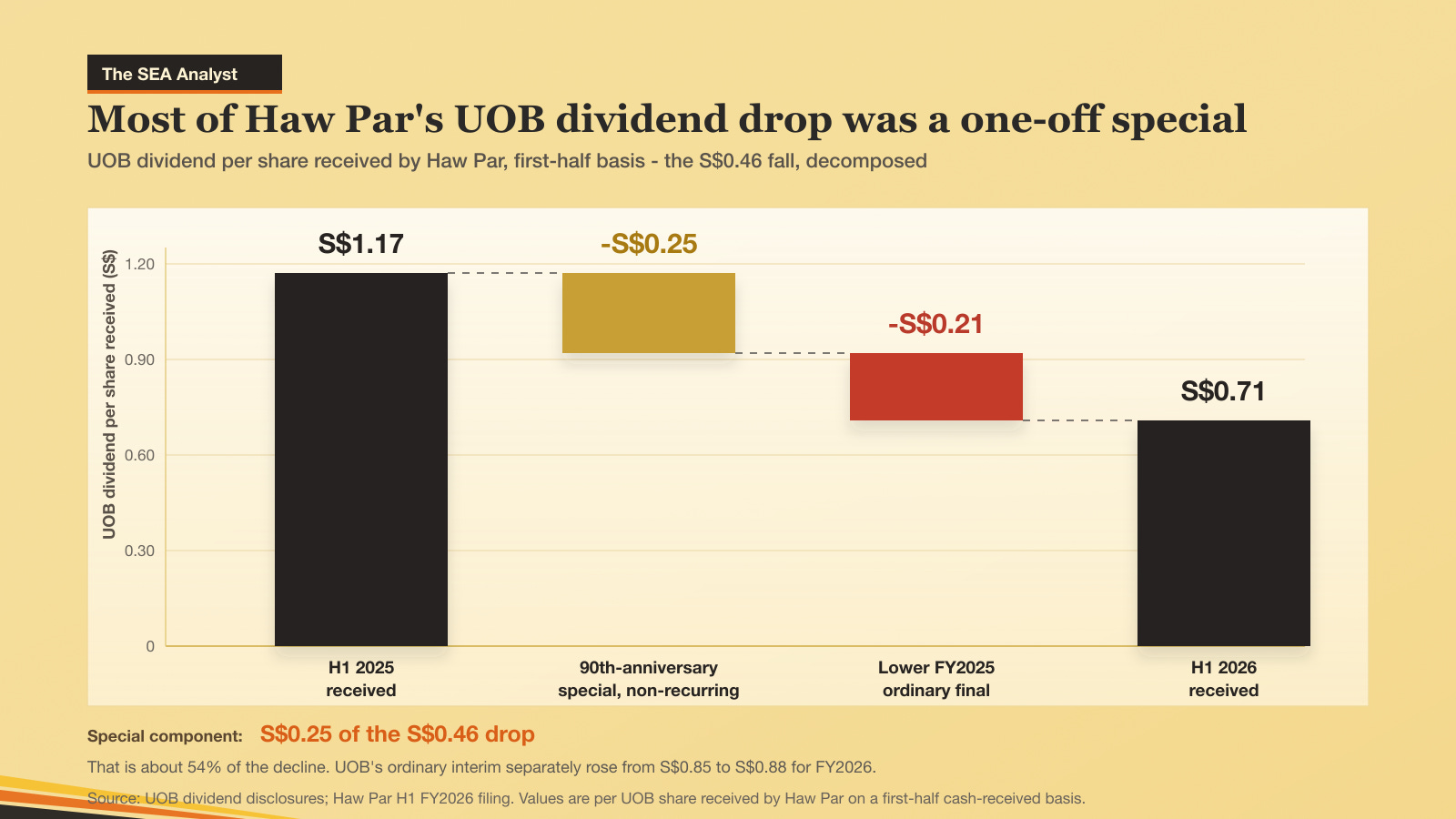
The UOB dividend Haw Par banked in the first half fell to S$0.71 per share (UOB’s FY2025 final) from S$1.17 in the year-ago period. That S$1.17 was not an ordinary payout: it comprised UOB’s FY2024 final of S$0.92 plus a S$0.25 tranche of UOB’s 90th-anniversary special dividend. [2] Stripped of the one-off, UOB’s ordinary final eased only from S$0.92 to S$0.71, and the rest of the year-on-year drop was simply the non-recurrence of the special.
With Haw Par holding roughly 74.8 million UOB shares, that S$0.46 per-share reduction cut UOB dividend income by about S$34 million, most of the S$36 million fall in net profit. Group dividend income fell a smaller S$28.8 million, as higher dividends from UOL and other holdings offset part of the UOB drop.
Healthcare segment revenue retreated 9.0% to S$106.3 million (from S$116.8 million), which management attributed to softer consumer sentiment affected by inflationary pressures from higher energy prices, ongoing trade policy uncertainties, and a higher comparative base from advanced orders in the first half of 2025. [1]
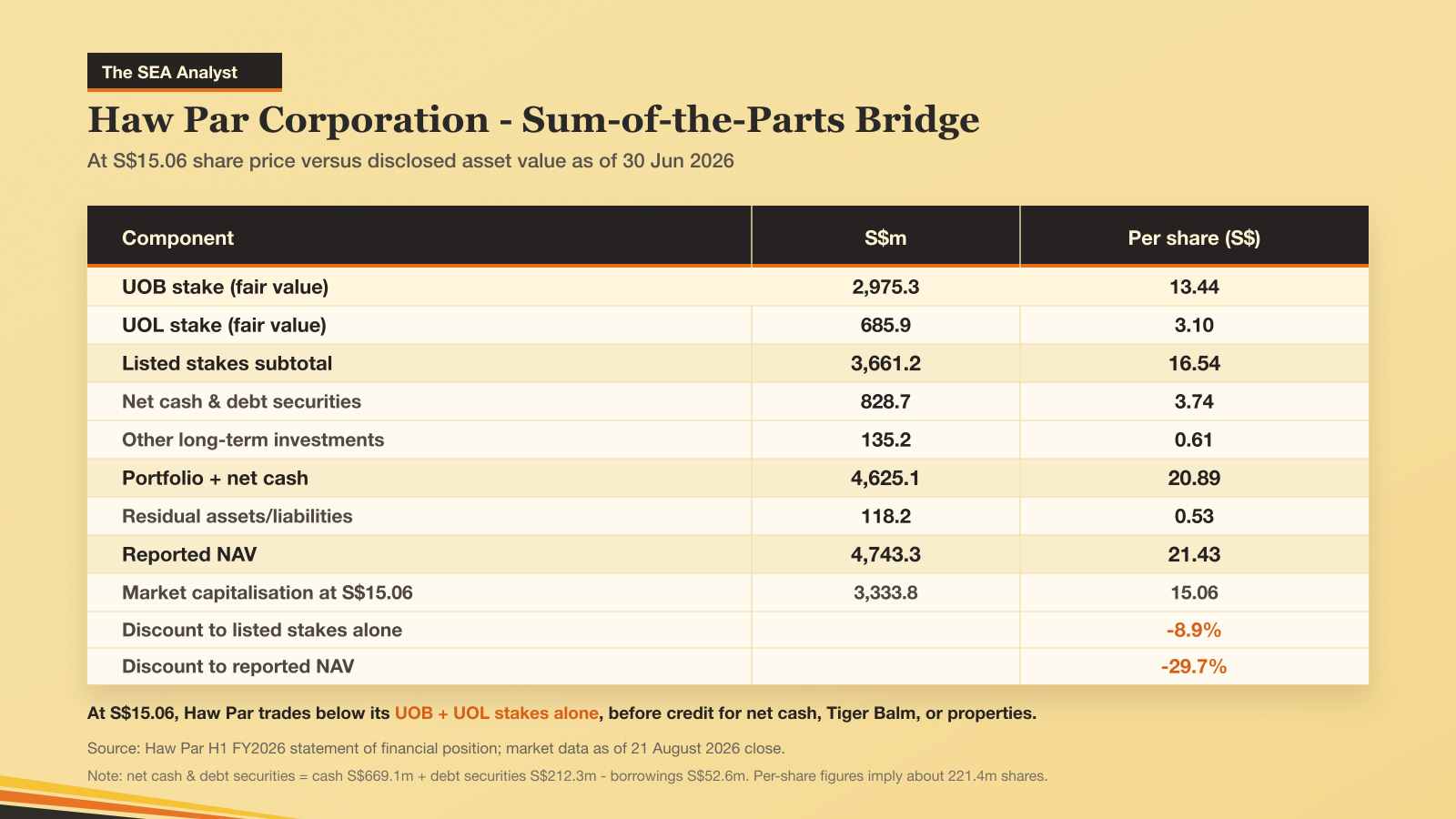
Here is the part worth pausing on, and the thread this update pulls: at S$15.06, the market values the entire company below the quoted worth of its UOB and UOL shares alone, before any credit for its cash, Tiger Balm, or its properties.
Healthcare segment revenue retreated 9.0% to S$106.3 million (from S$116.8 million), which management attributed to softer consumer sentiment affected by inflationary pressures from higher energy prices, ongoing trade policy uncertainties, and a higher comparative base from advanced orders in the first half of 2025. [1]
Here is the part worth pausing on, and the thread this update pulls: at S$15.06, the market values the entire company below the quoted worth of its UOB and UOL shares alone, before any credit for its cash, Tiger Balm, or its properties.
Prior Thesis Recap
Our initiation piece, published 4 April 2026, framed Haw Par as a company whose real value had nothing to do with muscle rubs. [4]
The central observation was structural: Tiger Balm is the brand people know, but the S$3.4 billion investment portfolio (primarily 74.8 million UOB shares and 72 million UOL shares) was the dominant value driver, contributing three times the healthcare business’s profit through dividend income alone.
The thesis rested on three legs:
the healthcare business as a cash-generative consumer franchise with pricing power,
the investment portfolio as a growing dividend machine anchored by UOB’s rising payouts, and
a persistent discount to net asset value that the FY2024 special dividend (S$1.00 per share, paid alongside FY2024’s 20-cent final in H1 2025, bringing that year’s total payout to S$1.40) suggested management was beginning to address.
The implicit flip trigger on the income side was a reversal in UOB’s dividend trajectory. The prior article noted that net profit had compounded at ~8.7% annually, “driven almost entirely by rising dividend payouts from UOB.”
Where the initiation's calls stand. The dividend picture to anchor on: the S$1.00 special was declared with FY2024's results and paid in H1 2025 alongside the FY2024 20-cent final (Note 8); the regular annual payout is 40 cents (20c interim + 20c final).
Against that baseline, the initiation's calls have played out unevenly.
The NAV-accretion thesis was correct: the portfolio and NAV both rose double digits.
The income thesis, that profit would keep compounding on UOB's rising payouts, was wrong, or at best too early, since UOB's payout reset lower within a single period and drove a 25% profit decline.
And the downside scenario we explicitly named, a 40-cent payout with the yield near ~2.4%, is now the live case, with H02 yielding roughly 2.7% on 40 cents at S$15.06.
Financial Snapshot Update
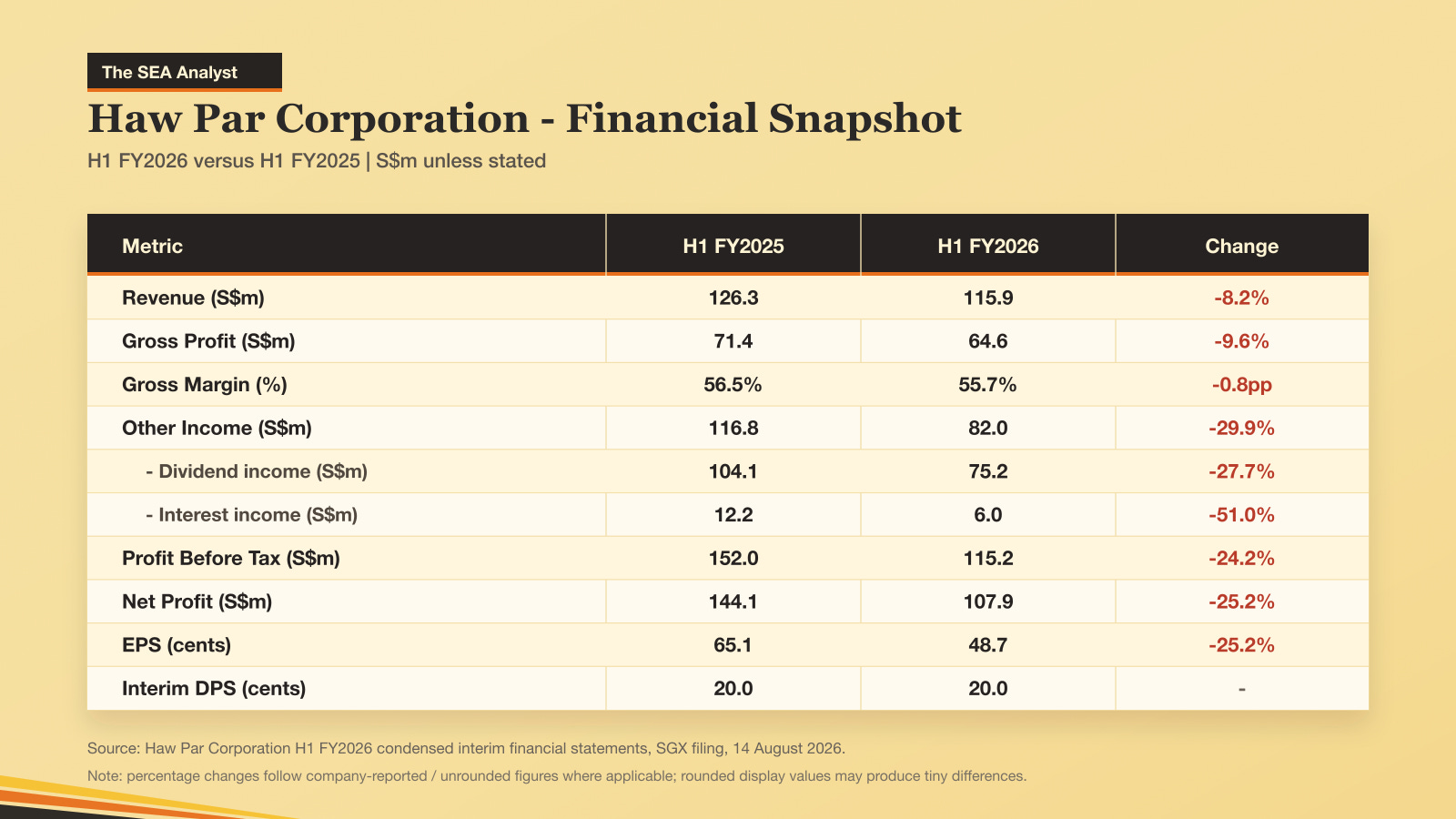
The half’s income statement carries the full weight of the dividend story.
Revenue slipped 8.2% and gross profit 9.6%, but the real mover was other income, down 29.9% as dividend and interest income fell together. That is what pulled pre-tax profit down 24.2% and net profit down 25.2%.
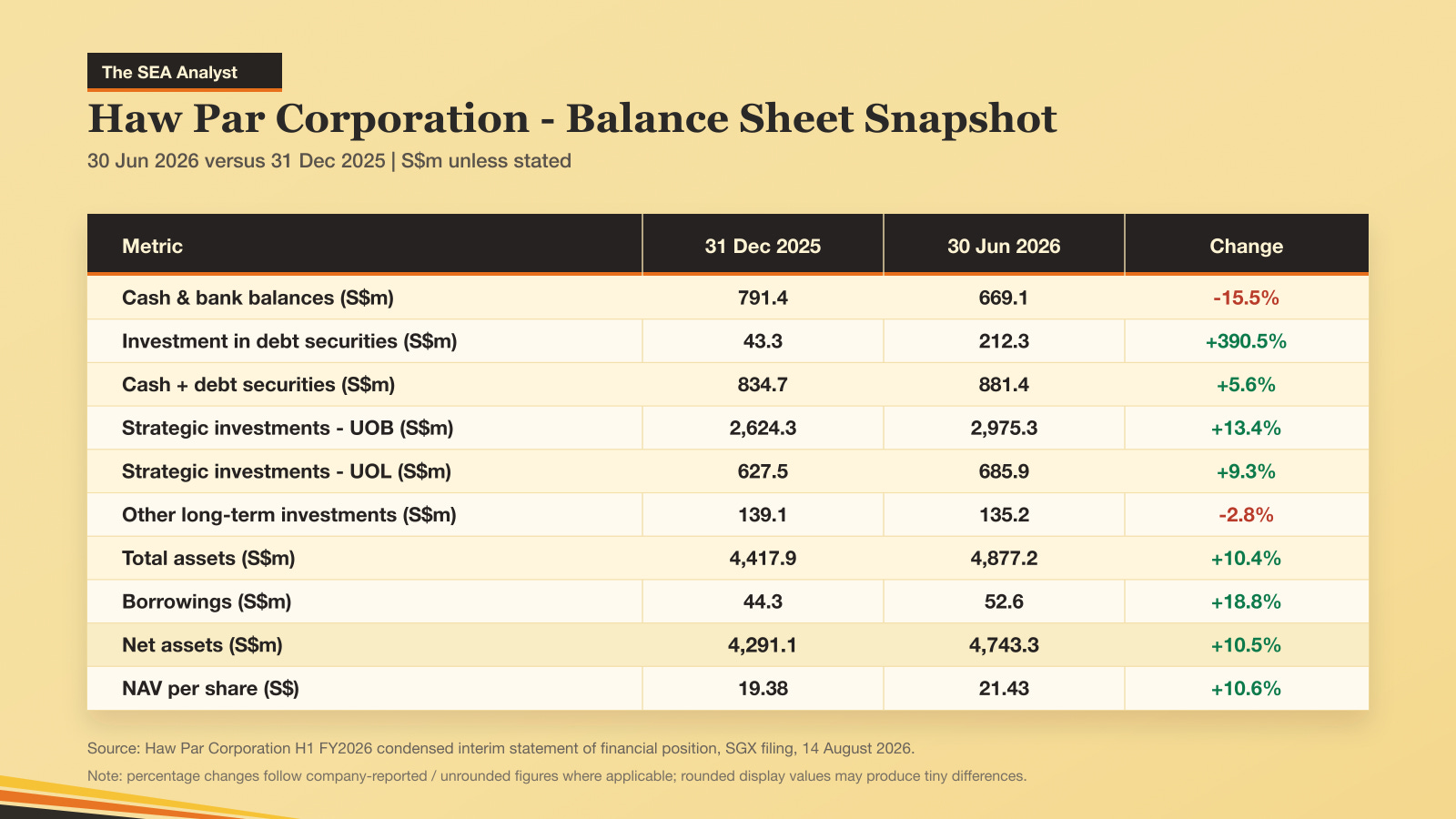
The balance sheet moved the other way.
Fair-value gains on the strategic portfolio lifted net assets over the six months, taking NAV per share up 10.6% to S$21.43 even as reported profit fell. The cash position stayed a fortress: the group rotated S$169 million out of bank deposits into Singapore Treasury bills, yet the combined cash-and-securities pile still grew to S$881 million against just S$53 million of borrowings.
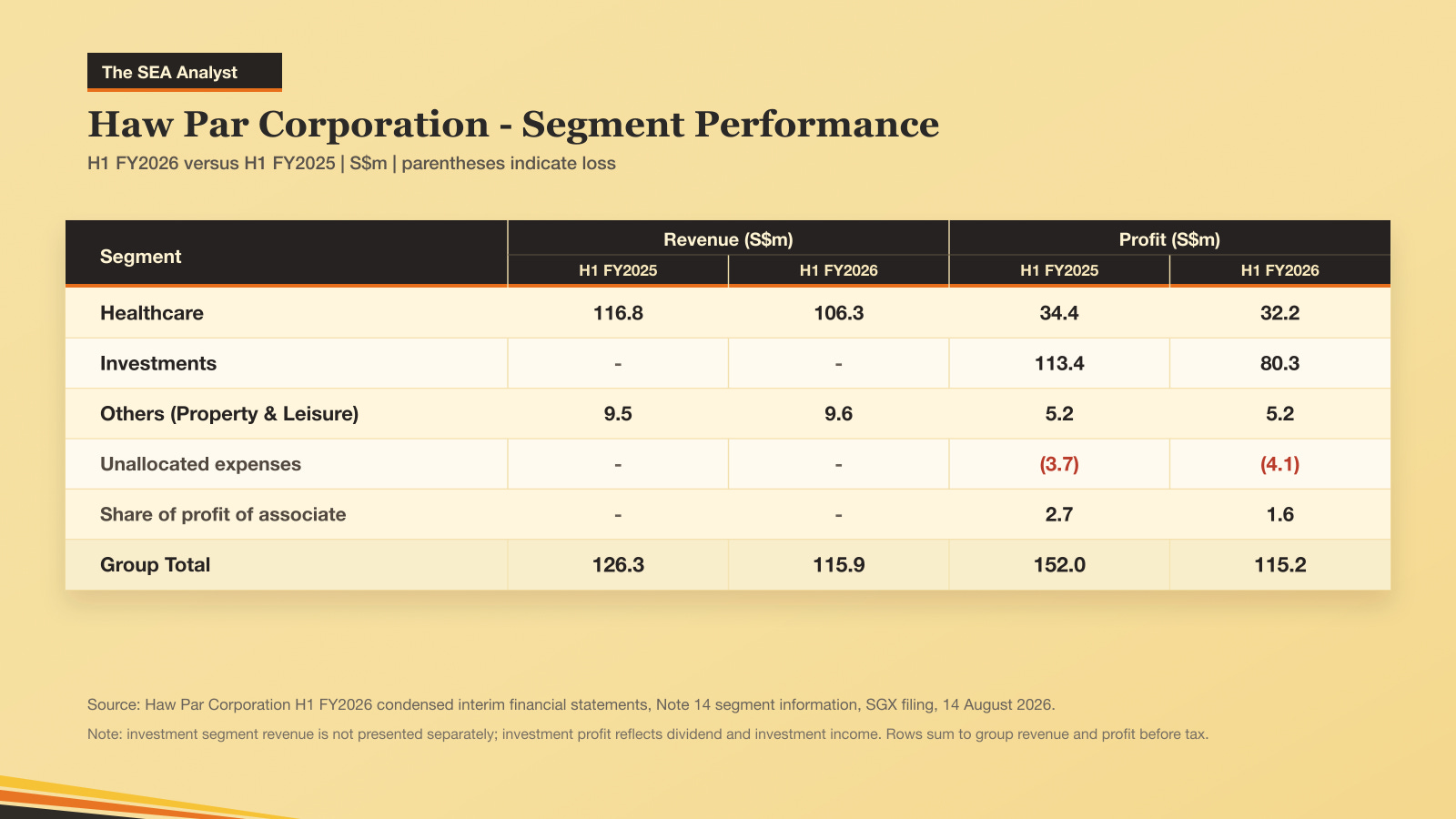
Underneath the group totals, the two engines diverged. Healthcare absorbed the revenue decline while holding most of its profit, and the investment segment, though lower year-on-year on the softer dividend, still earned more than twice the healthcare business.
Thesis Check
Bull thesis (UOB dividend income as a passive, growing stream): Income intact, growth premise overstated.
This was the core value-driver claim in the initiation: Haw Par’s investment segment generated S$205 million in FY2025 profit, “three times the healthcare business,” primarily through S$189 million in dividend income. The thesis implicitly assumed that UOB’s dividend trajectory would continue upward; the prior article traced UOB dividends to Haw Par growing from an estimated ~S$67 million (2016) to ~S$135 million (FY2025).
H1 2026 dents that trajectory, but less than the headline suggests. Dividend income dropped to S$75.2 million from S$104.1 million, and most of that is a special-dividend effect, not an ordinary cut. UOB’s FY2025 ordinary dividend was S$1.56 per share (S$0.85 interim + S$0.71 final); Haw Par’s H1 receipt reflects that lower S$0.71 final against a year-ago S$1.17 that had bundled UOB’s FY2024 final with a S$0.25 tranche of its 90th-anniversary special. [2] The ordinary line is intact: UOB has since declared an FY2026 interim of S$0.88 per share (payable 28 August 2026), up from S$0.85 a year earlier, alongside 1H2026 net profit growth of about 3%. [5]
So the income “reset” is really the fading of UOB’s anniversary specials plus a modestly lower final, not evidence that the underlying stream is shrinking. Haw Par still banked S$75.2 million in six months from an effectively passive holding. The ordinary interim improved from S$0.85 to S$0.88, but total H2 2026 UOB cash received will still land below H2 2025, because last year’s S$1.10 half-year receipt included a S$0.25 special tranche on top of the S$0.85 ordinary. The point is the shape of the H2 shortfall: it is entirely the vanished special, while the ordinary interim is edging up. The honest revision to the initiation is narrower than “the machine is breaking.” The ordinary dividend stream is stable-to-rising, but the elevated 2025 cash, inflated by anniversary specials, was never the run-rate, so full-year 2026 dividend income will sit below 2025’s special-boosted level even as the ordinary trend holds.
Bull thesis (Tiger Balm’s consumer franchise with pricing power): Pricing power intact, Asian demand weakening.
Healthcare segment revenue fell 9.0%, but the group gross margin held at 55.7% (vs 56.5%). The margin dip was marginal and attributed to product sales mix shifts, not pricing erosion. [1] Segment profit declined to S$32.2 million from S$34.4 million, a 6.6% drop on a 9.0% revenue decline, which means the cost base flexed. At the group level, distribution and marketing expenses fell 22.7%, suggesting management pulled back on promotional spend rather than chasing volume at deteriorating returns. [1]
Pricing power holds at the gross-margin line, but the demand trend is weaker than a single soft half suggests, and we are less sanguine than at initiation.
Healthcare revenue fell about 7% in FY2025, and because H1 2025 was inflated by advanced orders, the underlying second half was materially softer; H1 2026's further 9% decline extends that run. [6] The weakness is regional, not universal: FY2025 sales in the Americas, Europe and the Middle East grew about 6%, while ASEAN fell 9% and the rest of Asia 15%. [6]
Tiger Balm is really two stories: it is growing in the West but losing ground in Asia, where competitive undercutting and soft sentiment are eroding volume. That is a real demand problem, not simply a brand riding out a one-off comparative.
Bull thesis (NAV accretion / asset discount): Validated; capital-return catalyst still unproven.
NAV per share rose 10.6% to S$21.43, driven by S$388.6 million in fair value gains on strategic investments flowing through other comprehensive income. [1] At S$15.06, Haw Par trades at about 70% of NAV, a 29.7% discount.
But the sharper way to frame the mispricing is this: at S$15.06 the whole company is capitalised at about S$3.33 billion, while its two listed stakes alone, UOB (S$2,975.3 million) and UOL (S$685.9 million), are worth S$3.66 billion.
The market is paying less for all of Haw Par than the quoted value of its bank and property-developer holdings, implying little to no value for the S$829 million of net cash and treasury bills, the Tiger Balm franchise, and the investment properties.
This is not costless free money, and the discount can persist indefinitely: the Wee-family control structure removes any takeover pressure, the stock is thinly traded, there is no buyback, and management has signalled no path to monetising the stakes. What the SOTP establishes is a floor, not a catalyst; the price is anchored to assets that are themselves liquid and marked to market daily.
On the payout, the ordinary dividend is steadier than the initiation implied. Haw Par has paid a 20-cent interim since FY2023, and it maintained that 20 cents here despite the earnings drop, so the 40-cent ordinary annual payout held from FY2023 through FY2025, and the FY2026 interim keeps Haw Par on that path. The genuine outlier was the FY2024 S$1.00 special (paid in H1 2025); FY2025 reverted to 40 cents, and this interim gives no signal on whether a special will accompany the FY2026 full-year results.
Bear thesis (passive conglomerate structure, no catalyst for discount closure): Unchanged.
Nothing in this filing addresses the structural discount. There is no share buyback activity, no corporate restructuring signal, and no change to the conglomerate holding structure.
The investment portfolio continues to appreciate (UOB +13.4%, UOL +9.3% in six months), widening the absolute NAV gap even as the proportional discount fluctuates. The fortress balance sheet, S$881 million in cash and short-term debt securities against S$52.6 million in borrowings, remains under-leveraged by any measure.
Flip-trigger status. Three events would force us to revise the call, and none tripped this period.
A UOB dividend cut in two consecutive years or a credit-quality deterioration (a sharp rise in non-performing loans): not triggered — UOB’s ordinary interim rose to S$0.88, 1H2026 net profit grew about 3%, and no asset-quality stress was flagged, so the lower FY2025 final is not yet a sustained ordinary cut. [5]
A Haw Par sale, demerger, or monetisation of Tiger Balm or the investment portfolio, which would be a positive catalyst: no such signal, and no buyback.
A regulatory change to banking-holding-company rules that forced a reduction in the UOB stake: no development this period.
The thesis stands unchanged against all three breakers.
Answering the Questions We Opened in April
Our initiation left four questions explicitly open, and named four downside scenarios. Here is where H1 2026 leaves each.
Will the S$1.00 special dividend recur? On the evidence, no. It was a one-time FY2024 event; the regular payout is 40 cents (20c interim + 20c final). Specials, if declared at all, come with full-year results, so this interim offers no fresh signal. But the burden of proof has flipped: a repeat special is now the exception that would need explaining, not an emerging norm.
How would dividend policy evolve? The floor held: the 20-cent interim was maintained despite a 25% earnings drop, confirming the step-up from the old 15-cent interim is durable. But the growth our initiation extrapolated did not appear. The income line is now visibly hostage to UOB’s board, not Haw Par’s.
Is Tiger Balm gaining Western-market traction? Unanswerable from this filing; the interim carries no geographic split. Healthcare segment revenue fell 9.0%, which management ties to demand softness and a high comparative base rather than a retreat in the international push. It stays genuinely open, to be revisited at the FY2026 full-year, when the geographic breakdown returns.
Any restructuring signal from the Wee-family / UOI structure? None in this filing. No buyback, no structural change, no distribution of the Haw Par stake. The discount-closure catalyst the initiation was watching for remains absent.
Of the four downside scenarios we flagged, the income-volatility risk has moved from theoretical to demonstrated, though H1 showed it as special-dividend normalisation rather than a cut to the ordinary stream. The concentration risk, UOB as the dominant swing factor in both value and income, is no longer abstract. It produced this period’s headline.
Risks Revisited
The primary risk flagged in the initiation, dependence on UOB’s dividend policy, became visible this period, but H1 flattered the bear case. Most of the income drop was the non-recurrence of UOB’s anniversary specials plus a lower ordinary final, not a structural cut; UOB’s higher FY2026 interim confirms the ordinary stream is intact. [5] The real, unchanged risk is the shape of the dependence: a genuine shift in UOB’s capital-allocation priorities (higher CET1 buffers, buybacks over cash dividends) would compress Haw Par’s reported earnings with no offsetting operational lever. That has not happened, but this period is a reminder of how directly it would flow through.
A second risk worth noting: the healthcare revenue decline coincides with management’s commentary on “persistent inflation from prolonged geopolitical conflicts” and “trade policy uncertainties.” [1] The “both engines soft at once” scenario has eased on the income side, since UOB’s ordinary FY2026 interim came in above the prior year, leaving the healthcare trajectory as the swing factor for H2 2026.
Interest income also halved (S$6.0m vs S$12.2m), reflecting the declining rate environment. The shift of S$169 million from cash into Singapore Government Treasury Bills (debt securities rose from S$43.3m to S$212.3m) is a partial offset, with management actively locking in yields. [1]
What to Watch
Three forward indicators will determine whether this is a cyclical soft patch or a structural downshift:
First, and now answered, UOB’s FY2026 interim dividend. UOB has declared S$0.88 per share, payable 28 August 2026, up from the S$0.85 ordinary interim a year earlier, with 1H2026 net profit up about 3%. [5] That payment lands in Haw Par’s second half and confirms the H1 income drag was a timing-and-specials effect rather than a structural cut. What remains open is UOB’s FY2026 final (declared February 2027): the FY2025 final of S$0.71 was the figure that hurt Haw Par’s first half, so whether the next final rebuilds or holds near S$0.71 will set the direction of Haw Par’s 2027 income.
Second, Haw Par’s H2 2026 healthcare revenue trajectory. Management flagged the H1 2025 comparative base as elevated by advanced orders. If H2 2026 revenue recovers toward S$115–120 million (closer to FY2025’s S$210 million annualized run rate), the healthcare softness was base-effect, not demand erosion.
Third, the FY2026 full-year dividend decision (expected February 2027). FY2024’s total payout was S$1.40 (20c interim + 20c final + S$1.00 special); FY2025 reverted to 40 cents (20c + 20c, no special). If FY2026 delivers at least 40 cents total (20c interim already declared + 20c final), the 40-cent floor is confirmed. Any special dividend on top would signal the elevated payout is more than a one-off.
Bottom Line
Haw Par’s H1 2026 is a split-screen result. The income statement shows profit 25% below a year ago, but the cause is narrower than it looks.
The year-ago half was inflated by UOB’s 90th-anniversary special dividends; strip those out and the ordinary dividend stream is intact and, on UOB’s just-declared S$0.88 FY2026 interim, still edging up. The balance sheet tells the louder story: net assets grew S$452 million in six months to S$4.74 billion, the strategic portfolio’s carrying value rose S$409 million (S$388.6 million of it fair-value gains), and the company still sits on S$881 million of cash and treasury bills against just S$53 million of borrowings.
The thesis from April stands, with one refinement. The investment income is not a straight-line “rising machine,” since its year-to-year cash can swing on UOB’s special dividends, but the ordinary stream is stable and slowly rising, and the H1 drop overstated the underlying trend.
What has not changed is the structural mispricing: at S$15.06 the market values all of Haw Par below the quoted worth of its UOB and UOL stakes alone (S$3.66 billion), implying little to no value for the S$829 million of net cash and treasury bills, the Tiger Balm franchise, and the properties. The portfolio’s market value has continued to appreciate (UOB up 13.4% in six months), healthcare still earns 55%-plus gross margins, and the discount to NAV, 29.7% at S$15.06 against NAV of S$21.43, remains wide.
The interim dividend of 20 cents, maintained despite the earnings decline, suggests management intends to hold the 40-cent ordinary floor that has been in place since FY2023. Whether a special dividend is repeated for FY2026 depends on how UOB’s own capital return evolves.
For now, Haw Par remains what it was at initiation: a deep-value holding where the passage of time, UOB dividends, and portfolio appreciation do the work.
Data Integrity Notes
Share price of S$15.06 is based on Google Finance market data as of the 21 August 2026 close.
UOB dividend per share history (2024–2026) sourced from Stock Analysis (stockanalysis.com), cross-checked against the dividend income decline reported in Haw Par’s filing. The April 2026 UOB DPS of S$0.71 is consistent with Haw Par receiving ~S$53 million in UOB dividends, which aligns with the S$75.2 million total dividend income (with UOL and other sources contributing the remainder).
The filing has not been audited or reviewed (per Note 15 of the filing). [1]
Haw Par’s UOB shareholding (~74.8 million shares) is carried forward from the initiation article based on FY2025 annual report data. The H1 filing does not disclose the exact number of UOB shares held, only their fair value (S$2,975.3 million). At UOB’s 30 June 2026 closing price, this is consistent with the ~74.8 million figure.
UOL shareholding (~72 million shares) is similarly carried forward. The UOL stake at S$685.9 million fair value is consistent with ~72 million shares at UOL’s 30 June price.
No forecast or prospect statement was previously disclosed for H1 2026. [1]
Dividend-year attribution: our April initiation labelled the S$1.00 special as an FY2025 dividend. This update follows the company’s own Note 8 attribution: the special was declared with FY2024 results and paid in H1 2025; FY2025’s attributable payout was 40 cents. The S$1.40 “FY2025” figure in the initiation reflects cash paid during calendar 2025 rather than FY2025’s financial-year distribution. [1]
UOB dividend basis: UOB per-share dividends here separate ordinary from special components. UOB’s FY2025 ordinary dividend was S$1.56 (S$0.85 interim + S$0.71 final); the S$0.25 tranches paid during 2025 were part of a S$0.50 90th-anniversary special. The FY2026 interim of S$0.88 (payable 28 August 2026) and 1H2026 profit growth are from UOB’s own results release. [5] Calendar-year “cash received” totals (e.g. ~S$2.27 across 2025) mix fiscal years and specials and are not used here as the ordinary run-rate.
Haw Par share price of S$15.06 and derived market cap / SOTP discounts are as of the 21 August 2026 close; the H1 FY2026 financial figures are as of the 30 June 2026 balance-sheet date.
References
[1] Haw Par Corporation Limited, “Condensed Interim Consolidated Financial Statements for the Half Year Ended 30 June 2026,” SGX filing, 14 August 2026. Announcement ID: RCSKDYV9X0P0K4OA.
[2] UOB dividend history: Stock Analysis (stockanalysis.com/quote/sgx/U11/dividend/) and UOB “Shares & Dividends” (uob.com.sg/investor-relations/shares-and-dividends/dividends.html), accessed August 2026. UOB FY2025 ordinary dividend S$1.56 (S$0.85 interim + S$0.71 final); the S$0.50 90th-anniversary special was paid in S$0.25 tranches across 2025; the April 2025 receipt of S$1.17 = S$0.92 FY2024 final + S$0.25 special tranche.
[3] Haw Par Corporation Limited, “Cash Dividend/Distribution — Mandatory: First & Interim Dividend of 20 cents per share,” SGX filing, 14 August 2026. Announcement ID: 5F8JVXONDOBYHLLC.
[4] “Haw Par Corporation: The Tiger Balm Conglomerate Hiding a S$3.4 Billion Portfolio,” The SEA Analyst, published 4 April 2026 (prior initiation article).
[5] United Overseas Bank Limited, “1H2026 financial results,” UOB newsroom (uobgroup.com/uobgroup/newsroom/news-releases/2026/uobgroup-1h26-financial-results.page), accessed 18 August 2026. FY2026 interim dividend of S$0.88 per share, payable 28 August 2026; 1H2026 net profit up ~3% year-on-year; interim represents ~50% payout ratio.
[6] Haw Par Corporation Limited, FY2025 full-year results and Annual Report 2025 (year ended 31 December 2025), SGX filings. Healthcare revenue down about 7% to ~S$240 million; by region, Americas/Europe/Middle East +6%, ASEAN −9%, rest of Asia −15%.
IMPORTANT DISCLAIMERS
This article is published for informational and educational purposes only. It does not constitute financial or investment advice, a recommendation, or a solicitation to buy, sell, or hold any securities. The author is not a licensed financial adviser under the Financial Advisers Act 2001 of Singapore. This content is exempt from the requirements of the Singapore Financial Advisers Act pursuant to Regulation 34 of the Financial Advisers Regulations, as it is published in a generally available publication. This publication does not take into account the specific investment objectives, financial situation, or particular needs of any individual. Before making any investment decision, readers should consult a licensed financial or investment adviser in their relevant jurisdiction. Past performance is not indicative of future results.
No Warranty: While the data and analysis have been prepared in good faith from public sources believed to be reliable, no representation or warranty, express or implied, is made as to the accuracy, completeness, or timeliness of the information. The author accepts no liability for any loss arising from the use of this material.
Disclosure: The author holds no position in the securities discussed. No compensation has been received from any company mentioned in this article.