

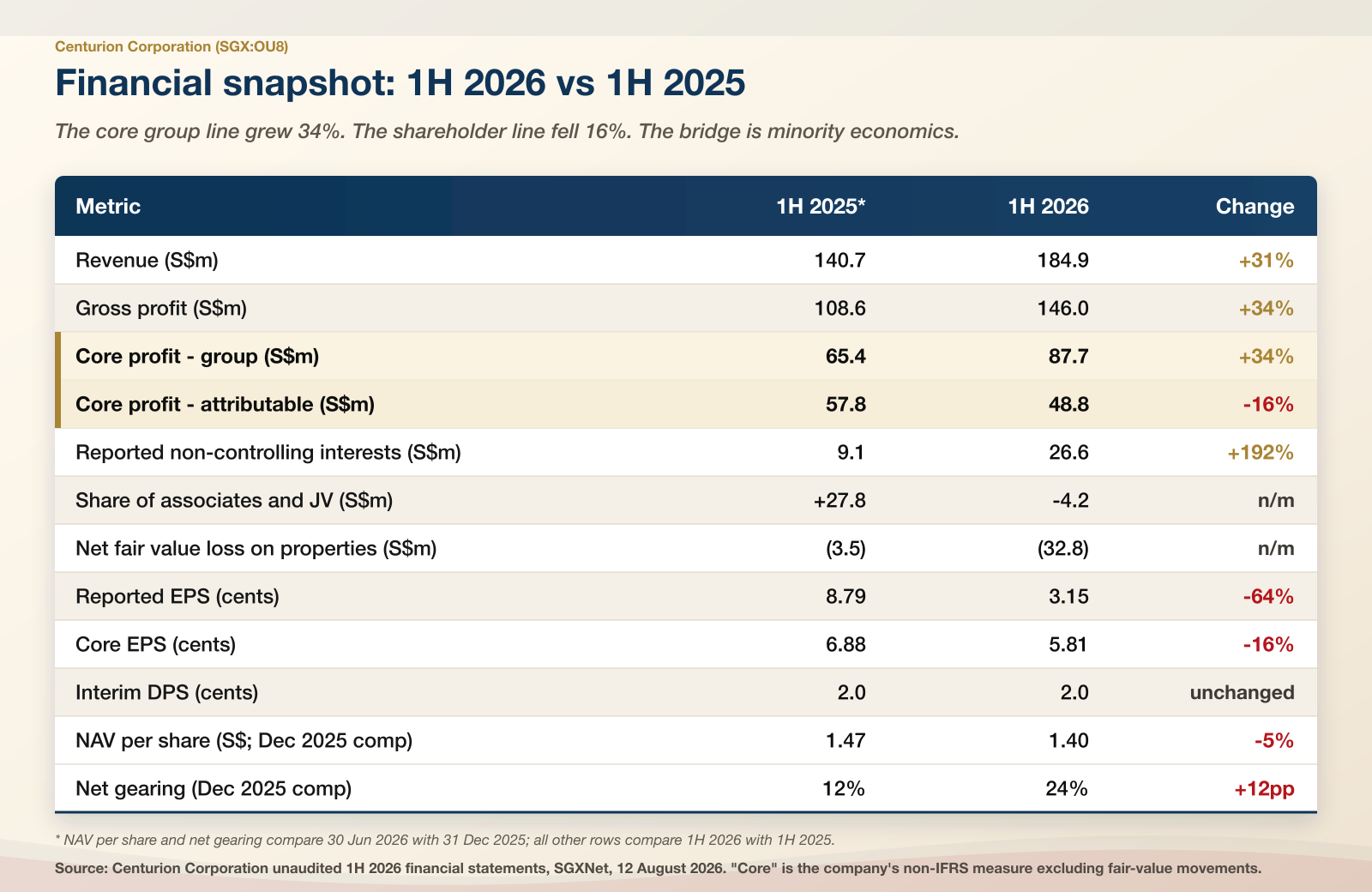
Centurion Corporation released its first-half results after the market close on 12 August 2026. Revenue rose 31% to S$184.9 million. Gross profit rose 34% to S$146.0 million. Profit from core business operations, the company’s own non-IFRS measure that strips out fair-value movements, rose 34% to S$87.7 million [1].
Then the same statement reported that profit from core business operations attributable to equity holders fell 16%, from S$57.8 million to S$48.8 million. Reported earnings per share fell 64%, from 8.79 cents to 3.15 cents. Net asset value per share fell from S$1.47 to S$1.40.
The market read the headline. OU8 closed at S$1.70 on 12 August and S$1.60 on 13 August, a 5.9% fall on the print, recovering to S$1.62 by 14 August and closing at S$1.60 on 21 August [14].
There are two separate declines here and they have different causes, which is worth establishing before anything else.
The fall in reported profit and earnings per share is explained by the fair-value loss on investment properties and the swing in associate accounting, both of which the company’s core measure deliberately strips out.
The fall in core attributable profit is explained by something else entirely, and by only one thing: the non-controlling interest share of core profit.
In the same fortnight, two other things happened that the earnings headline buried:
Centurion Accommodation REIT reported its first half-year as a listed trust and beat its IPO forecast distribution per unit by 9.6%.
On 4 August, Centurion won a Building and Construction Authority tender for a 7,000-bed dormitory site at Kranji Close for S$343.0 million, a commitment larger than any single land purchase disclosed in the filings we hold.
Where the thesis stood
Our initiation of 25 May 2026 [15] argued that the September 2025 CAREIT listing had converted Centurion from a dormitory operator into a three-pillar platform, that the consolidated accounts obscured rather than revealed this, and that the market was still applying operator multiples to a business that had become an operator, an asset manager, and a REIT unitholder.

We warned specifically that consolidation would make the reported headline diverge from the underlying economics. We described the FY2026 revenue line as set to jump for accounting reasons that would not translate cleanly into attributable earnings. What we did not do was size the effect on the attributable line. That omission is the reason this print landed harder than our framing prepared readers for, and we address it directly below.
The numbers
Revenue growth came from three places.
Westlite Mandai, consolidated since 25 September 2025, contributed S$22.9 million of the S$30.6 million increase in Singapore worker accommodation revenue.
New beds at Westlite Toh Guan added S$4.5 million.
EPIISOD Macquarie Park, operational from January 2026, added S$7.2 million and doubled Australian student accommodation revenue to S$16.5 million.
Occupancy moved the other way. Singapore worker accommodation financial occupancy fell from 99% to 94% on the ramp-up of newly completed beds at Toh Guan and Mandai; committed occupancy at Westlite Toh Guan and Westlite Mandai as at 31 July was disclosed at 99% and 87% respectively [1], which supports the ramp explanation rather than a demand explanation. Malaysian occupancy fell from 83% to 73% on foreign worker quota caps.
Thesis check
The accounting-versus-economics point: validated, and larger than we said
We wrote in May that the consolidation “does not translate cleanly to attributable earnings.” That was correct in direction and inadequate in magnitude. It is worth separating the two declines cleanly, because they are often run together and they carry different meanings.
The entire core decline is the minority share. Core profit is the company’s own measure, and it already strips out fair-value movements. So the gap between core profit for the whole group and core profit for shareholders is, by definition, the slice that belongs to outside investors, chiefly the other CAREIT unitholders. That slice went from S$7.6 million in 1H 2025 to S$38.9 million in 1H 2026.
It grew fivefold for two reasons: timing and ownership.
CAREIT only listed in late September 2025, so it was absent from the 1H 2025 comparison as a listed REIT. By the first half of 2026 it was a full six months in the accounts, and Centurion owns only about 38% of it, so roughly 62% of CAREIT’s profit belongs to other unitholders. Because CAREIT holds a large share of the group’s best, stabilised assets, a big part of group profit now flows to those outsiders before it reaches Centurion shareholders. That is why group core profit could rise 34% while the shareholders’ share fell 16%: the company earned more, but a bigger portion of it was owned by someone else.
The reported decline is fair value and an accounting reclassification. The reported number, which unlike core still includes revaluations, fell from S$73.9 million to S$26.5 million, and earnings per share from 8.79 cents to 3.15 cents. Two things caused it, and neither is worse trading. The first is a fair-value loss on investment properties, which widened to S$32.8 million this half from S$3.5 million a year ago, S$19.4 million of it in student accommodation; we return below to what actually drove that loss.
The second is the reclassification of Westlite Mandai. An associate is a company Centurion owns part of but does not control, and its share of that company's profit sits on a single line, "share of associates." A year ago Mandai was an associate, and that line carried S$28.4 million from it, of which S$22.7 million was a one-off gain from revaluing Mandai's property upward rather than recurring earnings. Centurion has since taken full control, so Mandai is now a subsidiary, and its revenue and profit are consolidated into the main lines instead. The associate line therefore lost the large Mandai figure it held last year and swung from a S$27.8 million profit to a S$4.2 million loss, not because anything deteriorated but because Mandai moved elsewhere in the accounts and last year's figure was flattered by a one-off gain.
Neither decline is an operating deterioration, but the core decline is real in the sense that a shareholder's claim on this year's core profit is genuinely smaller than last year's. The question is whether that reduction is permanent.
Is the shareholder’s share leaking? No, and it runs the other way
This was the question we could not answer from the results statement alone, so we went to the two filings that settle it.
On 2 June 2026, Centurion completed the Dividend in Specie it had proposed in February. A dividend in specie is one paid to shareholders in assets rather than cash, "in specie" being the term for payment in kind: here, Centurion handed out CAREIT units it held rather than selling them and paying cash. It distributed 84,077,200 CAREIT units to shareholders on a one-unit-per-ten-shares basis, a cash-equivalent S$0.11 per Centurion share at the S$1.10 unit price. Its holding fell from 42.9% to 657,873,900 units, or 38.1% of the trust [4].
That is a reduction in Centurion's stake in CAREIT. It is not a reduction in value for Centurion's shareholders, because they received the CAREIT units directly into their own accounts. The economic interest moved from one side of the shareholder's portfolio to the other.
The second filing is the more interesting one, and it runs the other way. As manager of CAREIT, Centurion Asset Management, a wholly-owned Centurion subsidiary, earns a base fee for running the trust, and it can take that fee in cash or in new CAREIT units. For the first quarter it elected to take 100% in units: on 20 May 2026 CAREIT issued 2,529,442 new units at S$1.1396 to settle the fee [5]. The manager then assigned the entitlement to Centurion Capital Investments Ltd, so the units were issued there rather than to the manager itself. Centurion Capital Investments is a wholly-owned subsidiary of Centurion Overseas Investments, which is wholly owned by Centurion Corporation, so the units stay inside the Centurion group.
This is the sponsor being paid its management fee in more of the REIT, and the effect compounds. Each issuance accrues entirely to Centurion, which held only about 38% beforehand, so its percentage stake rises every time the fee is settled this way. And as CAREIT grows its assets and distributable income, the base fee itself grows, so each subsequent issuance is larger. It is the opposite of the dilution a sponsor’s stake usually suffers:
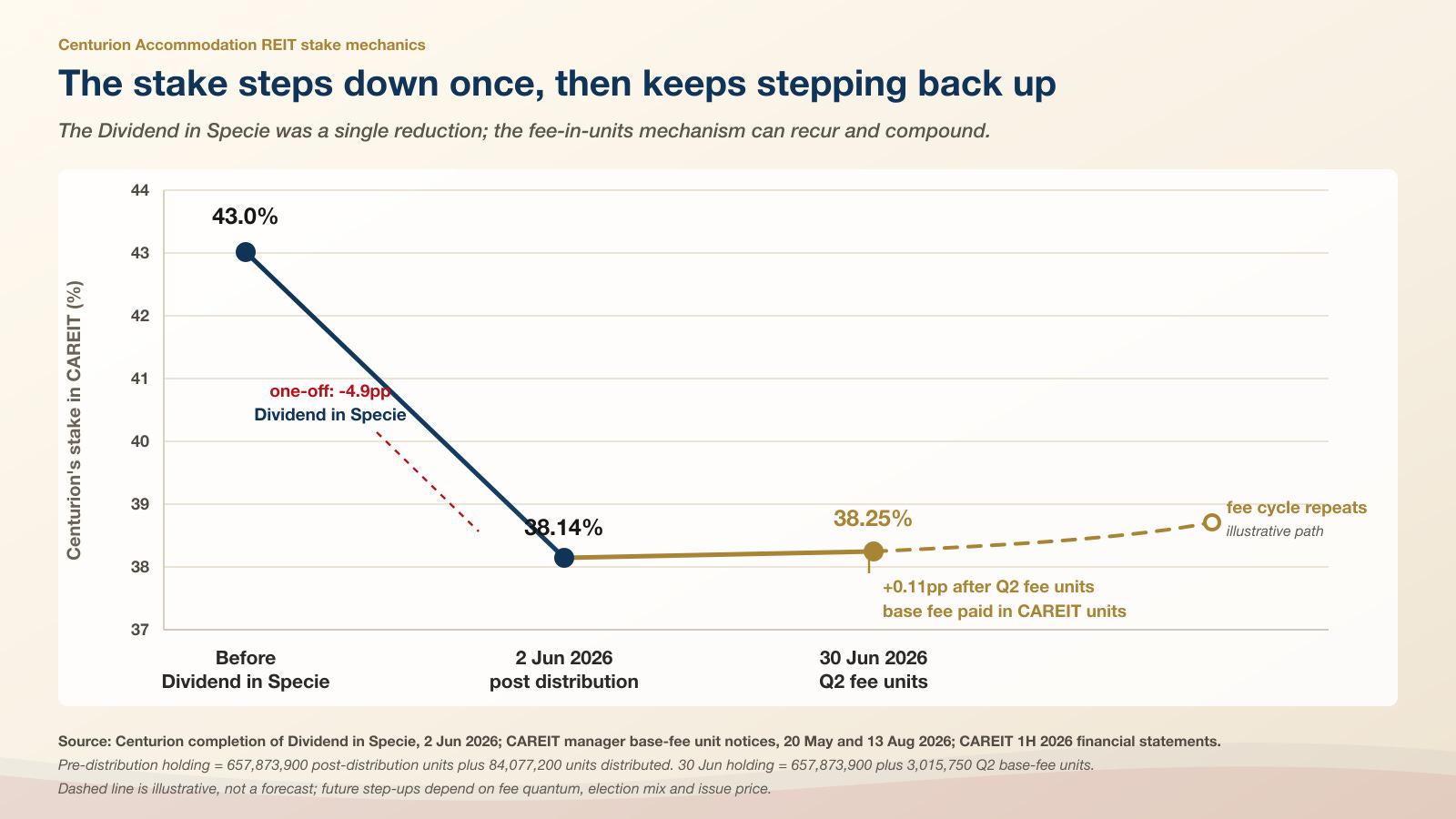
The Dividend in Specie was a single step down. The fee-in-units mechanism is a continuous step up: every unit issued or to be issued for the half-year was for manager fees, and on the election the manager has made so far, those units land with Centurion. Manager fees are now running at roughly S$14.8 million a year on the first-half figures, and while the manager elects to take them in units, that fee stream converts directly into a larger stake.
So the answer to the question is that the non-controlling interest drag is a one-time reset to a lower base, not a widening leak.
The REIT leg of our bull case has fired. The operating leg has not
Our initiation named a specific activation trigger for the bull scenario. We reproduce it here because it can now be scored:
“CAREIT 1H 2026 results print (likely August 2026) showing DPU run-rate of ≥3.4 cents (annualised ≥6.8 cents, above the 6.67 prospectus projection); plus Centurion 1H 2026 results print showing PBWA Singapore occupancy stabilising above 95% and Malaysian occupancy recovering to >75%.”
CAREIT reported a first-half distribution per unit of 3.499 cents against a prospectus forecast of 3.192 cents, a 9.6% beat, annualising to roughly 7.0 cents. Gross revenue beat forecast by 5.1% and net property income by 4.3%. Aggregate leverage is 29.9%, interest coverage 5.91 times, weighted-average interest cost 3.60% [3].
That leg fired.
Singapore occupancy came in at 94% against the 95% we specified. Malaysian occupancy came in at 73% against 75%. Both missed, narrowly. The Singapore miss looks like timing given the committed-occupancy disclosure. The Malaysian miss is a policy constraint that management expects to ease as quota applications reopen for selected industries.
The honest score is a half-fired trigger. The REIT and fee side is running ahead of plan; the operating side, the dormitories themselves, is behind on a lag.
The moat: validated, and more contested than we implied
On 4 August, the Building and Construction Authority awarded Centurion the Kranji Close site for S$343.0 million [6]. It is 22,079 square metres at a plot ratio of 3.0, on a 30-year lease from November 2026, for 7,000 New Dormitory Standards-compliant beds, with completion targeted for the second quarter of 2028 and operational readiness in the third [7]. Centurion will develop it through a 90:10 joint venture with an unnamed minority partner.
Our initiation argued that compliance is expensive, that roughly 900 dormitories housing 200,000 workers must retrofit by 2030, and that the operators who can fund compliance would take share. Winning a 7,000-bed compliant site is that argument made concrete.
What the tender documents also show is how contested that advantage is. The Kranji tender drew ten bids. Centurion is separately the top bidder for a second site at Lok Yang Way, a 5,000-bed plot [9] where the tender closed on 23 June and which the Jurong Town Corporation publishes in full [8]:
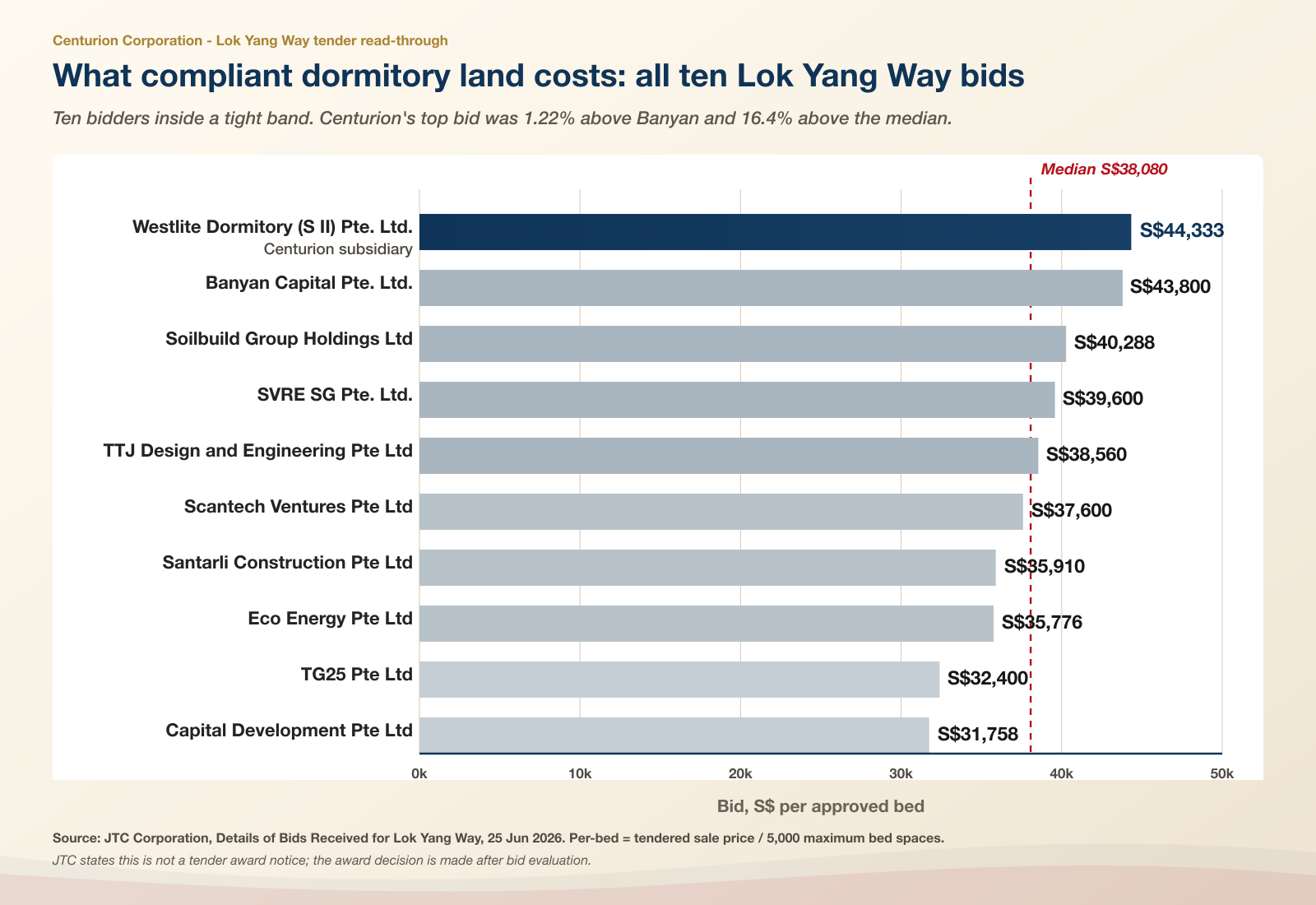
Centurion’s Kranji bid works out at S$49,000 per approved bed. Its own Lok Yang Way bid is S$44,333 per bed, and the Kranji site is 80% denser in beds per square metre of land, which accounts for much of the difference.
The useful comparison is not against the carrying value of the existing portfolio, which reflects assets bought years ago on leases now part-expired. It is against the other nine bidders. On that basis Centurion sits at the top of a tightly clustered band, winning Lok Yang Way by 1.22% over Banyan Capital and by 16% over the median.
That tells us something the initiation did not say. The regulatory advantage is real, but it is not proprietary. Ten well-capitalised parties, including established contractors, can all see the same opportunity and price it within a narrow range. Centurion’s edge is the willingness and the balance sheet to clear the top of that range repeatedly, not an insight the market lacks.
Management frames the supply backdrop as tightening rather than loosening. According to The Edge’s report of the results briefing, the chief operating officer of the accommodation business said the roughly 40,000 beds due to enter the market this year and early next are largely replacements for temporary dormitories whose land leases will not be renewed, and that the Dormitory Transition Scheme’s interim space standards will cut current operating supply by about 15% [16]. This is the operator’s own characterisation, reported second-hand and self-serving, but it is consistent with the compliance-driven attrition our initiation described.
A correction: the Australian pipeline is not Centurion’s in the way we described
Our initiation listed the Australian development pipeline under Growth Driver 4 as “Australian PBSA developments (Centurion-direct, separate from CAREIT-held)” and counted “approximately 1,791 beds” of additions. We described the Stirling Highway project in Perth as part of “Centurion’s directly-held Australian pipeline.”
That was wrong, and the company’s own disclosure is clearer than our reading of it. The correction matters enough to state precisely:
Of the 1,791 beds we presented as directly held, 472 are held through a vehicle in which Centurion owns a quarter. On an economic basis the pipeline is 1,437 beds. The Stirling Highway subscription was announced on 1 December 2025 and headed as an interested person transaction. We published on 25 May 2026. The filing was available to us for nearly six months and we did not read it against the growth-driver claim we were making.
Centurion holds 25% of the Perth developments. The other 75% is held by Centurion Properties Australia Investments, a wholly-owned subsidiary of Centurion Properties, which is wholly owned by Centurion Global Ltd. Centurion Global is owned in equal shares by Han Seng Juan and Loh Kim Kang David, the joint chairmen and controlling shareholders. Each subscription has been announced as an interested person transaction under Chapter 9 of the Listing Manual [10][11][12].
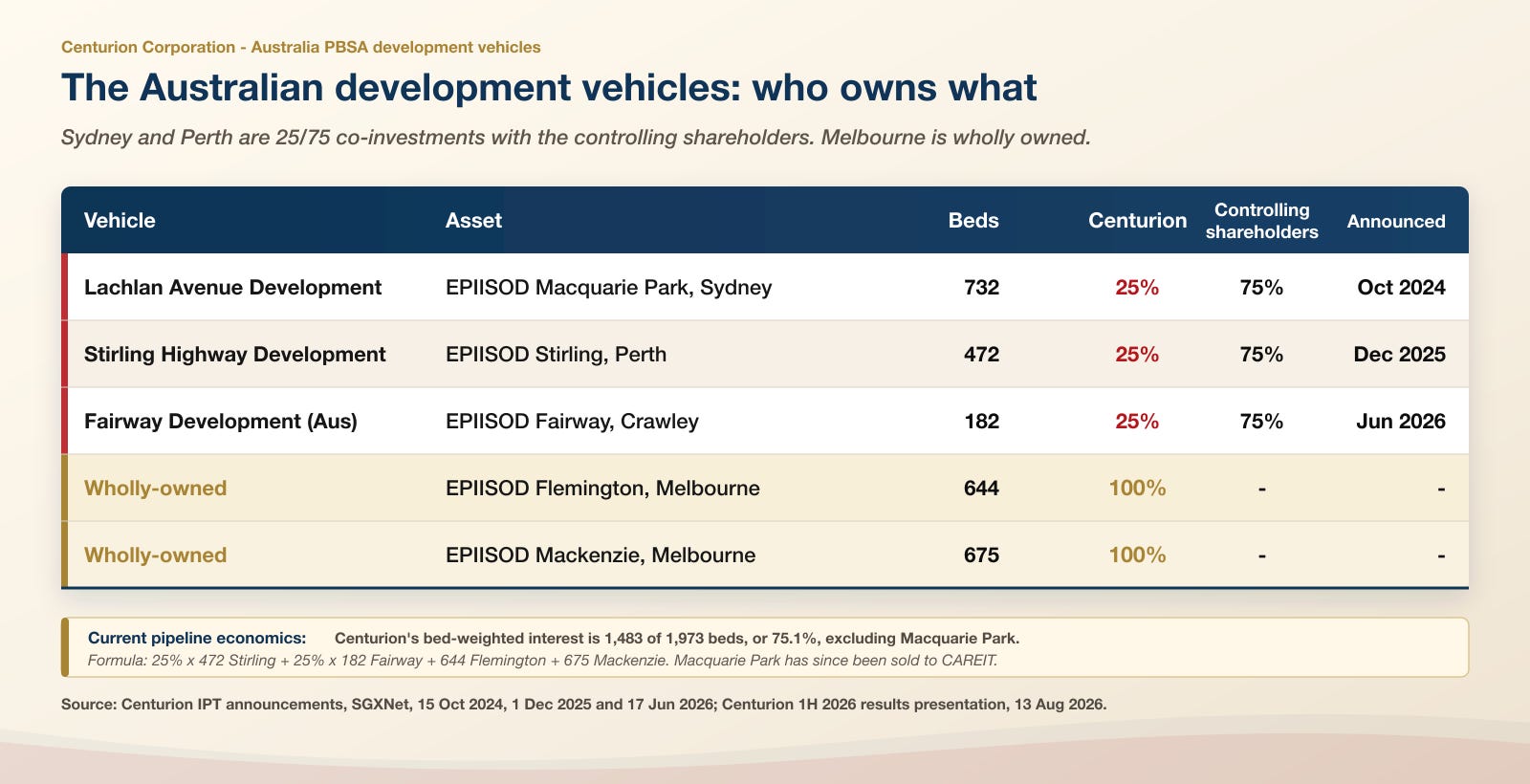
The terms are proportionate and on the record. Shareholder loans are advanced in proportion to shareholding, the corporate guarantee on the Fairway facility is exactly 25% of the loan, and the Audit Committee has reviewed each transaction as on normal commercial terms and not prejudicial to minority shareholders. Each is an announced interested person transaction, and the results presentation labels both Perth assets as "25% stake."
What matters analytically is what the structure does to a growth claim. Centurion supplies the brand, the operating platform and proportionate credit support.
When a development stabilises, the exit is a sale into CAREIT. That is exactly what happened with EPIISOD Macquarie Park: Lachlan Avenue Development owned the 732-bed Macquarie Park site, and CAREIT completed the acquisition in January 2026.
Centurion’s own first-half accounts confirm the route, attributing part of the associate loss to “the share of finance costs of the associated company from the prepayment of loan due to the sale of Macquarie Park to CAREIT.”
So the Sydney asset was owned three-quarters by the controlling shareholders and one-quarter by Centurion, and Centurion's REIT, in which Centurion now holds 38.25%, provided the exit. We are not able to say what development margin was realised or how it was split: the forward purchase price was agreed at the time of the CAREIT listing, the vehicle's cost base is not disclosed, and Centurion's associate line for the half shows a loss on the prepayment of the related loan. What we can say is who owned the asset on the way in. The transaction was disclosed, the CAREIT prospectus flagged Macquarie Park among properties "sold either wholly or in part by third party vendors," and two independent valuers appraised it.
We are correcting our own framing, and the 25/75 split matters less than it first sounds: it applies only to Sydney and Perth, the smaller projects, while Melbourne, which dominates the pipeline, is wholly owned. On a bed-weighted basis Centurion's economic interest in the current Australian pipeline is therefore roughly three-quarters, not a quarter:
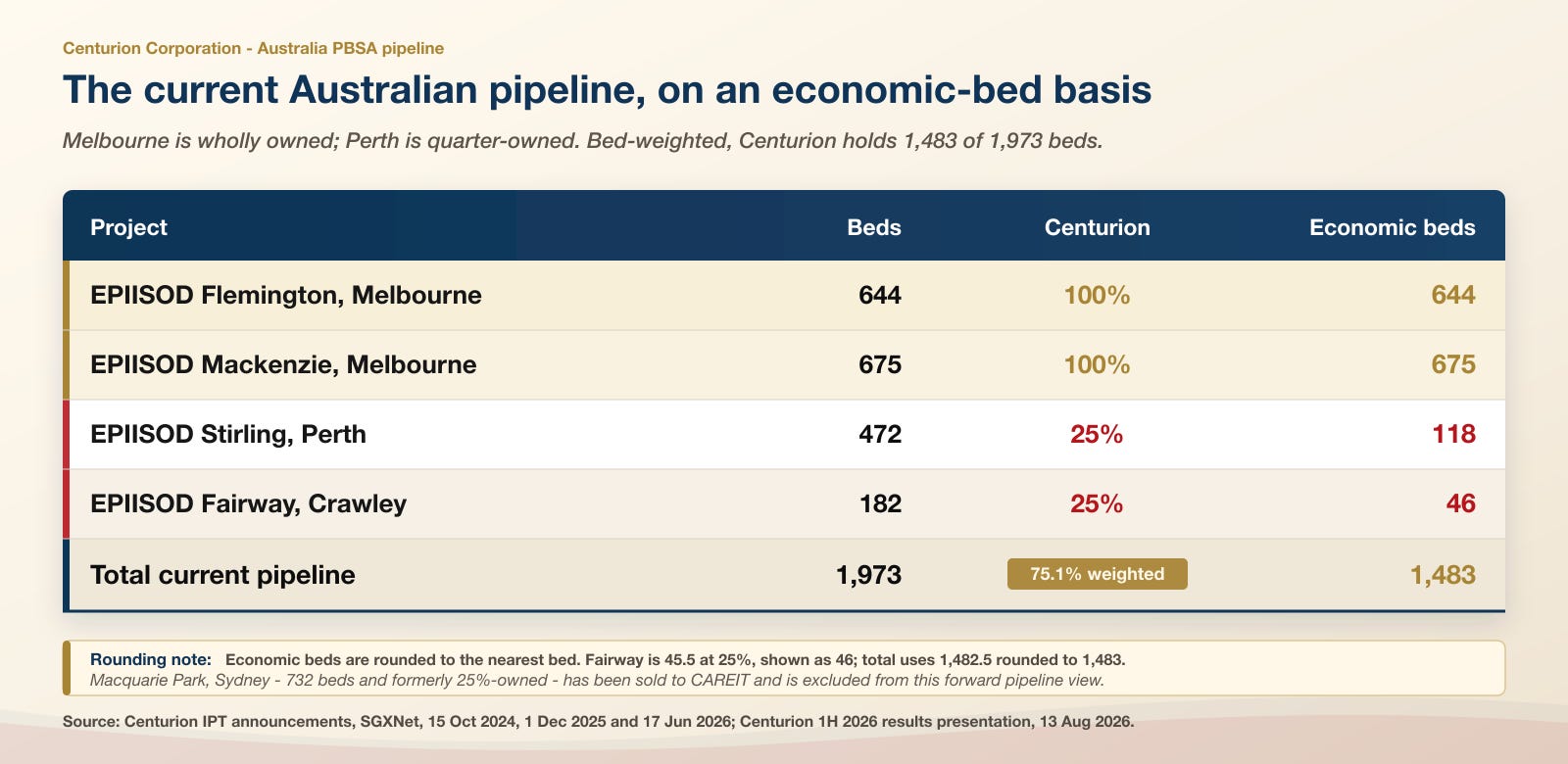
So the correct statement is narrower than “the pipeline belongs to the family.” It is that two of the four current projects, and the Sydney project before it was sold, are three-quarters owned by the controlling shareholders, and that our May article described one of them as directly held when it is not. A reader building a bed-count model of Australian growth should discount Perth by 75% and leave Melbourne alone. According to The Edge, the REIT manager gave the same split from the trust’s side at its 6 August briefing: the Macquarie Park master tenant, Herring Road Management Pty Ltd, is 25% owned by Centurion Corporation and 75% by Centurion Properties [16], which matches the ownership we set out in Figure 4.
Two details from the Fairway announcement are worth recording, and they cut in opposite directions.
The first is that Centurion’s A$250,000 was a subscription for new shares, not a purchase from the family vehicle: issued capital rises to A$772,011 on completion, so the cash went into the development company rather than to CPAI. Nobody cashed out.
The second is that the announcement states “no independent valuation was conducted on FDA by COI(II).” Centurion relied on a valuation FDA itself commissioned in April 2026, which put the site at A$6.7 million against a book value of A$7.13 million. At a 25% interest the difference is worth about A$108,000, which is immaterial to a group with S$2.2 billion of net assets. We note it because our published Risk 6 said to watch how related-party terms are set, not because the amount matters.
The new question: what it costs to keep winning
The rest of this update, what the land actually costs Centurion to keep winning, the rebuilt look-through valuation, the scorecard against every trigger we published in May, and where the thesis stands now, is for paid subscribers.