

If you have bought cough syrup in a Malaysian mall, filled a prescription on a high street in Johor Bahru, or picked up vitamins in Kota Kinabalu, there is a good chance the counter belonged to Big Caring Group Bhd (BCG). Under six brands (BIG Pharmacy, CARiNG, Georgetown, Wellings, Ting and iCare), it runs 668 outlets across all 13 states and three Federal Territories, and the prospectus describes it as the only pharmacy retailer present in every one of them.
On 19 November 2026 that network lists on the Main Market of Bursa Malaysia at a maximum retail price of RM1.08 a share, valuing the group at about RM8.0 billion (roughly S$2.5 billion). The headline multiple is 41.5 times FY2026 earnings, which makes it look like one of the most expensive retailers on the exchange. The number is accurate, but read the filing closely and it is incomplete in both directions. The price of the earnings is lower than it looks, because the IPO repays the debt that depressed them. The durability of the earnings is less certain than it looks, because much of FY2026’s step-up in margin came in a single year from better supplier terms, and Caring’s own listed history shows how quickly competition can hand gains like that to customers.
Retail applications closed on 5 November. The final price will be fixed by the institutional bookbuild on 10 November, ahead of the 19 November listing. This article works through both sides of that gap and puts numbers on where the shares could sit if the business delivers.
From Brightcare to Big Caring
The group started in 2006 as a single outlet in Damansara Uptown, Petaling Jaya, opened under the name Brightcare Pharmacy by two pharmacists who had both trained at Hospital Selayang: Lee Meng Chuan, now group managing director and CEO, and Lim Sin Yin, now executive director. The holding company was set up in 2013 and renamed Big Pharmacy Holdings that November, and BIG Pharmacy became the group's main brand. For more than a decade it grew slowly, reaching 12 outlets in the Klang Valley by 2017.
Then the strategy changed from opening shops to buying chains. RedCap Pharmacy in Johor came in 2018, along with the private equity firm Creador as a major shareholder. MY Pharmacy followed in 2020, Mercury Wellness on the East Coast and Ting Pharmacy in East Malaysia in 2022 and 2023.
The defining deal closed on 29 December 2023: the purchase of Caring Pharmacy Group for RM889 million. Three-quarters of Caring came from 7-Eleven Malaysia, and the remaining quarter from Motivasi Optima, the holding company of Caring's founding pharmacists, one of whom, Chong Yeow Siang, is now Big Caring's chief operating officer. The deal added 256 outlets and roughly doubled the network overnight. Five days later, on 3 January 2024, Big Pharmacy Holdings was renamed Big Caring Group, and it became Big Caring Group Bhd in March 2026 ahead of the listing.
Caring is worth pausing on. It was itself listed on Bursa from 2013, taken private in 2020 by 7-Eleven Malaysia's mandatory offer, and sold three and a half years later to BIG Pharmacy. The asset now returns to the public market inside a larger wrapper, on its third owner in six years.
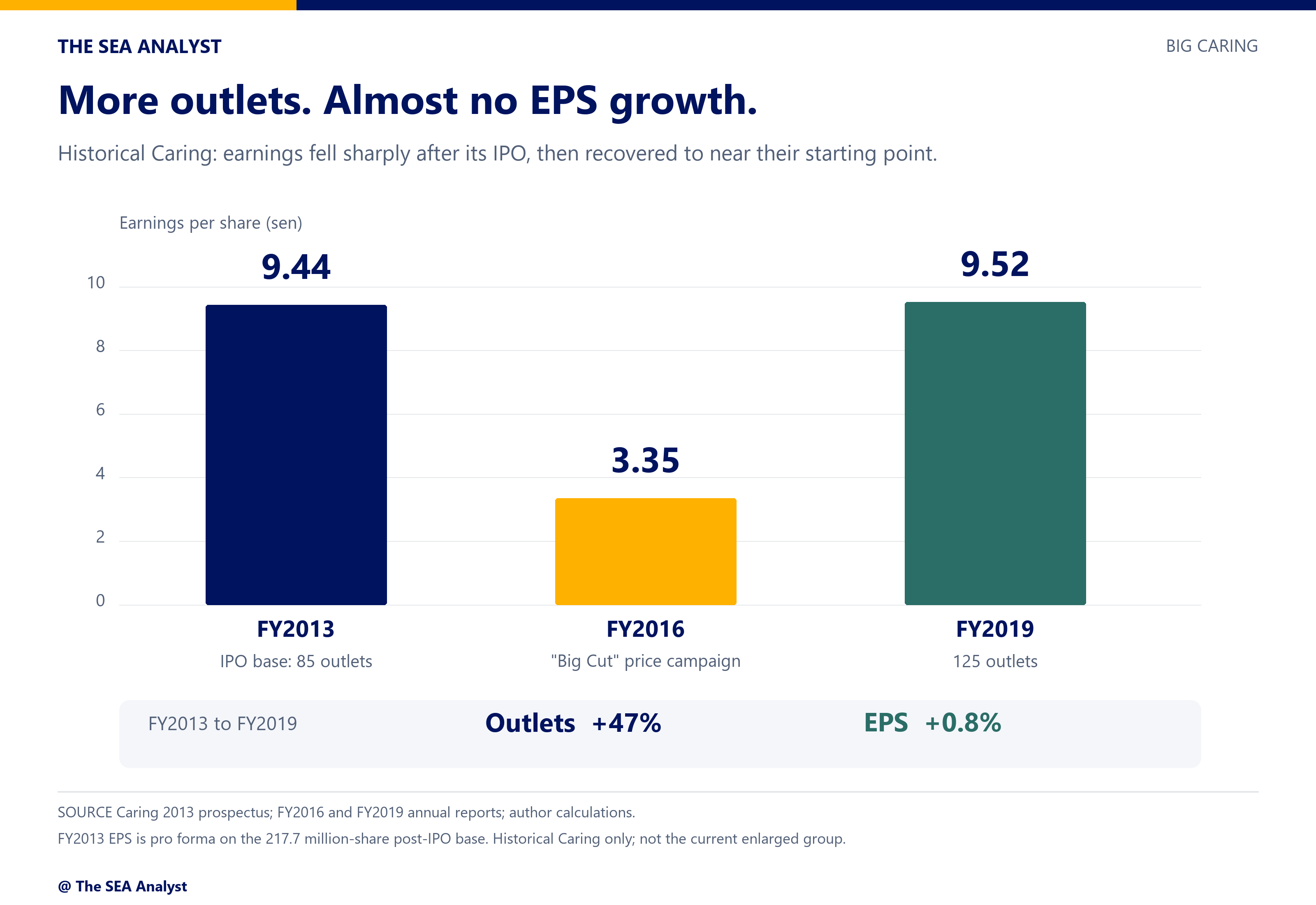
Caring’s listed record is the most useful evidence in this whole deal. It floated in 2013 at RM1.25 a share, 13.2 times its pro forma earnings of 9.44 sen [1]. By FY2016, earnings per share had fallen to 3.35 sen: same-store sales growth slowed to 2.2%, and management cut prices on nearly 800 popular products in a “Big Cut” campaign to defend market share, warning that it might give up some margin in the short term [2]. Gross margin fell from 25.8% in FY2013 to 20.0%.
By FY2019 the network had grown from 85 outlets to 125, yet earnings per share were back only to 9.52 sen [3]; price competition had passed much of the benefit of scale to customers. Shareholders still roughly doubled their money on the share price when 7-Eleven paid RM2.60 a share in 2020, but that was about 27 times earnings for shares that had floated at 13 times: the gain came from the multiple, not from earnings. Buyers of Big Caring at about 33 times normalised earnings cannot count on that kind of tailwind.
BIG Pharmacy bought it after the pandemic boost had faded. When 7-Eleven first put Caring up for sale in 2022, Carlyle reportedly offered RM1.3 billion while 7-Eleven sought RM1.5 billion to RM1.8 billion [4]. BIG was reportedly only the third-highest bidder and won after the talks with Carlyle and CVC fell through [5], paying about two-thirds of Carlyle's reported offer. On 7-Eleven's own figures, the agreed price was 20.7 times Caring's earnings [6]. Paying less than an earlier bidder offered is not, by itself, proof of a bargain.
In its last calendar year under 7-Eleven, 2023, Caring earned RM30.6 million after tax on revenue of RM1.38 billion, a 2.2% margin. The FY2026 accounts show the Caring sub-group earning RM120.2 million on RM1.97 billion of revenue, but that is not a clean read on Caring’s shops.
Since the merger, the whole group's procurement, BIG's included, has been centralised in the Caring subsidiary (Caring Pharmacy Group Sdn Bhd), which already bought centrally for its own shops, so the sub-group's figures carry purchasing terms earned on BIG's volumes as well, and its revenue is about RM210 million more than the Caring-branded outlets sold. The prospectus does not let an outside reader separate better shops from group profit booked in a different place. That question runs straight into the supplier section below.
Two upstream acquisitions followed in 2025: Medispec, a pharmaceutical importer and distributor (89.3% for RM249 million), and Your Physio, a physiotherapy chain. A Singapore deal for Yeap Medical Supplies and its seven Pharmex outlets was signed on 14 October 2026, the group's first step outside Malaysia.
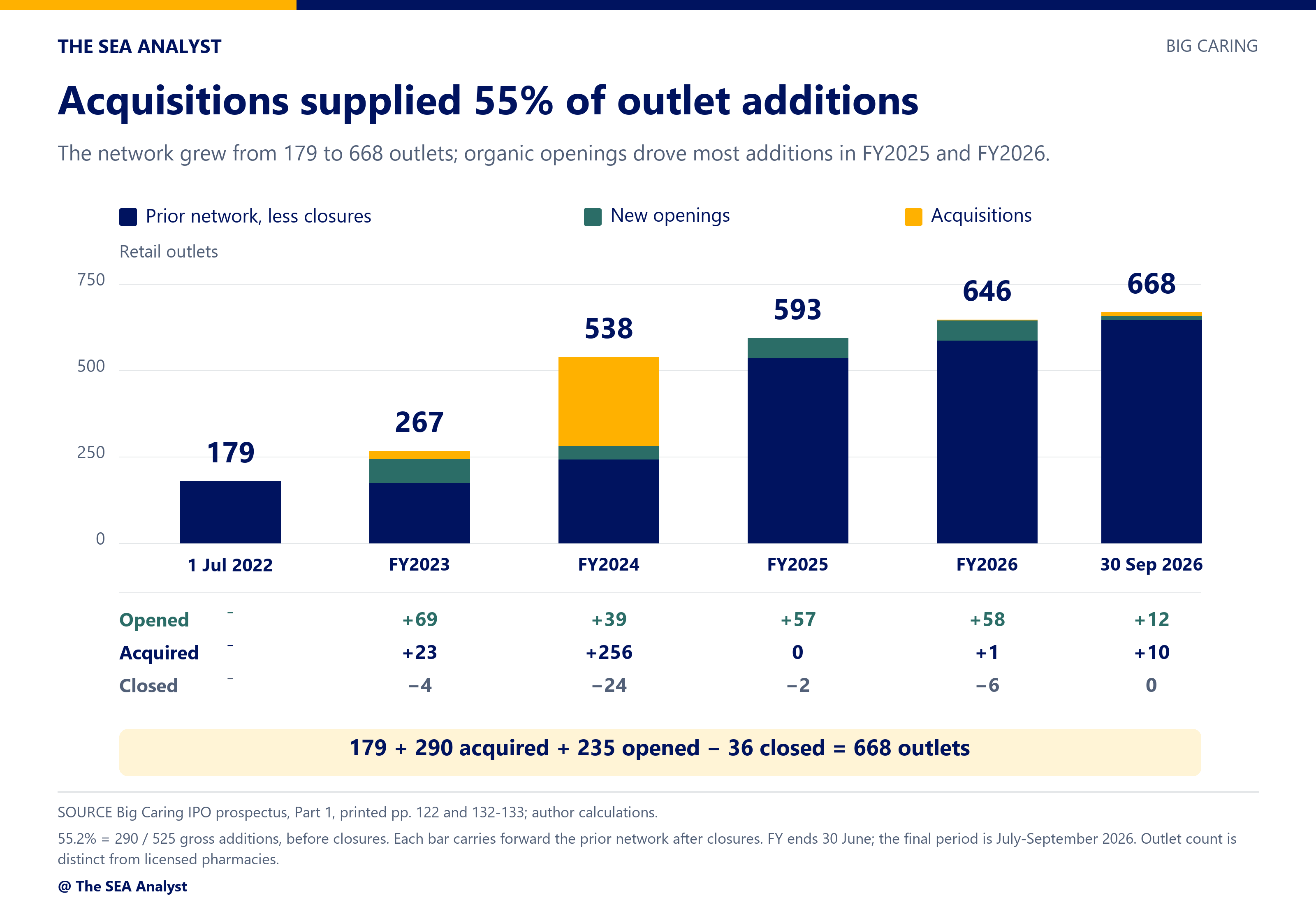
The outlet count tells the story: 179 at the start of FY2023, 646 by 30 June 2026, and 668 as at 30 September 2026. Since July 2022, 290 outlets were bought, 235 were opened and 36 were closed. The result is the country's largest chain: 660 of Malaysia's 4,002 licensed pharmacies, against 312 at the next largest, Alpro, and, on the report's measure, about 24.2% of retail pharmacy revenue in 2025, according to the Frost & Sullivan report in the prospectus [7]. Acquisitions supplied 55.2% of the 525 gross additions, before closures. That is a share of outlet additions, not a measure of acquired revenue growth.
The annual breakdown shows how the source of growth has changed. The network jumped from 267 to 538 outlets in FY2024, when the Caring acquisition added 256 outlets. In FY2025 and FY2026 combined, the group opened 115 outlets, acquired just one and closed eight. More recent network growth has relied much more heavily on organic openings.
What the offer actually contains
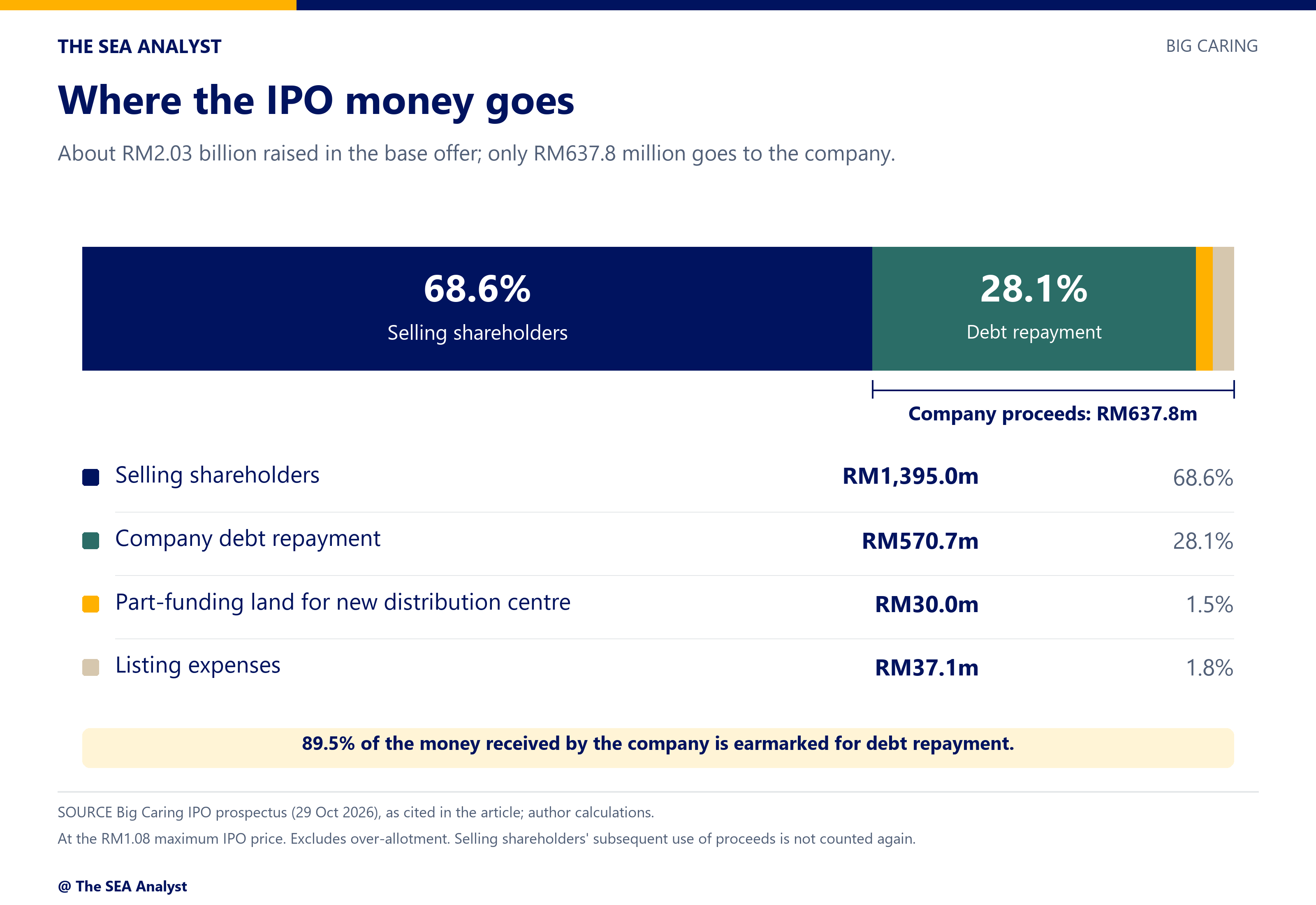
The IPO comprises up to 1,882 million shares, 25.5% of the enlarged share base of 7,382 million shares. Of these, 591 million are new shares raising RM637.8 million for the company, and 1,292 million are existing shares sold by shareholders for RM1,395 million. At RM1.08, total proceeds are about RM2.03 billion. A further 225 million shares may be sold by Creador’s vehicle under an over-allotment option.
The price has come a long way down. In November 2025, Bloomberg reported that the company was weighing a valuation of up to RM20 billion and a raise of up to RM6 billion [8]. By October 2026 the Wall Street Journal, as reported by The Edge, put the expected valuation at over RM6 billion [9]. RM8.0 billion at the top of the final range is 60% below the first figure. No reason for the change has been given, and a price below the one first mooted says nothing on its own about value at RM8.0 billion.
Nineteen cornerstone investors, including International Finance Corporation and JPMorgan Asset Management, have committed to 665.5 million shares, 9.0% of the enlarged company [10]. A further 922.7 million shares (12.5%) are reserved for Bumiputera institutions approved by the Ministry of Investment, Trade and Industry. The Malaysian public ballot is 147.6 million shares, 2.0% of the company.
The new money is spent as follows:
RM570.7 million (89.5%) repays bank borrowings within three months of listing,
RM30.0 million (4.7% of the company’s proceeds) part-funds land for a new distribution centre, and
RM37.1 million pays listing expenses.
The dividend policy targets a payout of up to 50% of profit attributable to shareholders, with no floor; the FY2026 payout was 13%.
After the IPO, Uptown Paradise Sdn Bhd (UPSB), the founders' holding company, owns 34.4%; Iris Pallida Sdn Bhd (IPSB), Creador's investment vehicle, owns 19.3% (16.3% if the over-allotment is exercised); and Lee and Lim hold a further 7.3% and 3.7% directly.
Where the money actually goes
Look at the flows rather than the totals. More than two-thirds of the RM2.03 billion goes to the sellers, not the company. Creador’s IPSB sells 863.7 million shares for RM932.8 million, about 38% of its stake, and stands to receive another RM243 million if the over-allotment is used. In December 2023, IPSB and UPSB subscribed for new shares to help pay for Caring at RM7.42 each, which is RM0.1855 after the 40-for-1 share split in August 2026. The IPO price is 5.8 times that level, three years later.
Of the money that does reach the company, nine ringgit in ten goes straight to the banks. That is sensible capital management: borrowings stood at RM1.36 billion at 30 June 2026, most of it taken on to buy Caring and Medispec. The listing primarily repairs the balance sheet, while also supporting expansion.
The 40 to 50 new outlets a year are to be paid for from internal cash, at RM280,000 to RM420,000 of fit-out each plus RM450,000 to RM650,000 of opening stock, recruitment and training, helped by the lower interest bill after repayment.
The RM30 million for the new distribution centre only part-funds the land; the existing Bukit Raja centre was running at 80.2% utilisation at September 2026, which the prospectus calls sufficient for present needs, with capacity expected to approach full within five years. The remaining capital requirement deserves attention. The company has not yet identified land for the new centre, aims to start looking in the first quarter of 2027, and says it cannot yet estimate the total cost. The 36-month window for spending the RM30 million is not a commitment to commission the facility in that time: the prospectus allows up to five years from listing to develop and build it.
The banks sit on both sides of the deal. Maybank and RHB are joint principal advisers and bookrunners, and are also lenders to the company and to both selling holding companies. IPSB will use about RM400 million of its sale proceeds to repay Maybank and UPSB about RM136.5 million to repay RHB. By our arithmetic, the two banking groups receive about RM1.08 billion across the company’s repayment and the holdcos’ repayments. The prospectus discloses this fully and appointed AmInvestment Bank as an independent principal adviser to manage the conflict. It is legal, ordinary in Malaysian IPOs, and still worth knowing: the people pricing the deal are also among the people it pays.
Lock-ups are six months for every controlling holder, the founders and Creador included. Promoters and substantial shareholders will hold about 61.6% after the IPO, so the first test of supply arrives in May 2027.
A few governance details are worth knowing, none of them hidden.
Brego Life Sciences, whose directors and major shareholders include Lee’s mother, is a related party on both sides of the ledger: Big Caring bought RM48.0 million of products from it in FY2026 (1.7% of cost of sales), sold it RM25.4 million, and Brego is a major shareholder in the Yanling manufacturing subsidiary. The sums are small and disclosed; how the audit committee polices them is what to watch.
A later Creador fund, Creador VI, has invested in FPT Long Chau, a Vietnamese pharmacy chain, which the prospectus lists as a potential conflict as Big Caring looks abroad.
The lock-up terms carve out existing pledges of promoter shares to the two lending banks, 3.44 billion shares under UPSB’s facility with RHB and 1.36 billion under IPSB’s facility with Maybank; the holdco loans are to be repaid from the sale proceeds, and the prospectus does not say whether the pledges are then released.
The financial scoreboard
The growth is real, though most of it was bought. Revenue rose from RM1.11 billion in FY2023 (year to June) to RM4.02 billion in FY2026, a 53.6% compound annual rate driven largely by Caring.
The organic engine is steadier: same-store sales growth (the sales increase at outlets open at least two years) was 7.3%, 9.6% and 7.3% over FY2024 to FY2026. Profit attributable to shareholders went from RM37.0 million to RM191.6 million.
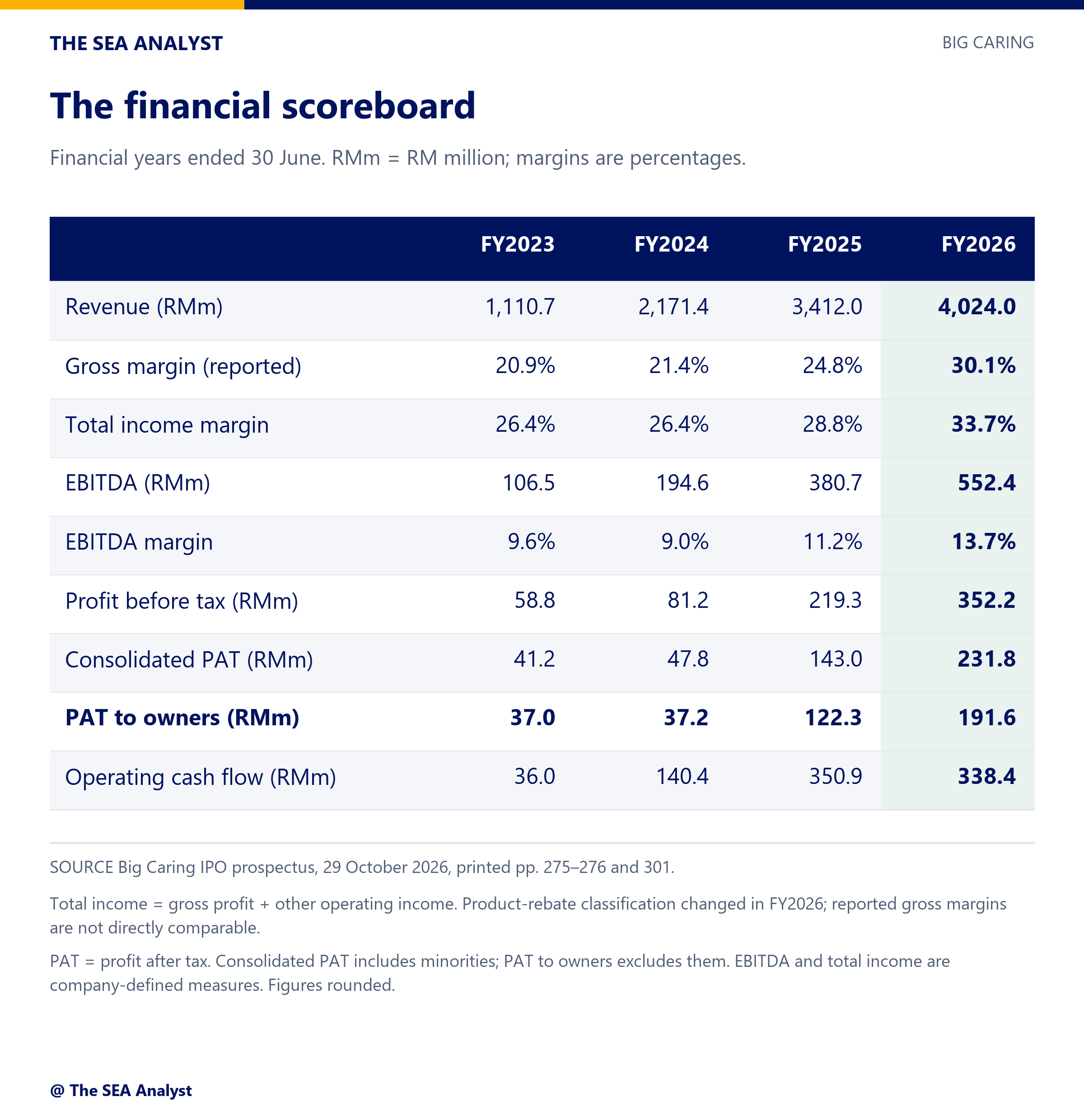
The margin line needs care. Gross margin jumped from 24.8% in FY2025 to 30.1% in FY2026, but part of that is an accounting change: from July 2025, product rebates from suppliers are booked as a reduction in the cost of goods rather than as other income. Restating FY2025 on the new basis, by moving its RM32.3 million of product rebates out of other income and netting them against cost of sales, gives a like-for-like FY2025 gross margin of about 25.7%. The company’s own comparable measure, “total income” (gross profit plus other operating income, over revenue), rose from 28.8% to 33.7%. That is a genuine step-up of about five percentage points in one year.
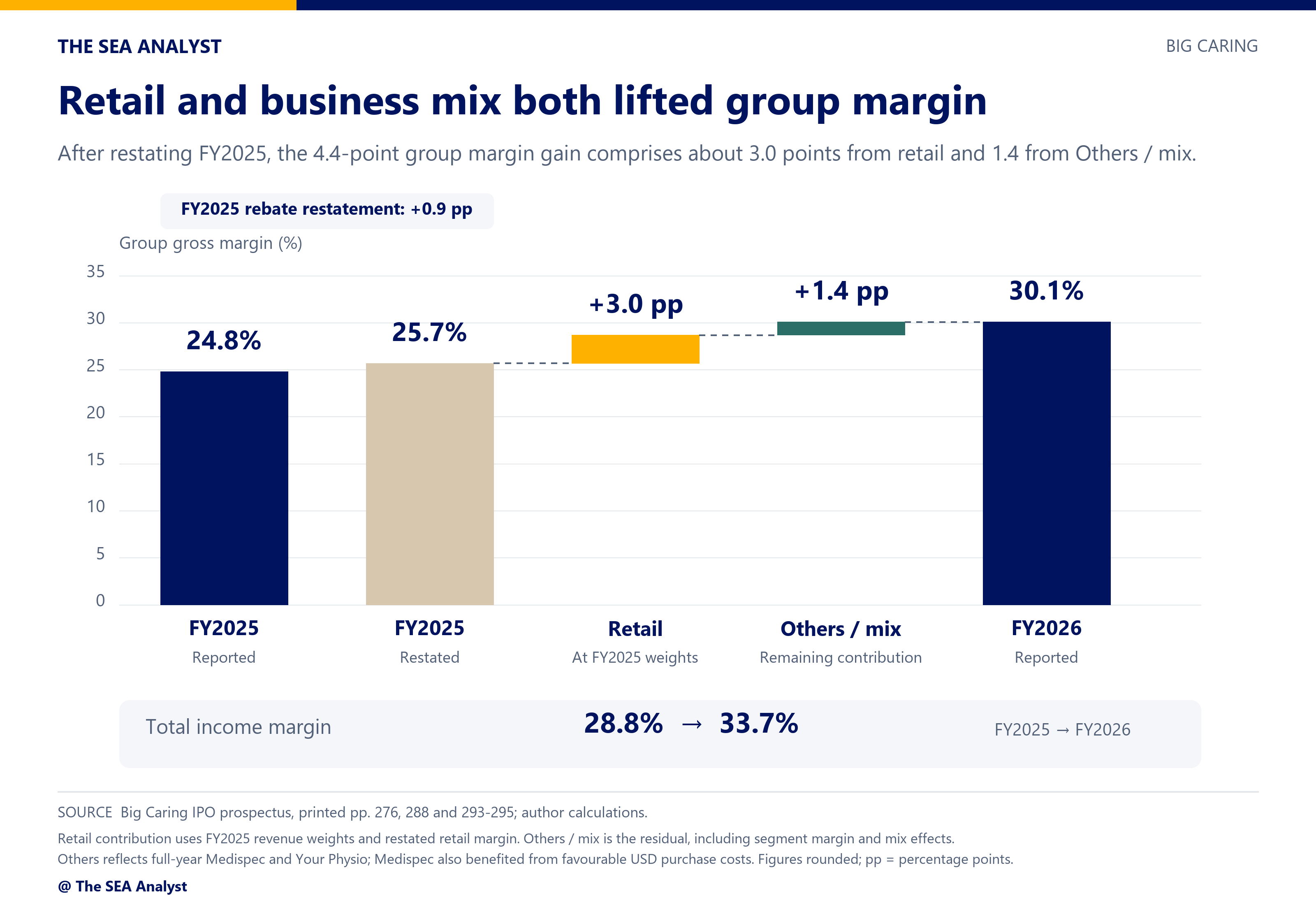
Underneath the headline profit sit three items that will not recur in the same form: listing costs, a non-cash charge on a put option, and interest on the debt the IPO repays. The first two fall away: FY2026 carries RM12.0 million of listing costs and RM10.5 million of non-cash charges on a put option over a subsidiary’s minority stake, neither tax-deductible. The third shrinks: FY2026 carries about RM62 million of bank interest, and the IPO repayment removes RM26.3 million a year of it. Because interest on the acquisition loans was largely non-deductible (the effective tax rate was 34.2% against the 24% statutory rate), most of that saving falls straight to profit.
Remove the one-offs and add back the saving, and FY2026 profit attributable to shareholders would have been about RM240 million, or 3.26 sen a share. At RM1.08 that is about 33 times, against a 35.7 times median for the Bursa retailers the prospectus uses as peers: 99 Speed Mart, Mr D.I.Y., Eco-Shop and 7-Eleven Malaysia.
That RM240 million is the right starting point for the forward view. Our base case below reaches RM313 million in FY2028, which is growth of about 14% a year from that base, not the 50%-plus of recent years, and part of even that comes from buying out a minority stake rather than from the shops.
Minority shareholders also take a meaningful slice. Big Caring owns many outlets through subsidiaries in which pharmacists, area managers and the founders of acquired chains hold stakes, and those minorities took RM40.2 million, or 17.3% of after-tax profit, in FY2026. That is partly an operating model rather than pure leakage. Since 2000, Caring has offered selected pharmacists equity in the subsidiaries that run their outlets, which helps recruitment and retention. At its 2013 IPO, 59 of its 85 pharmacies were partly owned this way [1], and in FY2019 minorities took 19.2% of its profit, more than the 17.3% they take across the larger group today [3]. Most new outlets now open in wholly-owned subsidiaries, and the model is used only where required, so the share of profit reaching listed shareholders could rise over time, depending on how the wholly-owned and partly-owned outlets grow relative to each other. The cost is the cash for buyouts and, possibly, weaker local incentives.
Further down: whether the margin jump can last, where the cash goes, and what Big Caring has to earn for RM1.08 to look cheap.